Snags (Sunken Trees) on the Missouri
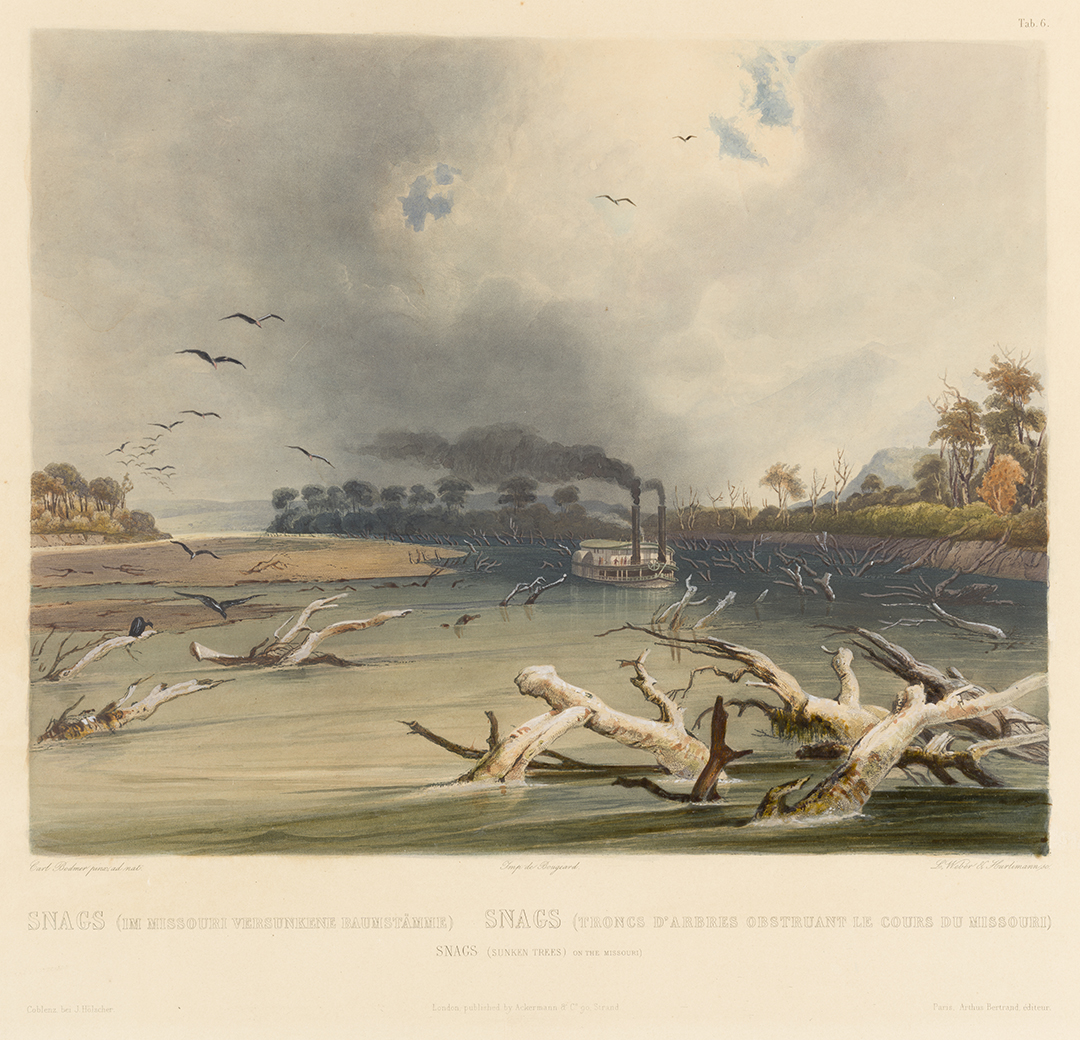
Bodmer’s watercolor depicts a stretch of the Missouri River cluttered with snags—the partially submerged trunks and root masses of fallen cottonwoods that lodged in the riverbed and presented the gravest navigational hazard on the upper river. The composition foregrounds the tangled, bleached limbs jutting above the waterline, with the broader river channel and low, wooded banks receding into a pale, atmospheric distance. Bodmer worked in transparent washes, building up the gnarled wood with fine drawn detail while leaving the water surface relatively flat and reflective. The picture is essentially a landscape study without human figures, unusual for Bodmer, whose Missouri River output is dominated by Native American portraiture and encampment scenes. Here the river itself is the subject, and the snags read almost as portraits of individual dead trees.
The watercolor was made during the 1832–1834 expedition of Prince Maximilian of Wied-Neuwied, a German naturalist who had hired the young Swiss artist Bodmer to document the journey up the Missouri. In 1833 the party traveled by the American Fur Company steamboat Yellow Stone and then the Assiniboine from St. Louis as far as Fort McKenzie in present-day Montana, wintering at Fort Clark in North Dakota. Snags were a constant operational concern: Maximilian’s journals record repeated delays as crews cleared or maneuvered around them, and the steamboat Assiniboine itself would later be lost on the river. A study like this served Maximilian’s scientific project of recording the physical character of the western environment, not only its peoples.
Bodmer (1809–1893) is best known for the eighty-one aquatints engraved after his Missouri watercolors and published in Maximilian’s Reise in das innere Nord-America (1839–1841). He spent most of his later career in France, associated with the Barbizon circle, and produced relatively little American material after the expedition. The bulk of his original Missouri River watercolors, including this sheet, descended through the Wied family until purchased by Northern Natural Gas Company in 1962 and given to the Joslyn Art Museum in Omaha in 1986, which now holds the Maximilian-Bodmer Collection. Landscape studies like this one are valued by Lewis and Clark scholars as the earliest detailed visual record of conditions Lewis and Clark themselves had described in prose nearly thirty years earlier.