View on the Missouri, Blackbird’s Grave
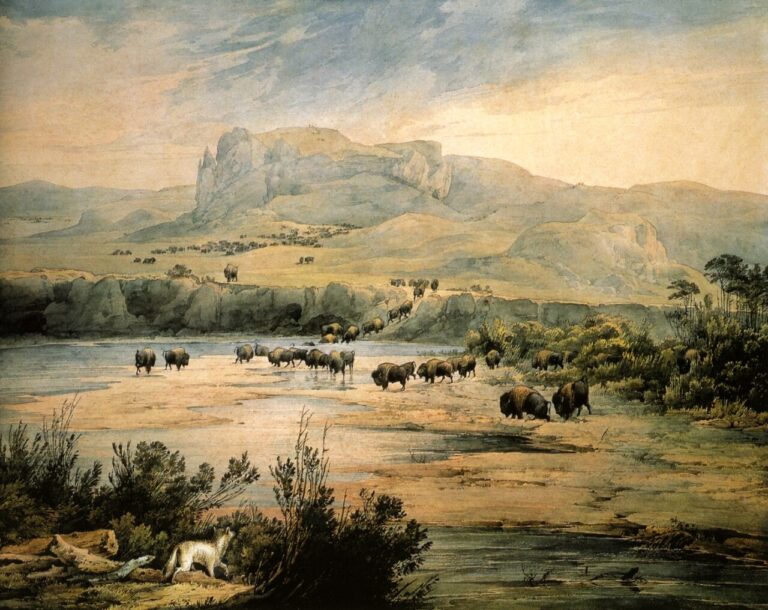
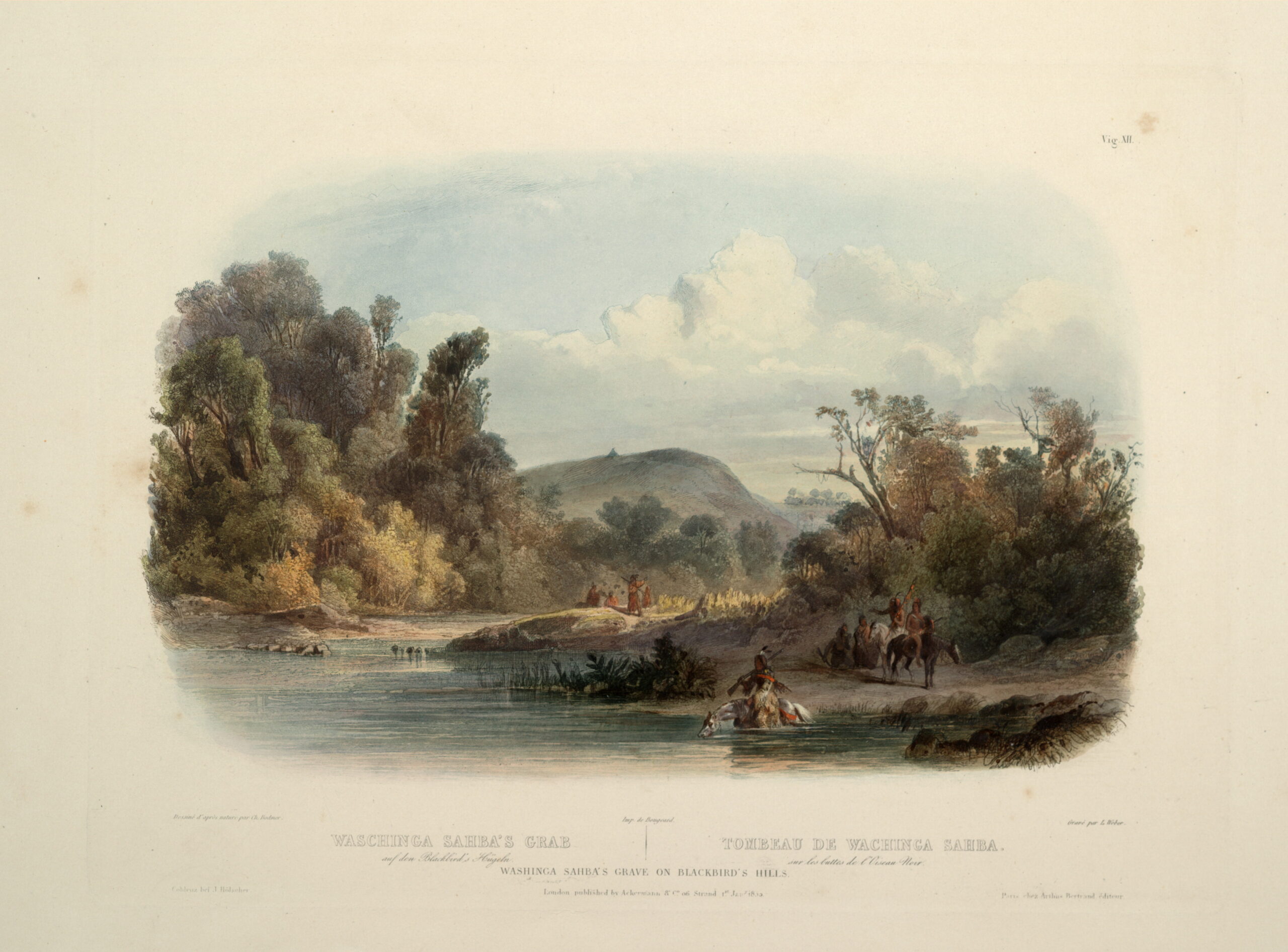
Bodmer’s watercolor depicts a stretch of the Missouri River dominated by a high, rounded bluff rising on the west bank. The composition is horizontal, with the river occupying the foreground in muted greens and grays, low wooded banks framing the middle distance, and the bluff—Blackbird Hill—anchoring the right side of the sheet. A small detail at the summit marks the burial site of the Omaha chief Blackbird, who according to tradition was interred mounted on his horse so that he could continue to watch travelers passing on the river below. Bodmer worked in transparent watercolor with delicate graphite underdrawing, recording the topography with the same topographical precision he applied throughout his Missouri River studies.
The watercolor was made in 1833 during the expedition of Prince Maximilian zu Wied-Neuwied, whom Bodmer accompanied as expedition artist from 1832 to 1834. The party ascended the Missouri aboard American Fur Company steamboats, reaching Fort McKenzie in present-day Montana before wintering at Fort Clark. Blackbird Hill, in what is now Thurston County, Nebraska, had already entered the literature of the river: Lewis and Clark visited the grave on August 11, 1804, climbing the bluff to place a flag on the mound, and Maximilian’s party stopped at the same location nearly three decades later. By 1833 the site functioned as a recognized landmark for traders, naturalists, and travelers moving upriver.
Bodmer, a Swiss-born artist trained in Zurich and Paris, was twenty-three when Maximilian hired him. The Missouri watercolors and the aquatints later engraved from them for the atlas accompanying Maximilian’s Reise in das innere Nord-America (1839–1841) constitute the most detailed visual record of the upper Missouri before the cholera and smallpox epidemics of the late 1830s transformed the region’s Native communities. The original field watercolors, including this view, were preserved in the Wied family collection at Schloss Neuwied for more than a century before being acquired by the InterNorth Art Foundation and placed at the Joslyn Art Museum in Omaha, which holds the principal repository of Bodmer’s American work. The Blackbird’s Grave sheet has been frequently reproduced in Lewis and Clark scholarship as a visual document of a site the Corps of Discovery itself recorded.