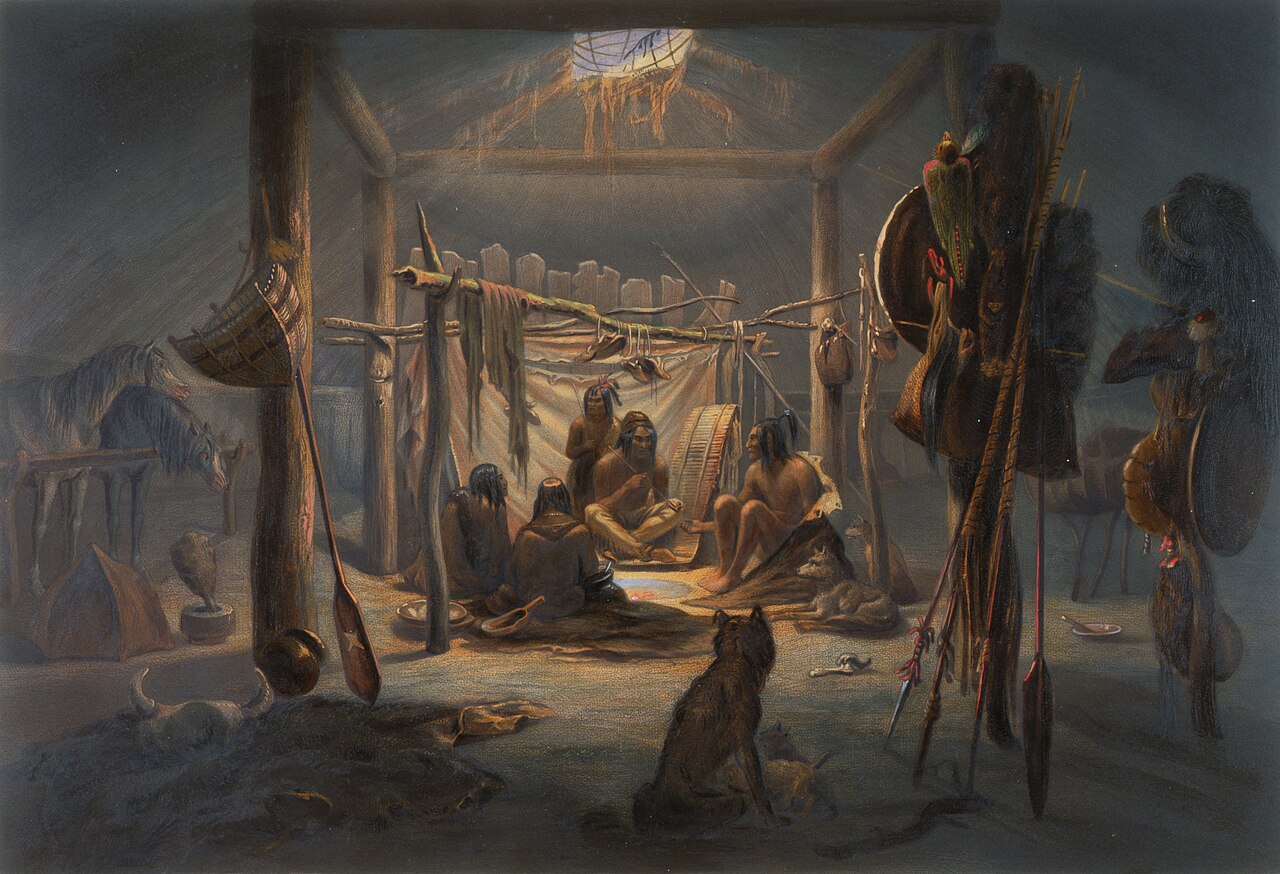
The Interior of the Hut of a Mandan Chief
Bodmer’s aquatint shows the cavernous interior of an earth lodge belonging to a Mandan leader on the upper Missouri River. The composition centers on a hearth where smoke rises toward an opening in the domed roof, with shafts of light angling down through the smoke hole to illuminate the figures below. A group of men sits and reclines around the fire, some wrapped in robes, while horses stand tethered along the back wall—a practical arrangement during winter months when valuable animals were brought inside for protection. Shields, weapons, parfleches, and ceremonial bundles hang from the supporting timbers and rafters. The radiating log structure of the lodge frames the scene, with the four central support posts visible and the earthen walls receding into shadow. Bodmer rendered the space with attention to architectural detail: the hearth pit, the willow-and-grass thatching beneath the earth covering, and the elevated sleeping platforms at the perimeter.
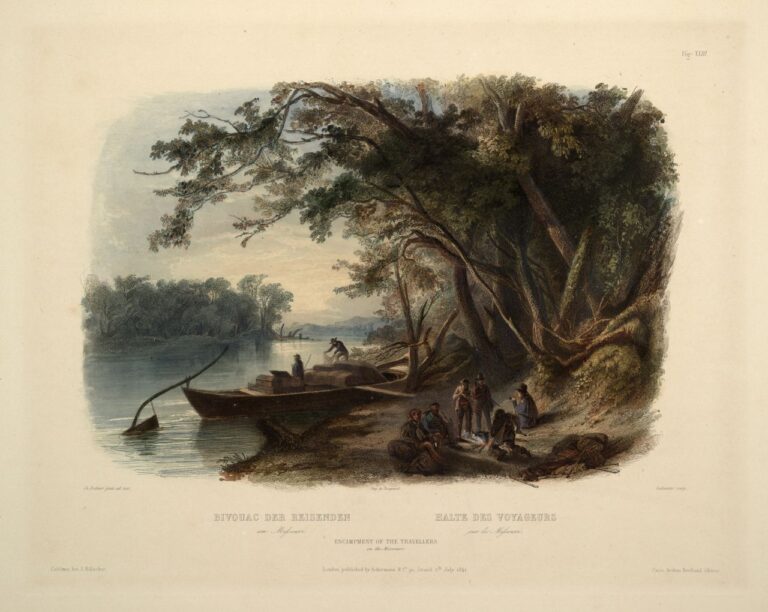
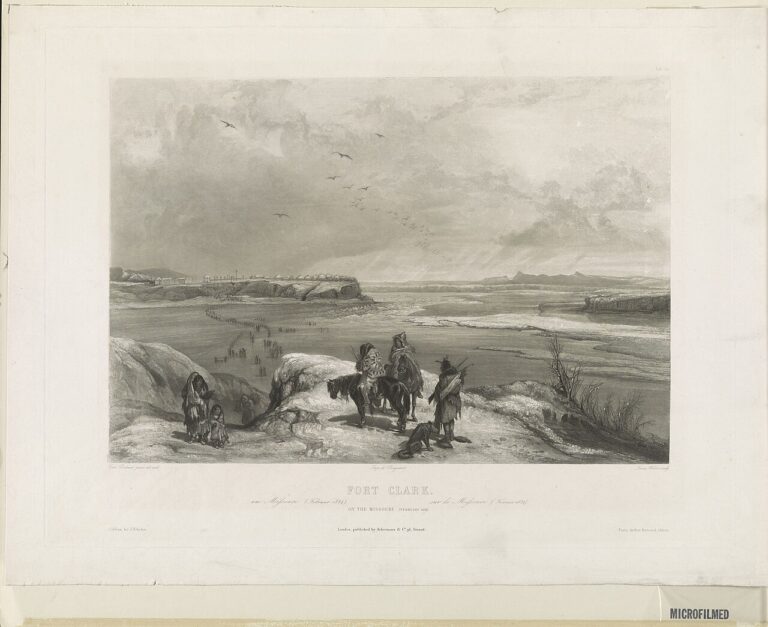
The image was made during Bodmer’s travels with Prince Maximilian zu Wied-Neuwied in 1833–1834. The party wintered at Fort Clark in present-day North Dakota from November 1833 through April 1834, living adjacent to the Mandan village of Mih-Tutta-Hang-Kusch and the nearby Hidatsa towns. The lodge depicted is generally identified as that of Mato-Tope (Four Bears), the second chief of the Mandan, who became one of Bodmer’s principal subjects. Within roughly three years, smallpox introduced in 1837 would kill the great majority of the Mandan population, lending Bodmer’s documentary record unanticipated ethnographic weight. Lewis and Clark had wintered at Fort Mandan among these same villages in 1804–1805, and Bodmer’s images remain the most detailed visual record of the culture the expedition encountered a generation earlier.
Bodmer, a young Swiss artist when Maximilian engaged him, produced 81 aquatints for the atlas accompanying Maximilian’s Reise in das innere Nord-America, published in Koblenz between 1839 and 1841. The Joslyn Art Museum holds the Maximilian-Bodmer Collection, acquired from the Northern Trust Company of Chicago in 1986 after long stewardship by the princely family at Schloss Neuwied. The interior view has been frequently reproduced in studies of Plains earth-lodge architecture and in Lewis and Clark literature illustrating the Fort Mandan winter.
Scene Location
Mandan Village, near Washburn, North Dakota