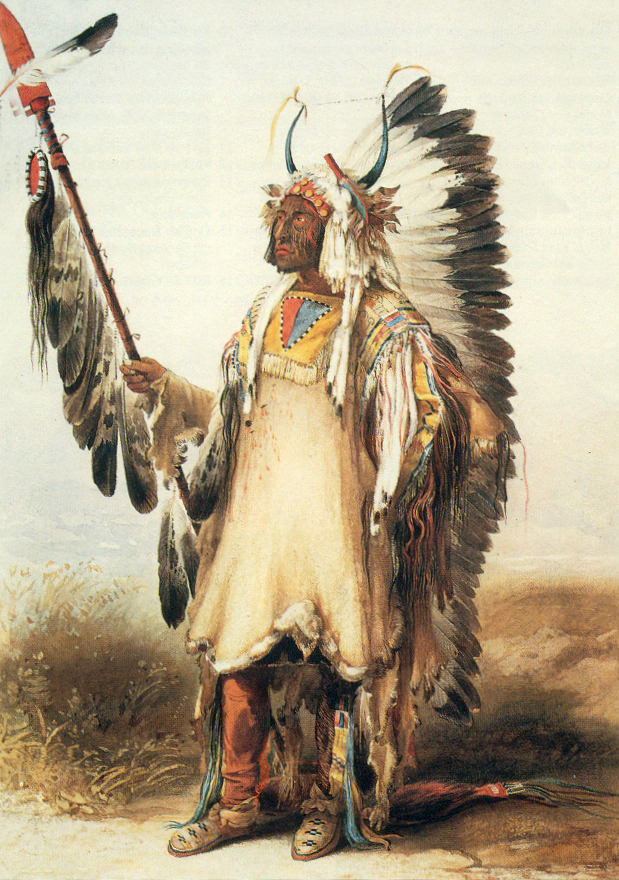
Mato-Tope, A Mandan Chief
Bodmer’s portrait shows Mato-Tope (Four Bears), second chief of the Mandan, in full regalia. The figure stands in three-quarter view, his face painted with vertical stripes and a yellow hand mark across the mouth signifying that he had killed an enemy in hand-to-hand combat. He wears a split-horn and ermine headdress with trailing eagle feathers, each feather notched or painted to record a specific war honor. A wooden knife replica is fixed in his hair, commemorating his killing of a Cheyenne chief with the man’s own blade. His shirt is decorated with quillwork and locks of hair. Bodmer rendered the original in watercolor on site; this hand-colored aquatint was produced for the print atlas accompanying Prince Maximilian zu Wied’s published travel account.
The portrait was made during the winter of 1833–1834 at Fort Clark, on the upper Missouri in present-day North Dakota, where Maximilian and Bodmer wintered among the Mandan and Hidatsa villages. This was the same Mandan community Lewis and Clark had visited at Fort Mandan in 1804–1805, roughly three decades earlier. Mato-Tope sat for Bodmer repeatedly and also produced his own pictographic self-portraits on paper supplied by the artist. Within four years the sitter would be dead: the smallpox epidemic of 1837 carried up the Missouri by the steamboat St. Peter killed Mato-Tope and reduced the Mandan population from roughly 1,600 to fewer than 150.
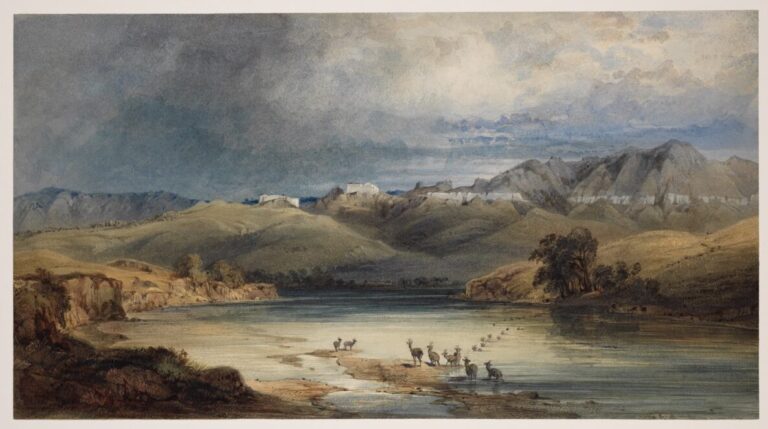
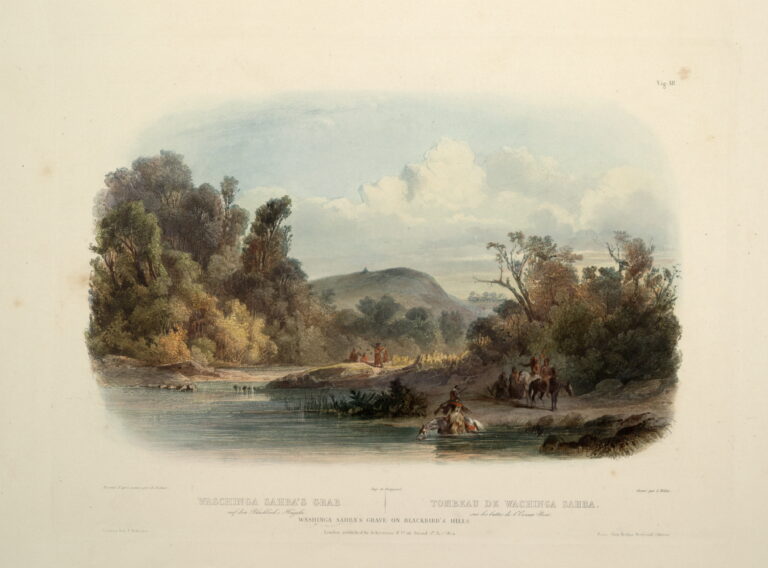
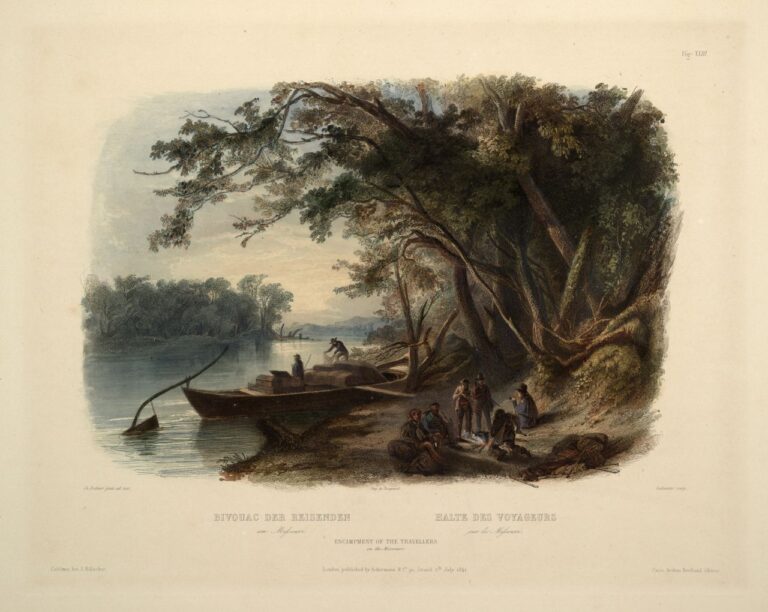
Karl Bodmer (1809–1893), a Swiss painter, was hired by Maximilian specifically to document the peoples and landscapes of the American interior. The resulting Maximilian-Bodmer expedition produced one of the most precise visual records of Plains Indian life before the epidemics and treaty era of the mid-century. The aquatints, engraved in Europe between 1834 and 1843, were issued as the atlas to Maximilian’s Reise in das innere Nord-America. The Joslyn Art Museum in Omaha holds the principal Bodmer archive, acquired from the Maximilian family through the Northern Natural Gas Company in 1962. The Mato-Tope portrait is among the most reproduced images in the series and has become a standard illustration in scholarship on the upper Missouri tribes encountered by Lewis and Clark.
Scene Location
Fort Clark, near Stanton, North Dakota