Fort Clark on the Missouri
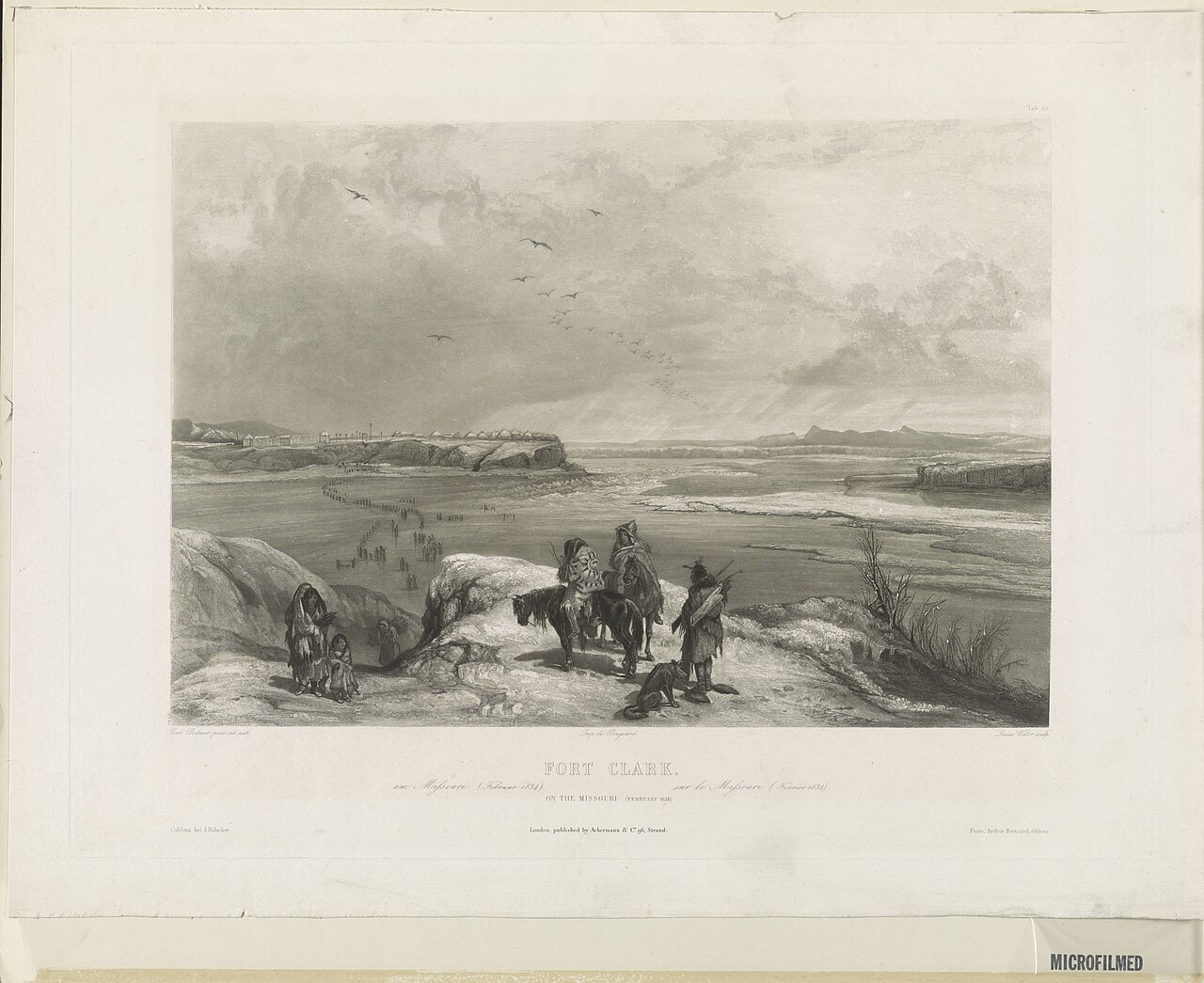
Bodmer’s view of Fort Clark looks across a wide, snow-flecked bottomland on the upper Missouri River toward the small American Fur Company post, which sits on a low bluff above the water. The fort itself—a rectangle of palisaded log walls with bastions at the corners and a few interior buildings rising above the stockade—occupies the middle distance. In the foreground, Mandan figures move across the open ground: men on foot, some wrapped in robes, with the river curving away behind them. Beyond the post, the earthlodge village of Mih-Tutta-Hangkusch is suggested by rounded domes on the horizon. The aquatint medium, finished with hand-applied watercolor, gives the sky and snow a flat, even tonality and allows precise architectural detail in the fort’s timbers.
Bodmer made the field studies for this plate during the winter of 1833–1834, when he and Prince Maximilian zu Wied-Neuwied wintered at Fort Clark, near the Mandan and Hidatsa villages in present-day North Dakota. Built by James Kipp in 1830–1831, the post stood only a few miles from the site where Lewis and Clark had spent the winter of 1804–1805 at Fort Mandan, and the Mandan communities the expedition described were the same ones Maximilian’s party studied three decades later. The 1834 date refers to the engraving’s preparation for publication; the print was issued as part of the Atlas accompanying Maximilian’s Reise in das innere Nord-America, which began appearing in installments later that decade. Within a few years, the 1837 smallpox epidemic would devastate the Mandan population shown here, making Bodmer’s images among the last detailed visual records of the villages in their pre-epidemic state.
Karl Bodmer (1809–1893), a Swiss-born painter trained in the Rhineland, was hired by Maximilian specifically to document the North American journey, and the Maximilian-Bodmer expedition produced the most ethnographically careful body of imagery of the upper Missouri tribes before mid-century. The Joslyn Art Museum in Omaha holds the Maximilian-Bodmer Collection, including the original watercolors and a set of the published aquatints. The Fort Clark plate has been reproduced consistently in Lewis and Clark scholarship as documentation of the Mandan landscape the Corps of Discovery knew.
Scene Location
Fort Clark, near Stanton, North Dakota