Mih-Tutta-Hangkusch, A Mandan Village
Bodmer’s view of Mih-Tutta-Hangkusch shows the principal Mandan village on the west bank of the Missouri River in present-day North Dakota. The composition is structured around the cluster of domed earthlodges that rise from the bluff above the river, with bullboats drawn up along the shoreline and figures moving among the lodges and on the surrounding plain. A scaffold burial platform stands at left, and human and equine activity is scattered throughout the middle ground. Bodmer worked from on-the-spot watercolor and pencil studies, which were later translated into hand-colored aquatint engravings by European printmakers under his supervision. The high horizon and panoramic sweep give equal weight to the architecture of the village and the landscape that sustained it.
The drawing on which this print is based was made during the winter of 1833–1834, when Bodmer and his patron Prince Maximilian of Wied-Neuwied stayed at Fort Clark, near the Mandan villages, from November 1833 through April 1834. Maximilian’s expedition was explicitly conceived as a scientific follow-up to Lewis and Clark, who had wintered with the Mandan in 1804–1805 at Fort Mandan a short distance upriver. By the time of Bodmer’s visit the Mandan population had already been reduced by earlier epidemics; within three years of his stay, the smallpox epidemic of 1837 would devastate the village, making his images among the last detailed visual records of Mandan settlement before that catastrophe.
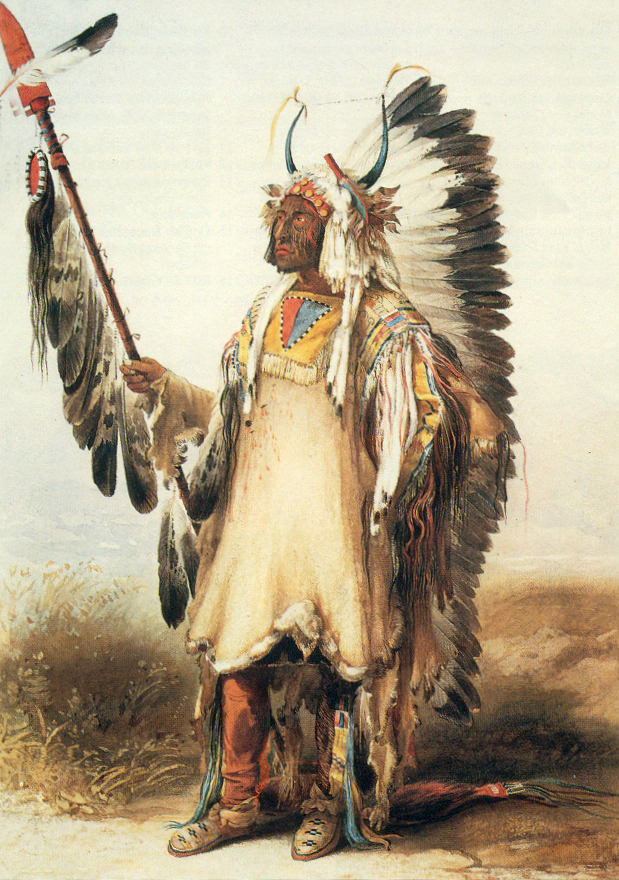
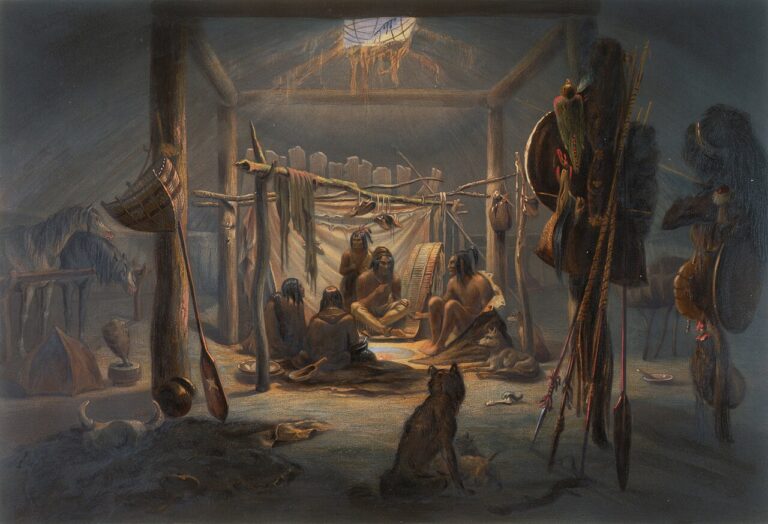
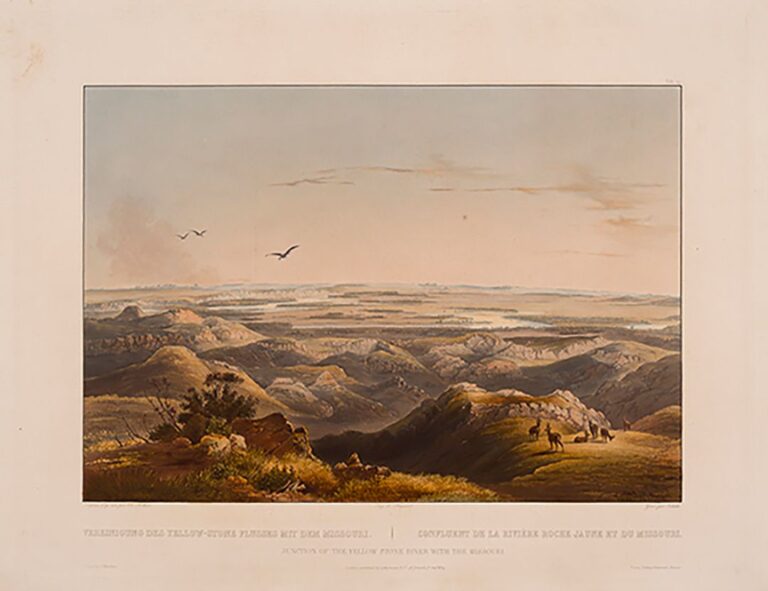
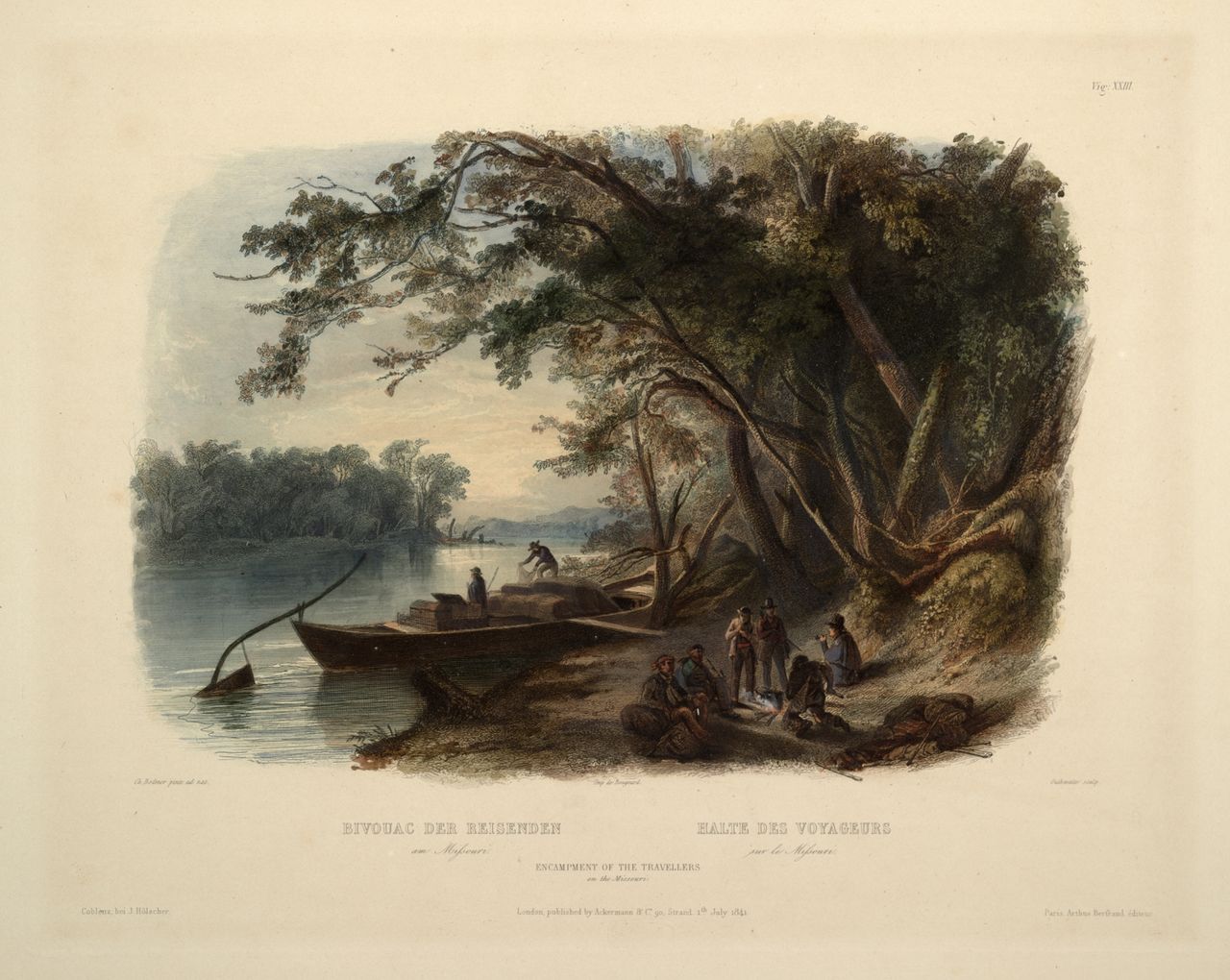
Bodmer (1809–1893) was a young Swiss artist when Maximilian engaged him for the North American journey of 1832–1834. The resulting body of work, published as the atlas to Maximilian’s Reise in das innere Nord-America (1839–1841), is among the most accurate ethnographic visual records of the upper Missouri tribes in the early nineteenth century. After returning to Europe, Bodmer settled in France and worked principally as a landscape and animal painter associated with the Barbizon circle, never revisiting his American subjects at comparable scale. The print is held by the Amon Carter Museum of American Art in Fort Worth, whose holdings of Bodmer aquatints are among the most complete in the United States and have been drawn on repeatedly for Lewis and Clark commemorative exhibitions.
Scene Location
Mandan Village, near Washburn, North Dakota