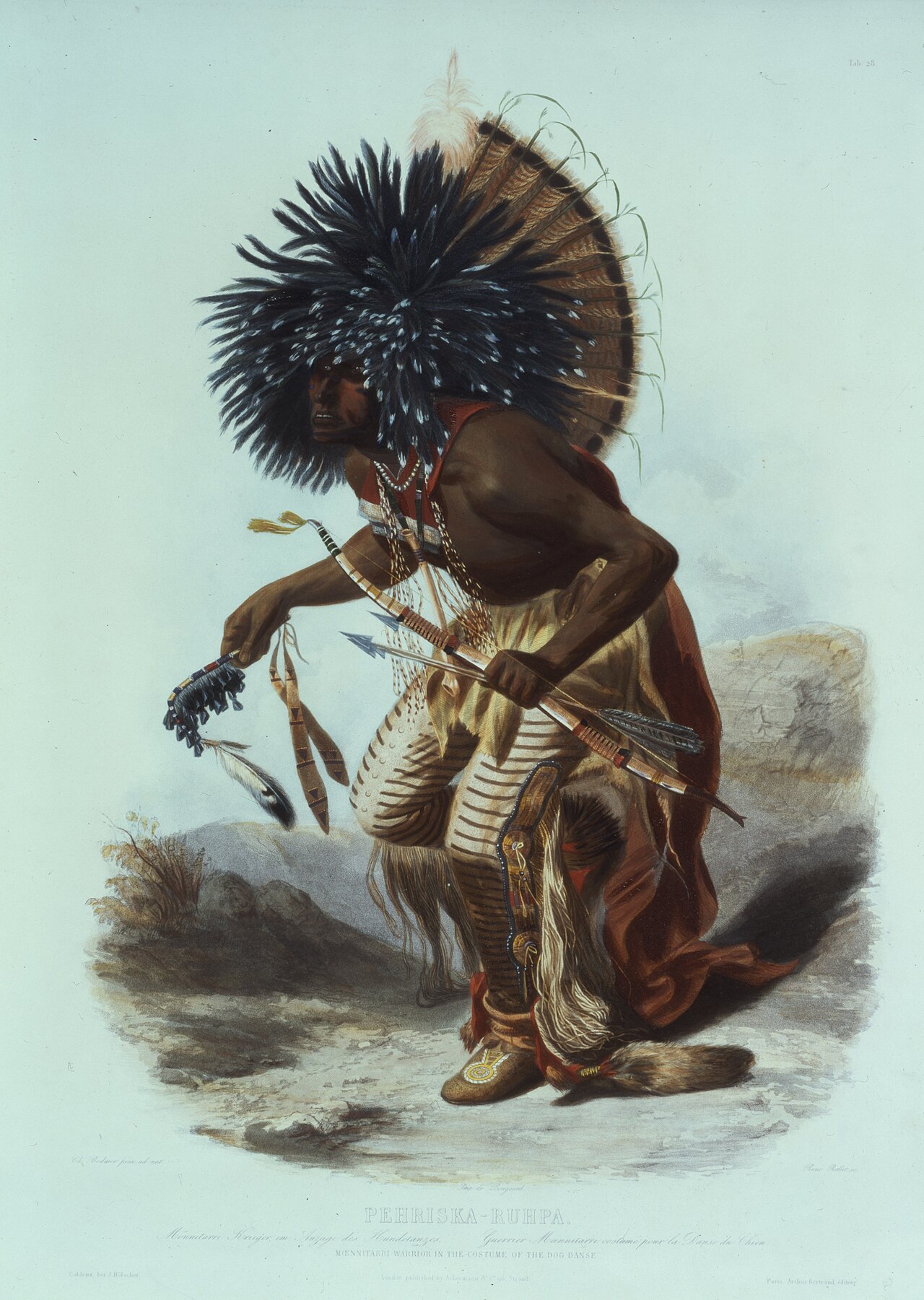
Pehriska-Ruhpa, Moennitarri Warrior in the Costume of the Dog Dance
Bodmer’s full-length portrait shows Pehriska-Ruhpa, a Hidatsa (Moennitarri) warrior, in the ceremonial regalia of the Dog Society, one of the men’s military and dance associations of the upper Missouri tribes. The figure stands frontally, arms slightly extended, holding a feathered staff or rattle in one hand and a weapon in the other. The most striking element is the towering headdress, an arc of dyed turkey and eagle feathers and split bird quills rising in a circular fan around the head. He wears a fringed and ornamented kilt or breechclout, painted skin leggings, and bells or ornaments at the knees that would have produced sound during the dance. Bodmer’s aquatint reproduces with precision the layered textures of feather, hair, hide, and pigment, and the figure is set against a plain ground that isolates the costume for ethnographic study.
The image was made during the 1832–1834 expedition of Prince Maximilian zu Wied-Neuwied, who employed Bodmer to document the peoples and landscapes of the American interior. Maximilian and Bodmer wintered at Fort Clark, near the Mandan and Hidatsa villages in present-day North Dakota, during 1833–1834, and it was there that Bodmer drew Pehriska-Ruhpa from life. The villages they visited were the same Knife River settlements where Lewis and Clark had wintered in 1804–1805, hiring Toussaint Charbonneau and Sacagawea. By the time Bodmer arrived, less than three decades after the Corps of Discovery, the upper Missouri tribes were still intact, but the smallpox epidemic of 1837 would devastate them within three years of this portrait.
Bodmer (1809–1893), a Swiss-born painter trained in the topographical and aquatint traditions, produced his Missouri River work as watercolors and field drawings that were later engraved in Europe for the atlas accompanying Maximilian’s Reise in das innere Nord-America (1839–1841). The Dog Dance plate is among the most reproduced images from that atlas and is generally considered one of Bodmer’s two or three finest single-figure compositions. The Joslyn Art Museum in Omaha holds the principal collection of Bodmer’s original watercolors and a complete set of the aquatints, acquired from the Maximilian-Wied estate through the InterNorth Art Foundation in the 1960s.
Scene Location
Hidatsa Village, near Washburn, North Dakota