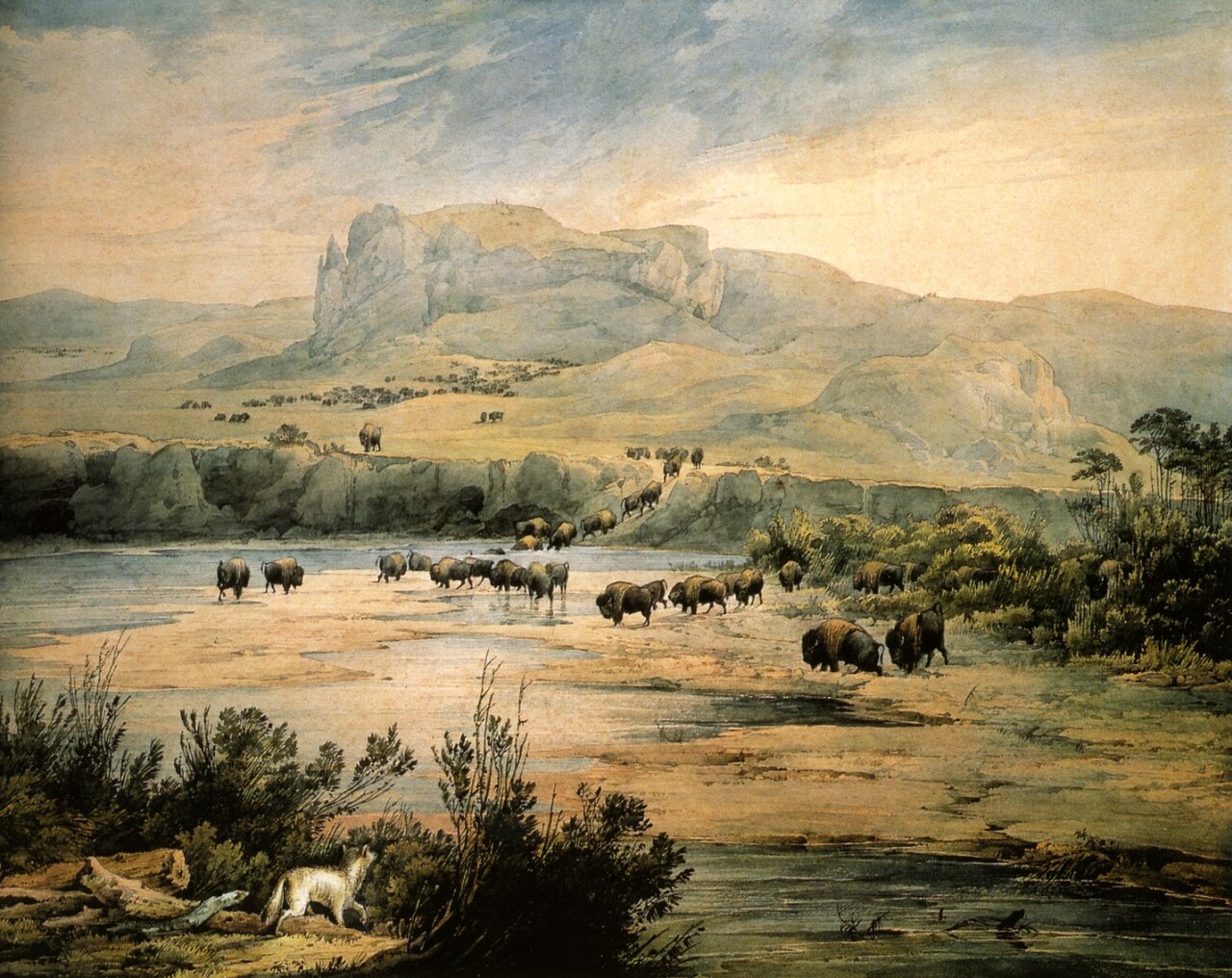
Landscape with Buffalo on the Upper Missouri
Bodmer’s watercolor depicts a stretch of the Upper Missouri River with a small herd of bison in the middle distance, set against the eroded bluffs and sediment terraces characteristic of the river’s course through present-day Montana and the Dakotas. The composition organizes itself horizontally: a band of river, a pale shoreline where the buffalo graze or move along the water’s edge, and the receding wall of cliffs behind. Bodmer handled the watercolor with the topographical precision he brought to all his Western fieldwork, using thin washes for atmosphere and sharper notation for the animals and rock strata. The palette is restrained — ochres, pale greens, and the chalky tones of the Missouri breaks — and the buffalo register as dark, compact forms rather than dramatic focal points.
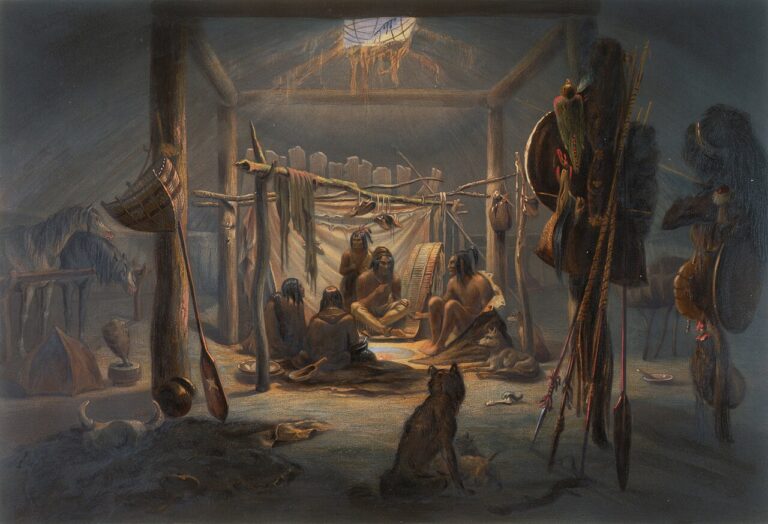
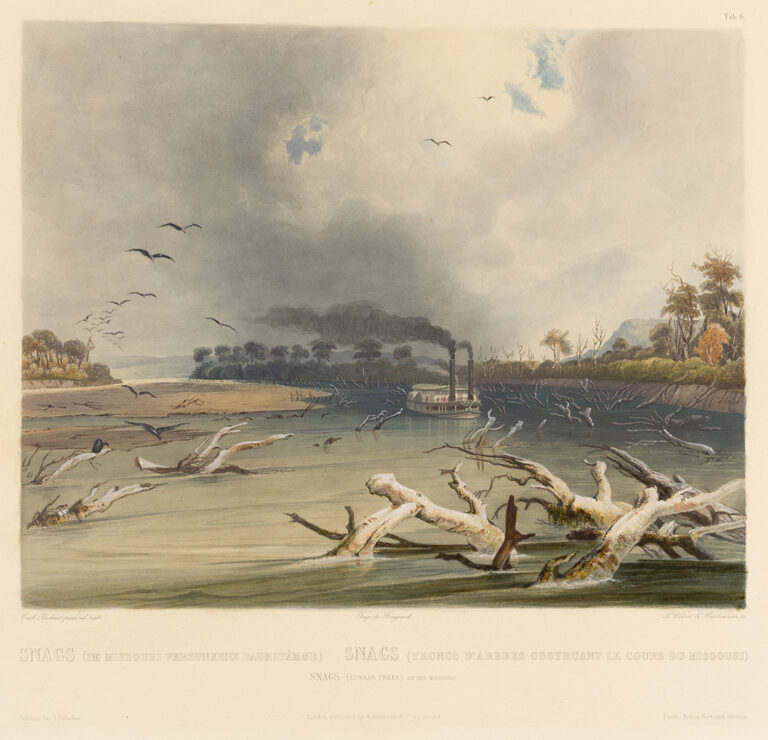
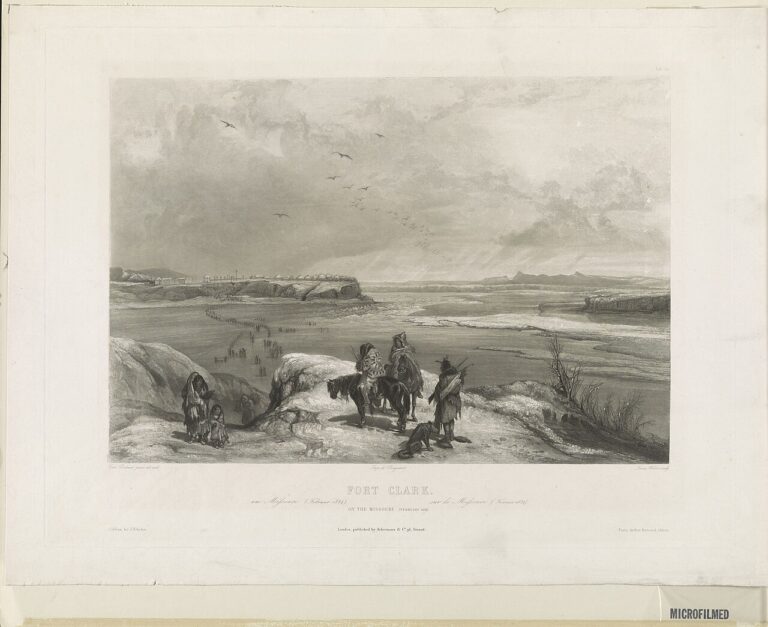
The work dates to 1833, the year Bodmer ascended the Missouri with Prince Maximilian zu Wied-Neuwied on the American Fur Company steamboat Yellow Stone and later the keelboat Flora. The expedition followed much of the route Lewis and Clark had recorded nearly thirty years earlier, reaching Fort McKenzie in August 1833 before wintering at Fort Clark among the Mandan and Hidatsa. Bodmer’s assignment was visual documentation, and he produced hundreds of sketches and watercolors of landscape, fauna, and Indigenous peoples to accompany Maximilian’s scientific observations. Bison were both subject matter and provision on the journey, and Bodmer recorded them repeatedly along the upper river.
Karl Bodmer (1809–1893), a Swiss-born painter trained in Zurich and Paris, is known almost entirely for the two years he spent on the Missouri with Maximilian; he returned to Europe in 1834 and spent the rest of his career in France, associated loosely with the Barbizon circle, rarely revisiting American subjects. The Joslyn Art Museum in Omaha holds the principal collection of his North American watercolors and field studies, acquired from the Maximilian-Wied estate at Schloss Neuwied through the InterNorth Art Foundation in the 1980s. Within the Lewis and Clark memory tradition, Bodmer’s Missouri River views have served as the closest visual approximation of the landscape the Corps of Discovery traversed, since no expedition artist accompanied Lewis and Clark themselves.