Floyd’s Grave, Where Lewis and Clark Buried Sergeant Floyd in 1804
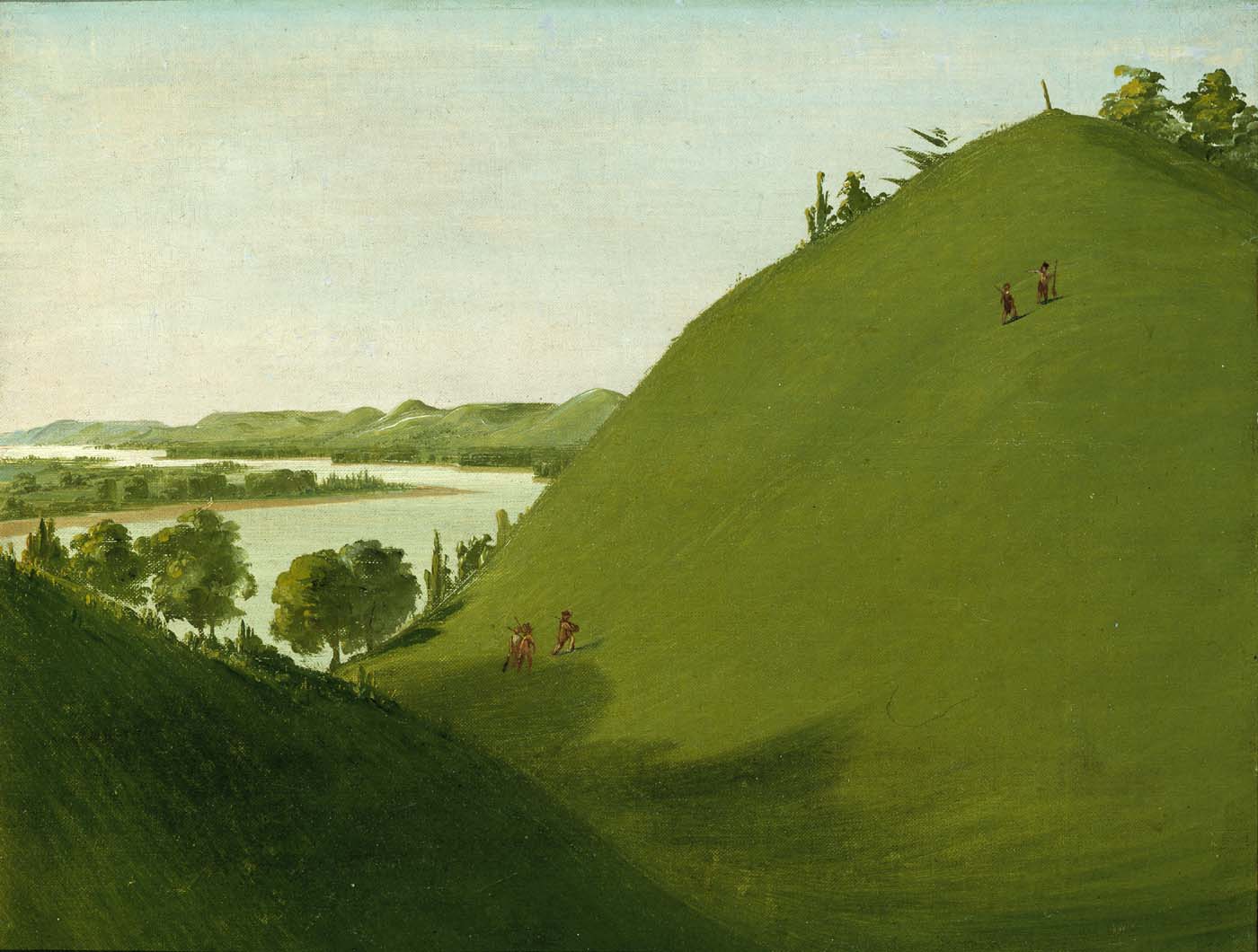
Catlin’s small oil shows a single bluff rising above the Missouri River, topped by a wooden marker or post that identifies the grave of Sergeant Charles Floyd. The composition is spare: a foreground of grassland sloping toward the water, the rounded promontory at center, and a broad sky filling the upper half of the canvas. A few small figures or distant features animate the river plain, but Catlin keeps the focus on the isolated landform. His handling is loose and quick, characteristic of the field studies he produced from a moving boat, with thin paint and visible brushwork rather than finished detail.
The site commemorates the only fatality of the Lewis and Clark Expedition. Sergeant Floyd, a Kentuckian and one of the original enlistees from the Falls of the Ohio, died on August 20, 1804, near present-day Sioux City, Iowa, almost certainly of a ruptured appendix. The captains buried him on a high bluff overlooking the Missouri, fired a salute, and named the adjacent stream Floyd’s River. The bluff became a recognized landmark for fur traders, steamboat pilots, and later travelers on the upper Missouri, who frequently noted the grave in their journals.
Catlin painted the scene in 1832 during his first major ascent of the Missouri aboard the American Fur Company steamer Yellow Stone, the journey that produced the bulk of his Indian Gallery. He was thirty-six and had committed himself to documenting Native peoples and Western landscapes before, as he believed, both were transformed by American expansion. Floyd’s grave was one of the few explicitly historical, non-Indigenous subjects he recorded on the trip, included because the bluff was already a fixture in the western traveler’s mental geography. The painting is held by the Smithsonian American Art Museum as part of the Catlin collection acquired from the artist’s estate through Joseph Harrison’s heirs in 1879. Within the Lewis and Clark visual tradition, it is one of the earliest images of any expedition-related site made by a professional artist on the ground, predating later commemorations of the burial place by more than half a century.