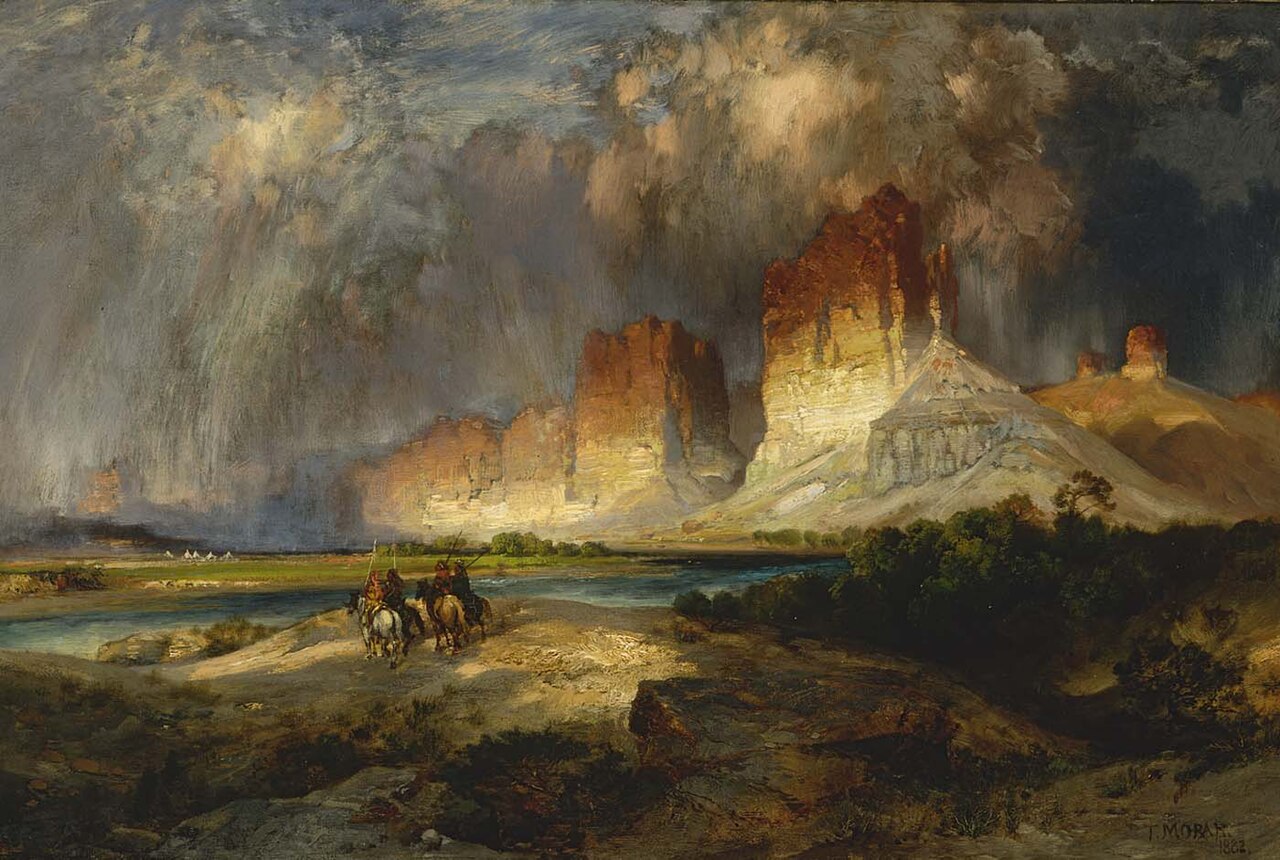
Cliffs of the Upper Colorado River, Wyoming Territory
Moran’s canvas shows a stretch of eroded sandstone cliffs rising above a curve of the Colorado River in what was then Wyoming Territory. The composition places the river in the middle ground, leading the eye back along a horizontal recession, while the cliff face dominates the right side in warm ochres, reds, and rust-browns. Vegetation along the bank — low scrub and scattered cottonwoods — provides the only green relief against the mineral palette. A pale, high-altitude sky occupies roughly the upper third of the canvas. Moran worked the rock in loose, broken brushwork that conveys stratification and weathering without descending into geological transcription, and he used thin glazes to suggest the haze characteristic of dry Western light.
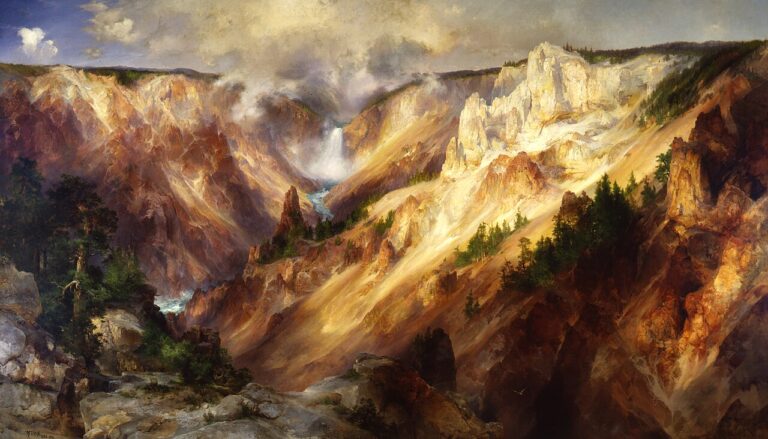
The painting dates from 1882, well after Moran had established his reputation through the large exhibition canvases that followed his 1871 trip to Yellowstone with the Hayden Survey and his 1873 trip to the Grand Canyon of the Colorado with John Wesley Powell. By the early 1880s he was producing smaller, more intimate oils drawn from his accumulated Western sketches, often reworking motifs from earlier field studies for the eastern art market. American interest in the Colorado Plateau and the high desert country remained strong, fed by railroad promotion, government survey reports, and the kind of imagery Moran himself had helped create.
Moran (1837–1926), English-born and Philadelphia-trained, was the painter most responsible for shaping the eastern public’s mental picture of the interior West, and his Yellowstone and Colorado canvases were directly cited in the congressional debates that produced the first national parks. While this painting does not depict a Lewis and Clark site — the Corps of Discovery did not reach the Colorado drainage — Moran’s body of work belongs to the broader nineteenth-century project of visualizing the trans-Mississippi West that Lewis and Clark’s journals initiated. The canvas is held by the Smithsonian American Art Museum in Washington, D.C., which holds one of the largest institutional collections of Moran’s oils and watercolors, much of it acquired from the artist’s estate and later gifts.
Scene Location
Green River, Wyoming