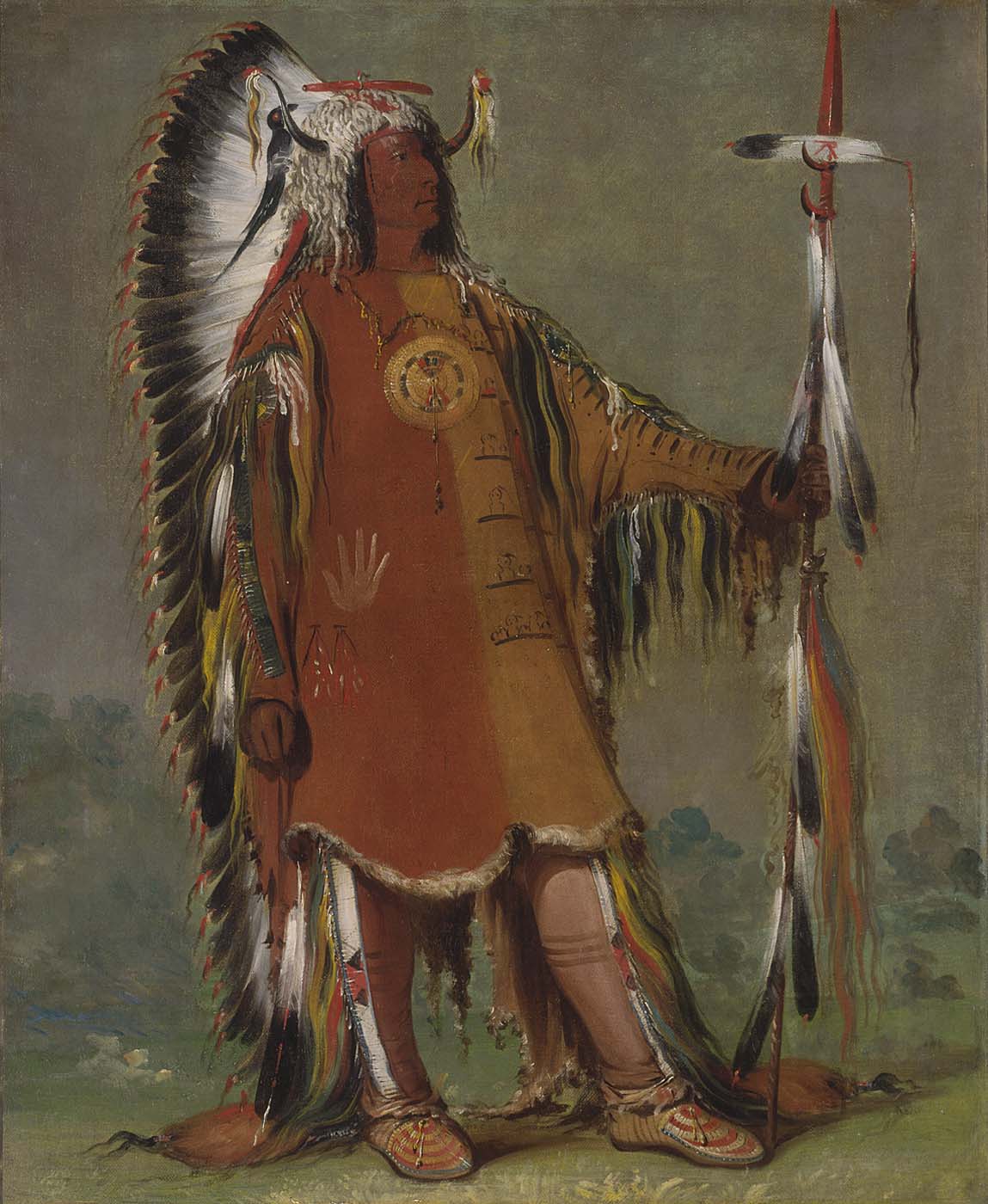
Mah-to-toh-pa, Four Bears, Second Chief in Full Dress
Catlin’s three-quarter-length portrait shows Mah-to-toh-pa (Four Bears), second chief of the Mandan, in formal regalia. The subject faces the viewer directly, painted against a plain, atmospheric ground that throws the figure forward. He wears a quilled and fringed buckskin shirt painted with horizontal stripes recording his war exploits, and his hair is dressed with feathers and ornaments denoting his honors. A pipe-tomahawk rests in his right hand. Catlin painted rapidly and economically: the face and headdress are worked up with care, while the shirt and accoutrements are sketched in with looser brushwork, a working method that allowed him to complete many sittings in a short field season.
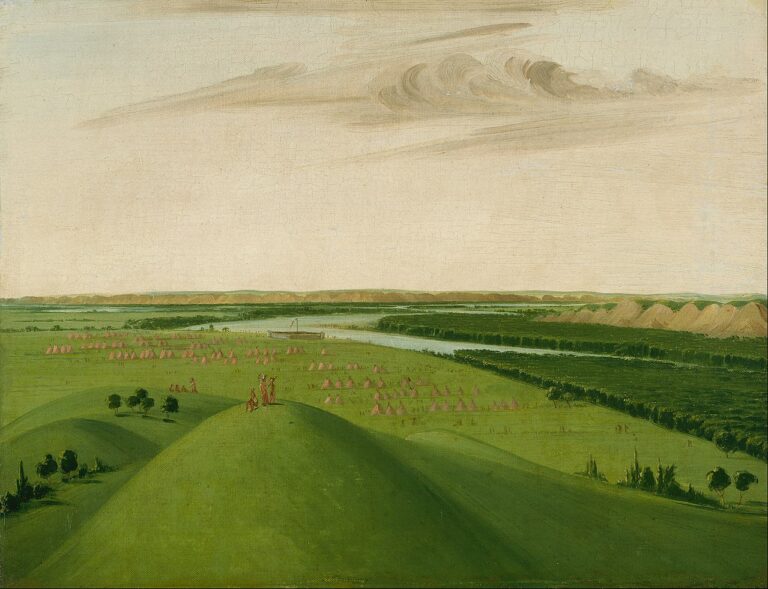
The portrait was made in the summer of 1832 at the Mandan villages near the mouth of the Knife River in present-day North Dakota, the same villages where Lewis and Clark had wintered in 1804–1805 at Fort Mandan. Catlin had traveled up the Missouri aboard the American Fur Company steamer Yellow Stone, reaching Fort Clark and the Mandan towns in July. Four Bears sat for him there. Catlin regarded him as one of the most distinguished men he met on the upper Missouri and produced both this full-dress portrait and a second image showing him in war costume. Five years later, in 1837, the smallpox epidemic brought up the river by steamboat killed Four Bears and nearly the entire Mandan nation, giving Catlin’s 1832 portraits unintended documentary weight.
The painting belongs to Catlin’s Indian Gallery, the body of roughly 500 portraits and scenes he produced during his Missouri and Plains travels of 1830–1836 and exhibited in American and European cities through the 1840s. After decades of failed attempts to sell the collection to the U.S. government, the Gallery was donated to the Smithsonian in 1879 by the widow of Joseph Harrison, the Philadelphia industrialist who had acquired it from Catlin’s creditors. The portrait is held by the Smithsonian American Art Museum. Together with Karl Bodmer’s 1834 drawings of the same sitter, it remains a primary visual record of Mandan leadership in the generation after Lewis and Clark.
Scene Location
Mandan Village, near Washburn, North Dakota