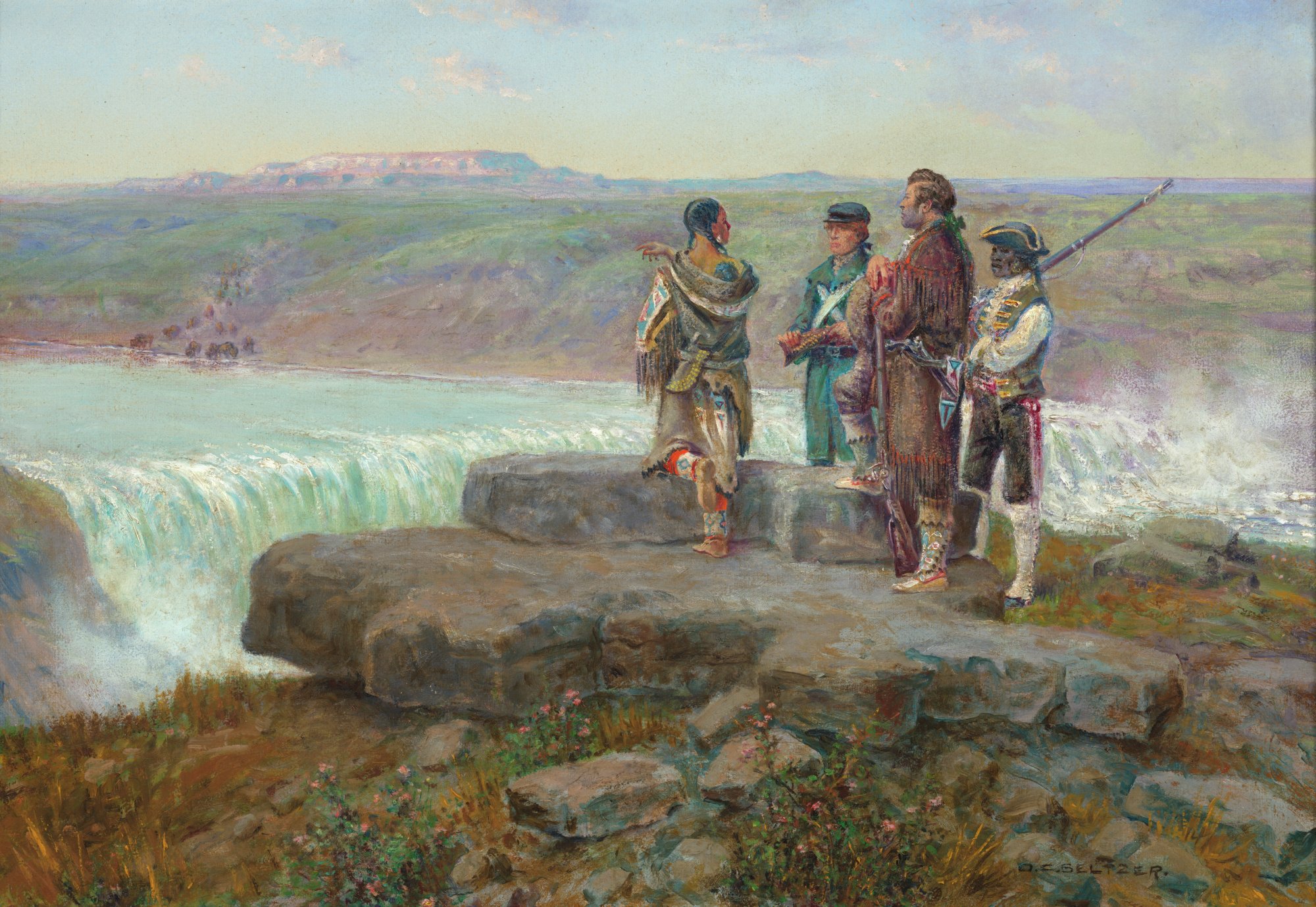
Lewis and Clark with Sacajawea at the Great Falls
Seltzer’s small oil shows the Corps of Discovery at the Great Falls of the Missouri, with Lewis and Clark in the foreground accompanied by Sacagawea and a portion of the party. The composition uses the cascading water as a backdrop, placing the human figures at middle distance against the spray and broken rock of the falls. The horizontal format and modest scale—roughly 11 by 16 inches—reflect Seltzer’s preference for tightly worked easel pictures rather than panoramic canvases. Detail is concentrated in the figures’ costume and gear: fringed buckskin, the captains’ hats, and Sacagawea’s blanket and child carrier. The palette is cool, dominated by the gray-greens of the cataract and the ochres of the surrounding bluffs.
The scene corresponds to the expedition’s arrival at the Great Falls in June 1805, when Lewis, scouting ahead of the main party on June 13, became the first member of the Corps to see the falls. The crossing of this stretch of the Missouri required an arduous month-long portage of roughly eighteen miles around five cascades, conducted through hailstorms, prickly pear, and grizzly encounters. Sacagawea, who had been gravely ill in the preceding weeks, recovered during this phase of the journey. Seltzer painted the subject in 1927, during a period when he was producing historical Montana scenes for Eastern patrons, several years after the death of his close friend and mentor Charles M. Russell in 1926.
Born in Copenhagen in 1877, Seltzer emigrated to Great Falls, Montana, in 1892 and worked as a machinist for the Great Northern Railway before turning to painting full-time. His association with Russell, who lived in the same town, shaped both his subject matter and technique, though Seltzer developed a tighter, more miniaturist handling than his mentor. After Russell’s death, Seltzer found a major patron in Dr. Philip G. Cole, whose Montana collection was acquired in 1944 by Tulsa oilman Thomas Gilcrease. The painting now resides at the Gilcrease Museum in Tulsa, where Seltzer is represented in depth and his Lewis and Clark subjects form part of the museum’s holdings on the documentary art of the American West.
Scene Location
Great Falls, Montana