Lewis and Clark at the Mouth of the Columbia
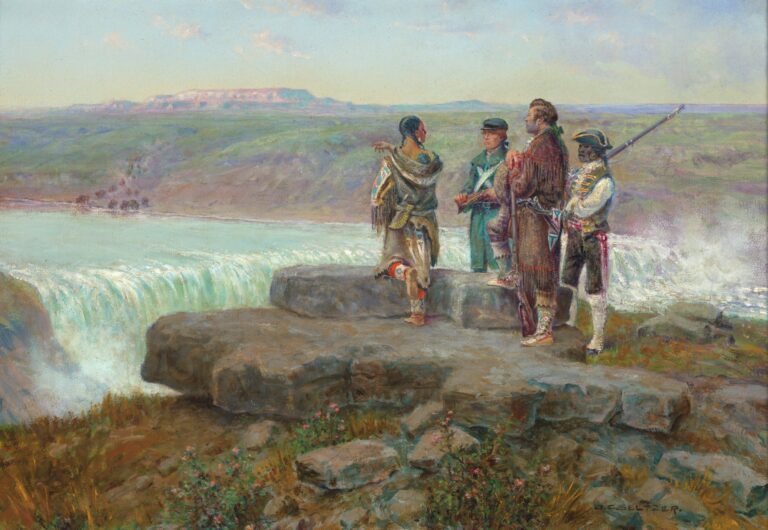
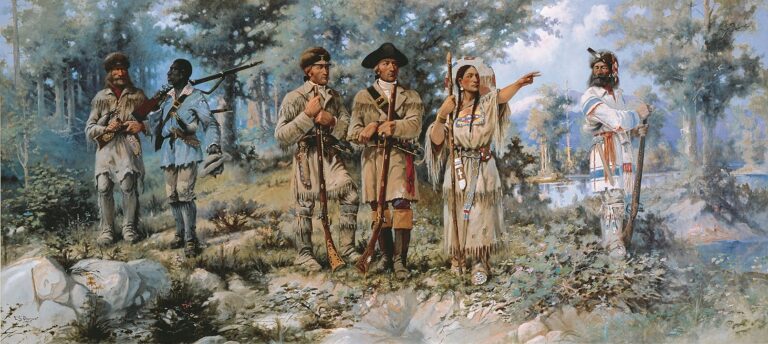
Seltzer’s painting depicts the Corps of Discovery at the Pacific terminus of their westward journey, the moment for which the expedition had labored eighteen months. The composition places Lewis and Clark in the foreground on a rocky promontory or beach, gesturing toward the broad estuary where the Columbia River meets the Pacific Ocean. Members of the party are arrayed around them, some standing, some attending to gear, with the gray water and distant headlands filling the background. Seltzer worked in a naturalistic style, with attention to the muted coastal palette—slate water, overcast sky, dark conifers—that distinguishes the lower Columbia from the brighter light of the interior plains he more often painted.
The historical moment referenced is November 1805, when the expedition reached the Columbia estuary after descending from the Bitterroots through the Nez Perce country and down the Clearwater, Snake, and Columbia rivers. Clark’s journal entry of November 7—”Ocian in view! O! the joy”—was in fact written from a vantage that proved to be Gray’s Bay, still some twenty miles from the open sea; the party would not actually stand on the Pacific shore until later that month. Seltzer painted this scene around 1920, well into a career devoted almost entirely to Western historical subjects, when public appetite for narrative paintings of the American frontier remained strong.
Olaf Carl Seltzer (1877–1957) was born in Copenhagen and emigrated to Montana in 1892, settling in Great Falls, where he became a close friend and studio associate of Charles M. Russell. After Russell’s death in 1926, Seltzer inherited much of his patron base, including the Montana oil executive and collector Philip Cole, whose holdings later formed a core of the Thomas Gilcrease collection. This painting’s presence at the Gilcrease Museum in Tulsa reflects that line of descent. Seltzer produced a substantial body of Lewis and Clark imagery, including a series of small history paintings commissioned by Cole in the 1920s and 1930s, and his treatments of the expedition have circulated widely in popular histories and bicentennial-era publications as visual reference for the Corps’s Pacific arrival.