The Lewis and Clark Expedition at Eagle Creek
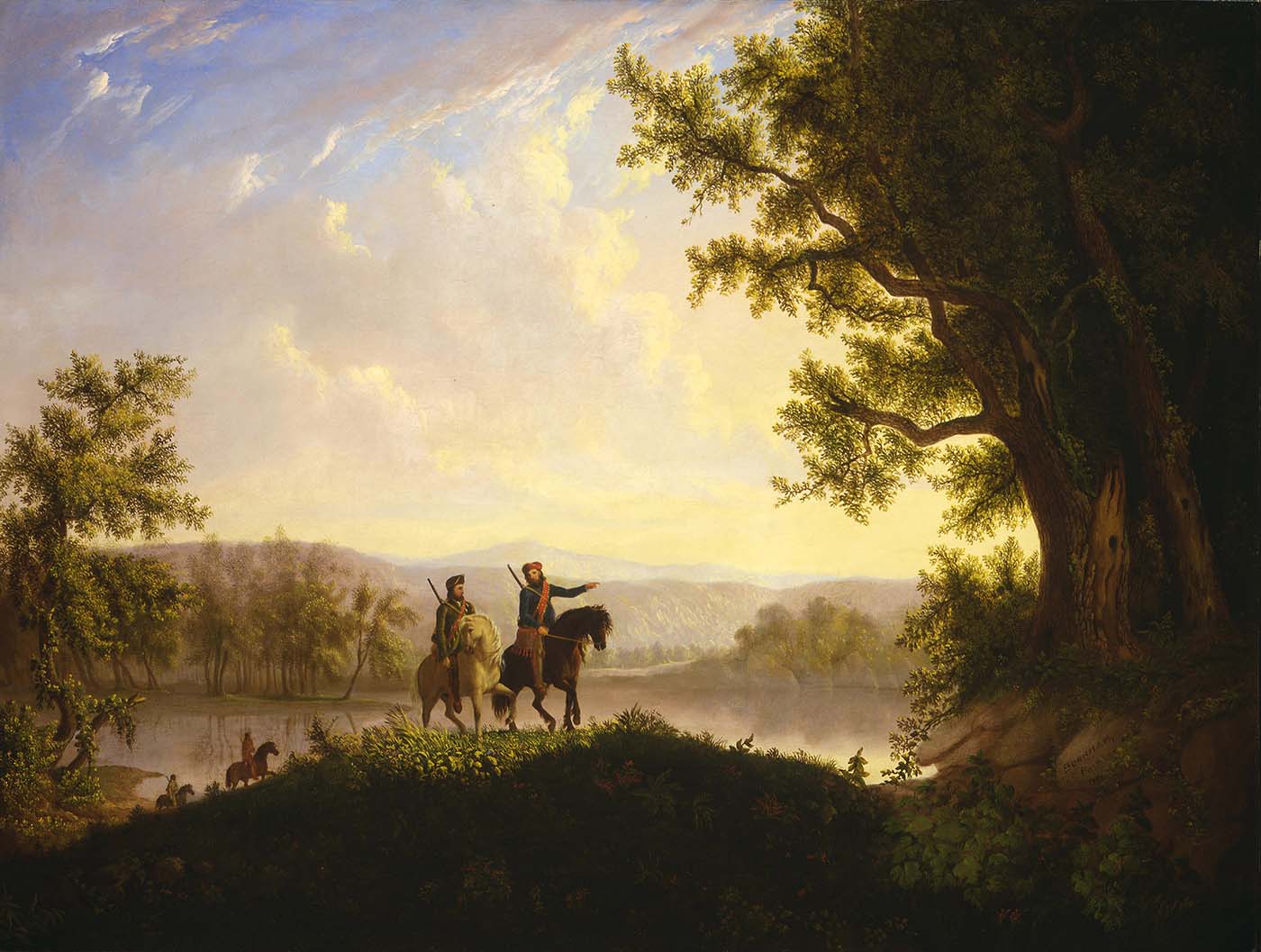
Burnham’s painting depicts the Corps of Discovery encamped along Eagle Creek, a tributary the expedition passed in what is now north-central Montana. The composition arranges figures and equipment along the creek bank, with the river bottom opening toward distant bluffs typical of the Missouri Breaks country. Captains Lewis and Clark are shown among their men, with the keelboat or pirogues drawn up along the shore and members of the party engaged in the routine labor of a wilderness camp. Burnham painted in the broad, narrative manner of mid-century American history painting, using warm earth tones and a stage-like spatial arrangement that places the principal figures in the middle ground against an expansive landscape backdrop.
The expedition reached the Eagle Creek vicinity in late May 1805, during the ascent of the Upper Missouri between the mouths of the Musselshell and the Marias. This stretch of the river drew some of the most lyrical entries in the journals, particularly Lewis’s descriptions of the white sandstone formations he likened to ancient ruined cities. Burnham, working around 1850, was painting roughly four and a half decades after the events themselves, at a moment when the expedition was beginning to enter American popular consciousness as a subject for retrospective historical art alongside the more familiar themes of colonial and Revolutionary history. The 1840s and 1850s saw rising public interest in the trans-Mississippi West, fueled by the Oregon migration, the Mexican War, and the California gold rush, which created an audience for paintings that located the western enterprise in a heroic national past.
Thomas Mickell Burnham (1818–1866) was a Boston-based painter best known for genre scenes and political subjects, including his often-reproduced election-day pictures. His western subjects are comparatively rare, and he worked without firsthand knowledge of the upper Missouri country, relying on published accounts and his own pictorial imagination rather than on field study of the kind George Catlin or Karl Bodmer had undertaken in the 1830s. The painting is held in a private collection, and its earlier ownership history is not documented in the public record. It remains one of the earlier easel paintings to take a specific Lewis and Clark episode as its subject.