Westward the Course of Empire Takes Its Way
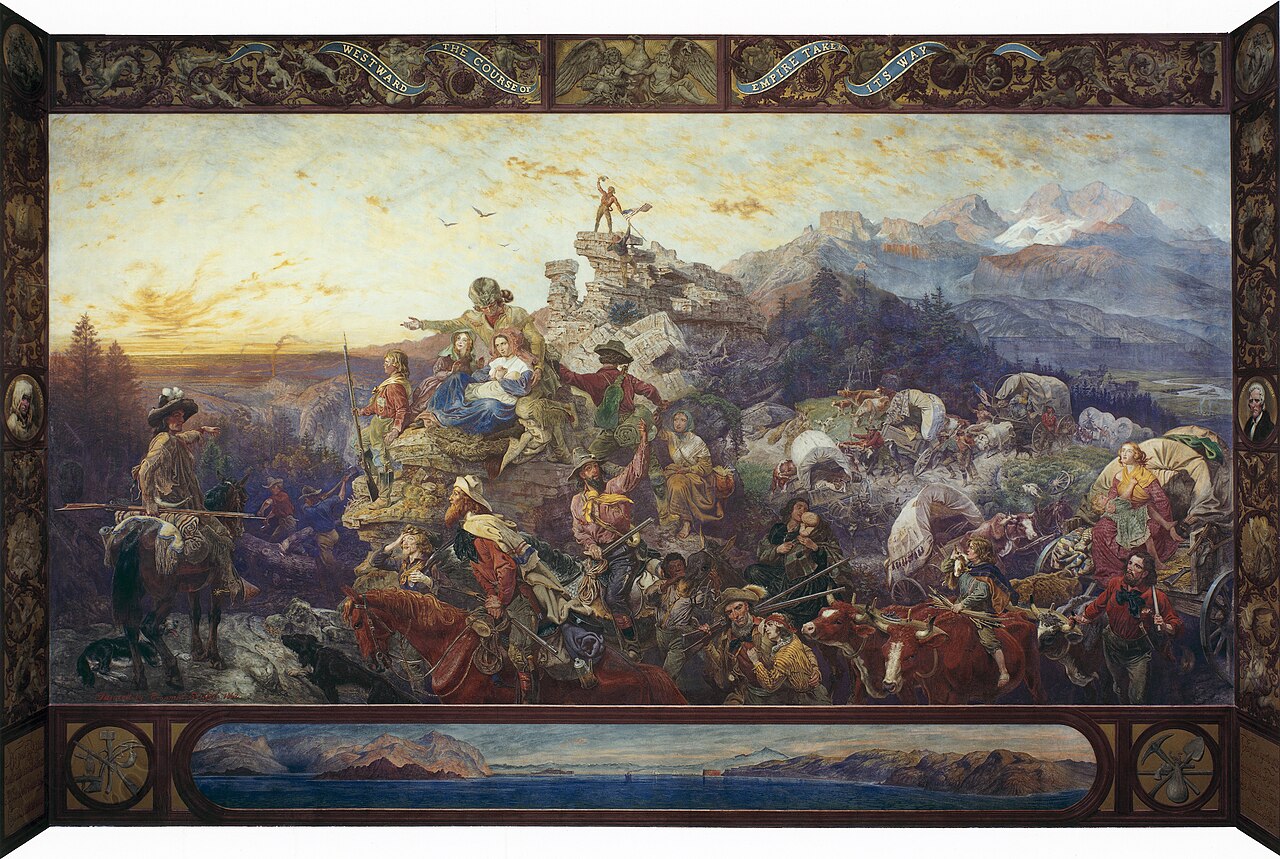
Leutze’s mural depicts a wagon train of emigrants cresting a Rocky Mountain pass at sunset, with the Pacific slope opening before them. At the center, a buckskin-clad scout points westward from horseback while a bearded settler raises his hat in exclamation. Women, children, and exhausted livestock cluster around the wagons; one woman nurses an infant, another mourns a dead companion at the right margin. A young man climbs a rocky outcrop to plant a makeshift flag, while at the lower edge a Black muleteer leads a packhorse, one of the few non-white figures included in the scene. Beneath the main composition runs a decorative border with portrait medallions of William Clark and Daniel Boone flanking a view of San Francisco’s Golden Gate. Leutze worked the mural in stereochromy, a water-glass technique meant to bond pigment permanently to the plaster wall.
The title comes from Bishop George Berkeley’s 1726 poem, a line widely quoted in nineteenth-century discussions of American expansion. Leutze received the commission from the U.S. Capitol’s art program in 1861 and completed the work in 1862, painting it directly onto the wall of the west stairway of the House of Representatives wing during the first year of the Civil War. The federal government’s decision to commission a monumental celebration of westward settlement at that moment was deliberate: with secession threatening the Union, the project asserted a continental national destiny that transcended sectional crisis. Clark’s inclusion in the border medallion places the 1804–1806 expedition within a genealogy of pathfinding that runs forward to the Gold Rush and the transcontinental migrations of the 1840s and 1850s.
Leutze, German-born and trained in Düsseldorf, had returned to the United States in 1859 after producing his most famous canvas, Washington Crossing the Delaware (1851). The Capitol mural was his last major work; he died in 1868. The mural remains in situ at the Capitol, where it has been periodically cleaned and conserved. A smaller oil study, completed in 1861, is held by the Smithsonian American Art Museum. The composition has been reproduced extensively in textbooks and exhibition catalogues treating Manifest Destiny, and the Clark medallion has made it a recurring reference point in Lewis and Clark visual scholarship.