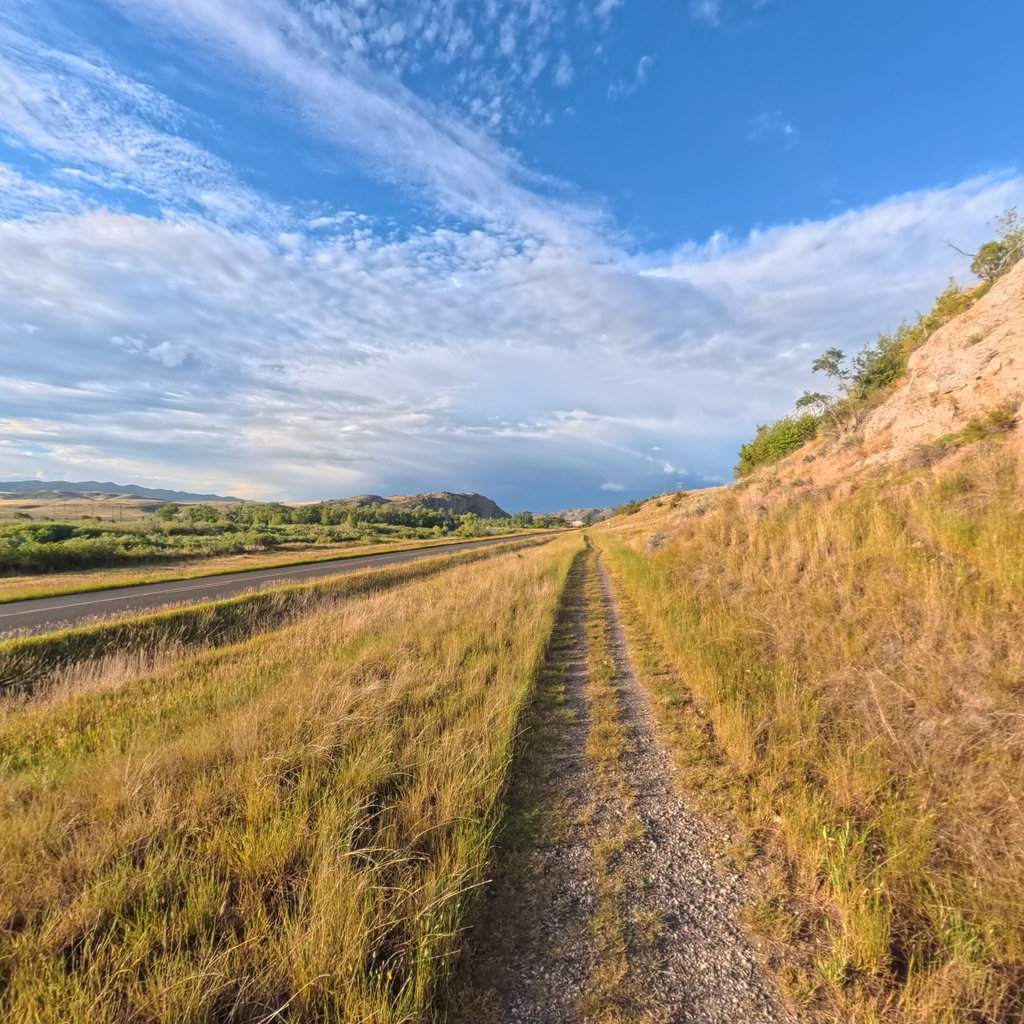
Lewis: July 26, 1805
The expedition pushed upriver against a strong current using cords and poles, passing a 15-yard creek named Howard's Creek after party member Thomas P. Howard. The valley widened with fertile bottomlands, though barbed grass seeds and prickly pear plagued the men's moccasins and tormented Lewis's dog. The party killed four deer, a beaver, and found a cedar Indian bow. Meanwhile, Captain Clark climbed a mountain seeking signs of Indians, fell ill after drinking from a cold spring, saved the non-swimming Charbono from being swept away crossing the North Fork, and made camp early feeling worse.
Friday July 26th 1805. Set out early this morning as usual current strong
with frequent riffles; employ the cord and seting poles. the oars scarcely
ever being used except to pass the river in order to take advantage of the
shore and cur-rent. at the distance of 33/4 m. passed the entrance of a
large Creek 15 yds. wide which discharges itself on Lard. near the center
of a Lard. bend it is a bold runing stream this we called Howard’s Creek
after Thomas P. Howard one of our party. at the distance of one mile
further we passed the entrance of a small run which falls in just above a
rocky clift on Lard. here the hills or reather mountains again recede from
the river and the valley again widens to the extent of several miles with
wide and fertile bottom lands. covered with grass and in many places a
fine terf of greenswoard. the high lands are thin meagre soil covered with
dry low sedge and a species of grass also dry the seeds of which are armed
with a long twisted hard beard at the upper extremity while the lower
point is a sharp subulate firm point beset at it’s base with little stiff
bristles standing with their points in a contrary direction to the
subulate point to which they answer as a barb and serve also to pres it
forward when onece entered a small distance. these barbed seed penetrate
our mockersons and leather legings and give us great pain untill they are
removed. my poor dog suffers with them excessively, he is constantly
hinting and scratching himself as if in a rack of pain. the prickly pear
also grow here as abundantly as usual. there is another species of the
prickly pear of a globular form, composed of an assemblage of little conic
leaves springing from a common root to which their small points are
attached as a common center and the base of the cone forms the apex of the
leaf which is garnished with a circular range of sharp thorns quite as
stif and more keen than the more common species with the flat leaf, like
the Cockeneal plant. on entering this open valley I saw the snowclad tops
of distant mountains before us. the timber and mountains much as
heretofore. saw a number of beaver today and some otter, killed one of the
former, also 4 deer; found a deer’s skin which had been left by Capt. C.
with a note informing me of his having met with a horse but had seen no
fresh appearance of the Indians. the river in the valley is from 2 to 250
yds. wide and crouded with Islands, in some places it is 3/4 of a mile
wide including islands. were it passed the hills it was from 150 to 200
yds. the banks are still low but never overflow. one of the men brought me
an indian bow which he found, it was made of cedar and about 2 F. 9 Inh.
in length. it had nothing remarkable in it’s form being much such as is
used by the Mandans Minetares &c. This morning Capt. Clark left
Sharbono and Joseph Fields at the camp of last evening and proceeded up
the river about 12 miles to the top of a mountain from whence he had an
extensive view of the valley of the river upwards and of a large creek
which flowed into it on Std. side. not meeting with any fresh appearance
of Indians he determined to return and examine the middle fork of the
missouri and meet me by the time he expected me to arrive at the forks. he
returned down the mountain by the way of an old Indian road which led
through a deep hollow of the mountain facing the south the day being warm
and the road unshaded by timber he suffered excessively with heat and the
want of water, at length he arrived at a very cold spring, at which he
took the precaution of weting his feet head and hands before drank but
notwithstanding this precaution he soon felt the effects of the water. he
felt himself very unwell shortly after but continued his march rejoined
Sharbono and Fields where the party eat of a fawn which Jo. Fields had
killed in their absence Capt. C. was so unwell that he had no inclination
to eat. after a short respite he resumed his march pass the North fork at
a large island; here Charbono was very near being swept away by the
current and cannot swim, Capt. C however risqued him and saved his life.
Capt. C. continued his march to a small river which falls into the North
fork some miles above the junction of the 3 forks it being the distance of
about four miles from his camp of last evening here finding himself still
more unwell he determined to encamp. they killed two brown or Grisley bear
this evening on the island where they passed the N. fork of the Missouri.
this stream is much divided by islands and it’s current rapid and much as
that of the missouri where we are and is navigable.-
Read this entry in modern English AI-translated
Friday July 26th 1805. Set out early this morning as usual; the current was strong with frequent riffles. We used the cord and setting poles. The oars were scarcely ever used except to cross the river in order to take advantage of the shore and current. At the distance of 3 3/4 miles we passed the entrance of a large creek 15 yards wide which discharges itself on the larboard side near the center of a larboard bend. It is a bold running stream; this we called Howard's Creek after Thomas P. Howard, one of our party. At the distance of one mile further we passed the entrance of a small run which falls in just above a rocky cliff on the larboard side. Here the hills, or rather mountains, again recede from the river and the valley again widens to the extent of several miles with wide and fertile bottom lands, covered with grass and in many places a fine turf of greensward.
The high lands are of thin, meager soil covered with dry low sedge and a species of grass, also dry, the seeds of which are armed with a long twisted hard beard at the upper extremity, while the lower point is a sharp subulate firm point beset at its base with little stiff bristles standing with their points in a direction contrary to the subulate point, to which they serve as a barb and also help to press it forward once it has entered a small distance. These barbed seeds penetrate our moccasins and leather leggings and give us great pain until they are removed. My poor dog suffers with them excessively; he is constantly hunting and scratching himself as if in a rack of pain. The prickly pear also grows here as abundantly as usual. There is another species of the prickly pear of a globular form, composed of an assemblage of little conic leaves springing from a common root to which their small points are attached as a common center, and the base of the cone forms the apex of the leaf, which is garnished with a circular range of sharp thorns quite as stiff and more keen than the more common species with the flat leaf, like the Cochineal plant.
On entering this open valley I saw the snow-clad tops of distant mountains before us. The timber and mountains were much as heretofore. Saw a number of beaver today and some otter; killed one of the former, also 4 deer. Found a deer's skin which had been left by Capt. C. (Capt. Clark) with a note informing me that he had met with a horse but had seen no fresh sign of the Indians. The river in the valley is from 200 to 250 yards wide and crowded with islands; in some places it is 3/4 of a mile wide including islands. Where it passed the hills it was from 150 to 200 yards. The banks are still low but never overflow. One of the men brought me an Indian bow which he had found; it was made of cedar and about 2 feet 9 inches in length. There was nothing remarkable in its form, being much like those used by the Mandans, Minetares, etc.
This morning Capt. Clark left Sharbono (Charbonneau) and Joseph Fields at the camp of last evening and proceeded up the river about 12 miles to the top of a mountain, from which he had an extensive view of the valley of the river upwards and of a large creek which flowed into it on the starboard side. Not meeting with any fresh sign of Indians, he determined to return and examine the middle fork of the Missouri and meet me by the time he expected me to arrive at the forks. He returned down the mountain by way of an old Indian road which led through a deep hollow of the mountain facing the south. The day being warm and the road unshaded by timber, he suffered excessively from heat and the want of water. At length he arrived at a very cold spring, at which he took the precaution of wetting his feet, head, and hands before he drank, but notwithstanding this precaution he soon felt the effects of the water. He felt very unwell shortly after but continued his march and rejoined Sharbono and Fields, where the party ate of a fawn which Jo. Fields had killed in their absence. Capt. C. was so unwell that he had no inclination to eat.
After a short rest he resumed his march and passed the North fork at a large island. Here Charbono was very near being swept away by the current, and he cannot swim; Capt. C. however risked himself and saved his life. Capt. C. continued his march to a small river which falls into the North fork some miles above the junction of the three forks, it being a distance of about four miles from his camp of last evening. Here, finding himself still more unwell, he determined to camp. They killed two brown or grizzly bear this evening on the island where they crossed the North fork of the Missouri. This stream is much divided by islands and its current is rapid, much like that of the Missouri where we are, and it is navigable.
This modernization is AI-generated for accessibility. The original above is the authoritative version.
Entities mentioned in this entry
Auto-extracted from the entry text. Hover any entity for context.