Lewis: June 6, 1806
Frazier returned with the Twisted Hair chief, but Lewis could not communicate without interpreter Drewyer, who was accompanying Captain Clark on a friendly visit to the Broken Arm. The Broken Arm reported the Nez Perce would not cross the mountains until late summer and could not select young men to guide the expedition until a council was held in ten or twelve days. The party traded for ample bread and roots. Hohastillpilp and other chiefs visited in the evening. Lewis described the Kooskooske River and detailed a small orange, yellow, and black bird observed nearby.
Friday June 6th 1806. This morning Frazier returned having been in quest
of some roots and bread which had left at the lodg of the Twisted hair
when on his way to the fishery on Lewis’s river. the Twisted hair came
with him but I was unable to converse with him for the want of an
interpreter, Drewyer being absent with Capt. C. This Cheif left me in the
evening and returned to his village. Capt C. Visited the Broken Arm today
agreeably to his promise; he took with him Drewyer and several others.
they were received in a friendly manner. The Broken Arm informed Capt. C.
that the nation would not pass the mountain untill the latter end of the
summer, and that with rispect to the young men whom we had requested
should accompany us to the falls of the Missouri, were not yet scelected
for that purpose nor could they be so untill there was a meeting of the
nation in counsil. that this would happen in the course of ten or twelve
days as the whole of the lodges were about to remove to the head of the
Commeap Creek in the plain near Lewis’s river, that when they had
assembled themselves they would hold a council and scelect the young men.
that if we set out previously to that period the men would follow us. we
therefore do not calculate on any assistance from them as guides, but
depend more upon engageing some of the Ootlashshoots in the neighborhood
of Travellers rest C. for that purpose. The broken arm gave Capt. C. a few
dryed Quawmas roots as a great present, but in our estimation those of
cows are much better, I am confident they are much more healthy. The men
who were with Capt. C. obtained a good store of roots and bread in
exchange for a number of little notions, using the Yanke phrase, with
which their own enginuity had principally furnished them. on examination
we find that our whole party have an ample store of bread and roots for
our voyage, a circumstance not unpleasing. They retuned at 5 P.M. shortly
after which we were visited by Hohastillpilp the two young Cheifs who gave
us the horses in behalf of the nation some time since and several others,
who remained all night. The Kooskooske is about 150 Yds. wide at this
place and discharges a vast body of water; notwithstanding it high state
the water remains nearly transparent, and it’s temperature appeas to be
quite as cold as that of our best springs. we meet with a beautifull
little bird in this neighbourhood about the size and somewhat the shape of
the large spar-row. it is reather longer in proportion to it’s bulk than
the sparrow. it measures 7 inches from the extremity of the beek to that
of the tail, the latter occupying 21/2 inches. the beak is reather more
than half an inch in length, and is formed much like the Virginia
nitingale; it is thick and large for a bird of it’s size; wide at the
base, both chaps convex, and pointed, the uper exceeds the under chap a
little is somewhat curved and of a brown colour; the lower chap of a
greenish yellow. the eye full reather large and of a black colour both
puple and iris. the plumage is remarkably delicate; that of the neck and
head is of a fine orrange yellow and red, the latter predominates on the
top of the head and arround the base of the beak from whence it graduly
deminishes & towards the lower part of the neck, the orrange yellow
prevails most; the red has the appearance of being laid over a ground of
yellow. the breast, the sides, rump and some long feathers which lie
between the legs and extend underneath the tail are of a fine orrange
yellow. the tail, back and wings are black, ecept a small stripe of yellow
on the outer part of the middle joint of the wing, 1/4 of an inch wide and
an inch in length. the tail is composed of twelve feathers of which those
in the center are reather shortest, and the plumage of all the feathers of
the tail is longest on that side of the quill next the center of the tail.
the legs and feet are black, nails long and sharp; it has four toes on
each foot, of which three are forward and one behind; that behind is as
long as the two outer of the three toes in front.
Read this entry in modern English AI-translated
Friday June 6th, 1806. This morning Frazier returned, having been in quest of some roots and bread which he had left at the lodge of the Twisted Hair when on his way to the fishery on Lewis's River. The Twisted Hair came with him, but I was unable to converse with him for want of an interpreter, Drewyer being absent with Capt. C. (Capt. Clark). This chief left me in the evening and returned to his village.
Capt. C. visited the Broken Arm today, agreeably to his promise; he took with him Drewyer and several others. They were received in a friendly manner. The Broken Arm informed Capt. C. that the nation would not pass the mountain until the latter end of the summer, and that with respect to the young men whom we had requested should accompany us to the falls of the Missouri, they were not yet selected for that purpose, nor could they be so until there was a meeting of the nation in council. This would happen in the course of ten or twelve days, as the whole of the lodges were about to remove to the head of the Commeap Creek in the plain near Lewis's River. When they had assembled themselves, they would hold a council and select the young men. If we set out previously to that period, the men would follow us. We therefore do not calculate on any assistance from them as guides, but depend more upon engaging some of the Ootlashshoots in the neighborhood of Travellers Rest Creek for that purpose.
The Broken Arm gave Capt. C. a few dried quamash roots as a great present, but in our estimation those of cows are much better; I am confident they are much more healthy. The men who were with Capt. C. obtained a good store of roots and bread in exchange for a number of little notions, using the Yankee phrase, with which their own ingenuity had principally furnished them. On examination, we find that our whole party have an ample store of bread and roots for our voyage, a circumstance not unpleasing. They returned at 5 P.M., shortly after which we were visited by Hohastillpilp, the two young chiefs who gave us the horses on behalf of the nation some time since, and several others, who remained all night.
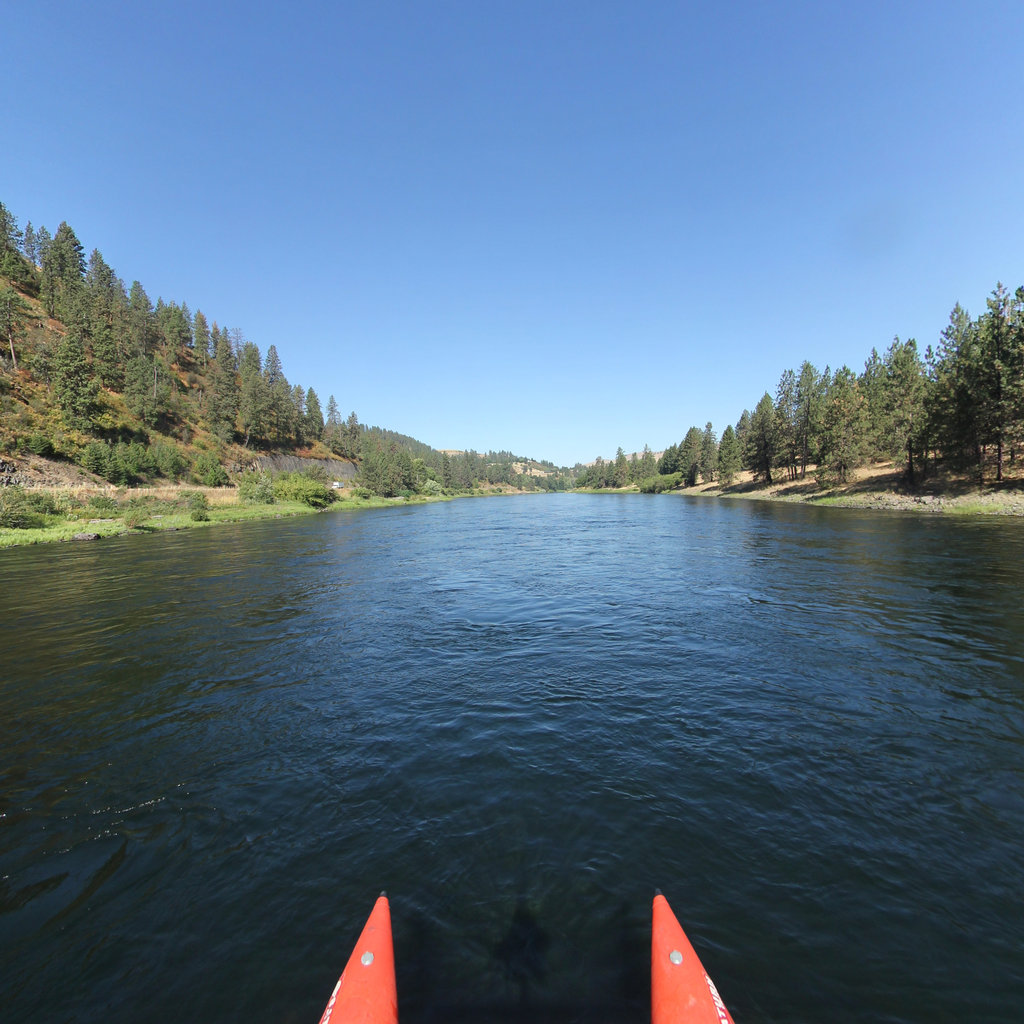
The Kooskooske is about 150 yards wide at this place and discharges a vast body of water; notwithstanding its high state, the water remains nearly transparent, and its temperature appears to be quite as cold as that of our best springs.
We meet with a beautiful little bird in this neighborhood, about the size and somewhat the shape of the large sparrow. It is rather longer in proportion to its bulk than the sparrow. It measures 7 inches from the extremity of the beak to that of the tail, the latter occupying 2½ inches. The beak is rather more than half an inch in length, and is formed much like the Virginia nightingale's; it is thick and large for a bird of its size, wide at the base, both mandibles convex and pointed. The upper exceeds the lower a little, is somewhat curved, and of a brown color; the lower mandible is of a greenish yellow. The eye is full, rather large, and of a black color, both pupil and iris. The plumage is remarkably delicate; that of the neck and head is of a fine orange yellow and red, the latter predominating on the top of the head and around the base of the beak, from whence it gradually diminishes, and towards the lower part of the neck the orange yellow prevails most. The red has the appearance of being laid over a ground of yellow. The breast, the sides, rump, and some long feathers which lie between the legs and extend underneath the tail are of a fine orange yellow. The tail, back, and wings are black, except a small stripe of yellow on the outer part of the middle joint of the wing, ¼ of an inch wide and an inch in length. The tail is composed of twelve feathers, of which those in the center are rather shortest, and the plumage of all the feathers of the tail is longest on that side of the quill next the center of the tail. The legs and feet are black, the nails long and sharp; it has four toes on each foot, of which three are forward and one behind; that behind is as long as the two outer of the three toes in front.
This modernization is AI-generated for accessibility. The original above is the authoritative version.
Entities mentioned in this entry
Auto-extracted from the entry text. Hover any entity for context.