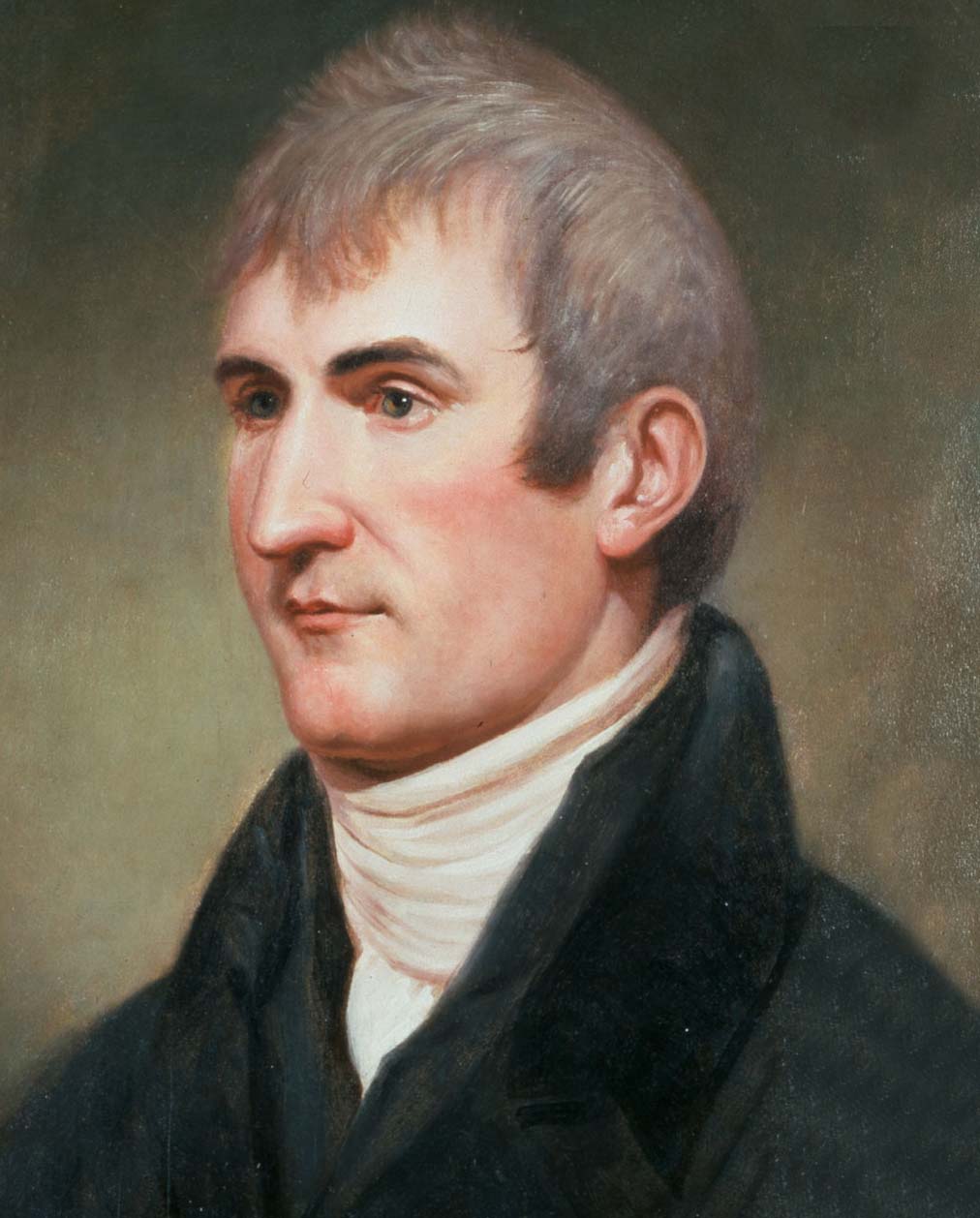


August 5, 1805 finds the Corps physically split among three groups, and the cross-narrator record reflects that division with unusual clarity. Lewis is on foot with Drouillard and (initially) Gass and Charbonneau, reconnoitering ahead. Clark commands the canoe party laboring up the river. The journals of Ordway and Whitehouse document the water party’s ordeal; Lewis records the reconnaissance; Clark notes the decision; Gass — uniquely — describes a different splitting still to come.
Three Vantages on One Confluence
The day’s central event is the arrival at a forks — what would prove to be the junction of the Big Hole and Beaverhead rivers. Clark, commanding the boats, frames it as a navigational decision:
passed the mouth of principal fork which falls in on the Lard. Side, this fork is about the Size of the Stard. one less water reather not so rapid… the N W. fork being the one most in our course i. e. S 25 W. as far as I can See, deturmind me to take this fork as the principal and the one most proper
Ordway preserves a detail Clark omits — the uncertainty about Lewis’s whereabouts and the note left at the point:
we was not certian whether Cap* Lewis was up the left fork or right So Cap* Clark left a note for him on the point which is level prarie, & proceeded on up the right hand fork
Lewis, meanwhile, has climbed a spur of the mountain and from that eminence reads the entire valley system. His entry is the day’s longest and the only one that explains why the right-hand (northwest) fork was the wrong choice strategically — though navigable, it bent west of the desired course, while the middle fork offered a wider valley and lower mountains beyond. The irony the journals collectively preserve: Clark, without Lewis’s panoramic view, chose the harder and ultimately less useful branch.
Ordway and Whitehouse: Near-Identical Twins
The Ordway-Whitehouse parallel, well documented elsewhere in the expedition record, is exceptionally tight on this date. Both record the same hunters, the same deer killed before breakfast, the same cold south wind, the same rocky shores, the same beaver dams felled across the channel, the same 8 miles, the same closing line about the men wishing to leave the canoes. Compare:
Ordway: “the party much fatigued and wish to go by land.”
Whitehouse: “the party much fatigued and wish to leave the canoes & go by land.”
Whitehouse’s version is slightly expanded but structurally derivative. Where the two diverge is small: Whitehouse renders the rapids as falling “3 or 4 feet” while Ordway specifies “nearly 3 feet in the length of a canoe” — Ordway’s measurement is more precise, suggesting his entry is the source. Whitehouse also misdates his marginal header to August 6, an OCR or copying slip.
What Each Narrator Alone Preserves
Lewis alone records Drouillard’s accident on the descent — a sprained finger and bruised leg from a misstep on the rocky precipice — and the detail that an old, large Indian road followed the fork, with horse tracks that “appeared to have passed early in the spring.” This is the day’s most consequential observation for the expedition’s future: evidence of regular Indigenous use of the route they were about to take.
Clark alone records the temperature (49° at 4 P.M.) and the painful state of his foot — a recurring complaint that will worsen. He also notes the greenish color of the southeast fork, a small chemical-geographical detail.
Gass’s entry is the strangest in the cluster because it appears to describe a different reconnaissance plan than Lewis describes — Gass writes of being assigned to the “west branch” while another party would go up the “north,” cross over, and rejoin. Lewis’s own account places Gass with Charbonneau on the middle fork, waiting in timber. The discrepancy is partly resolved by recognizing Gass’s entry was likely composed retrospectively, telescoping events of August 5 and 6; his closing note that “At night they came to our camp, but had not seen any of the natives, nor any fresh signs” aligns with Lewis’s account of returning in perfect darkness, hooping for Gass and receiving no reply.
The Pattern of the Day
Five narrators, three physical locations, one wrong turn. The collective record demonstrates how command-level reconnaissance (Lewis), command-level navigation (Clark), and enlisted-level labor (Ordway, Whitehouse, Gass) produced complementary but rarely overlapping observations. Without Lewis’s mountain view, the canoe party’s exhausting ascent of the Big Hole would read as ordinary fatigue; with it, the day becomes a study in the cost of incomplete information.


