
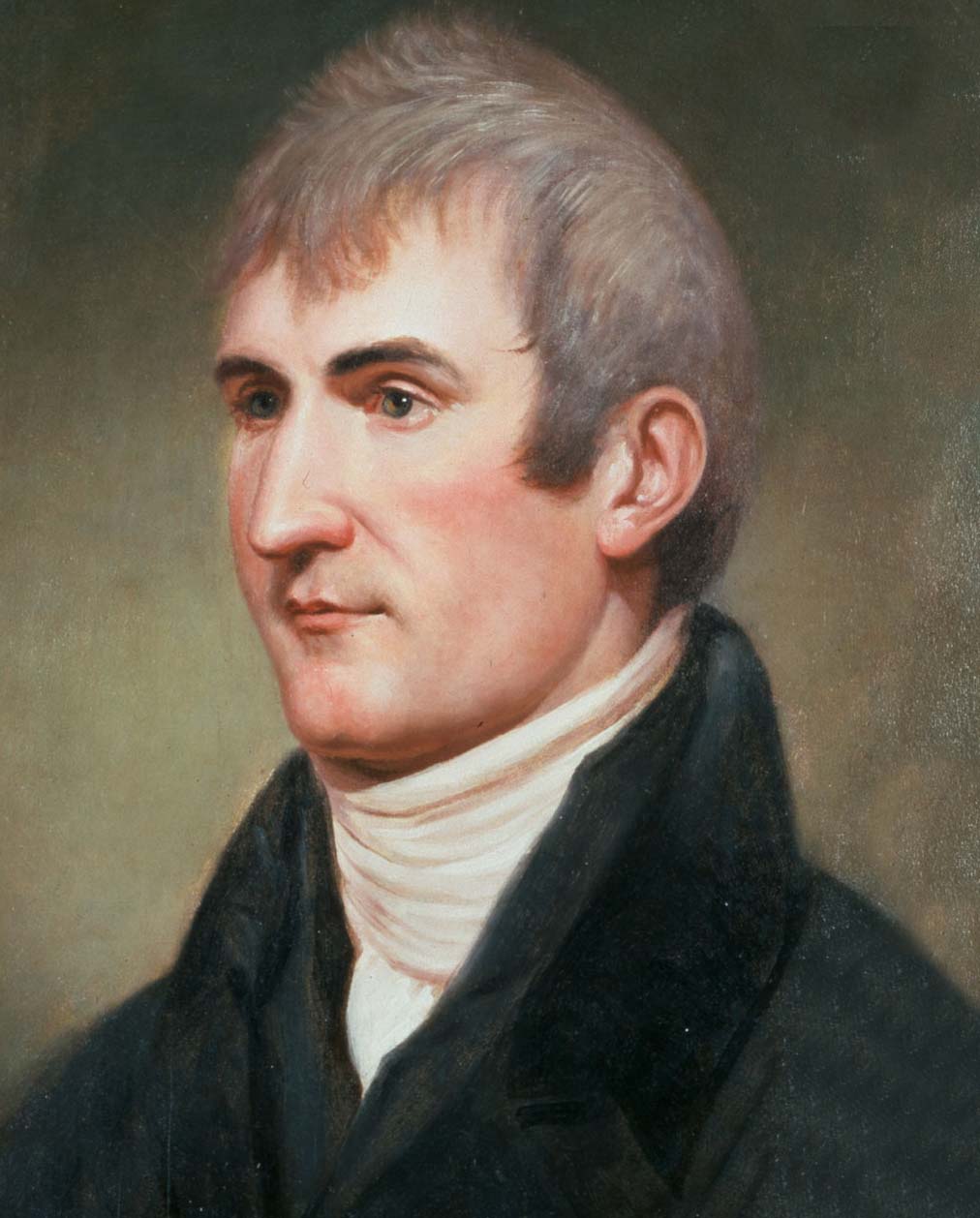


The expedition’s first full day after departing Fort Clatsop produced a geographic realization of the return. While hunters fanned out across the bottoms above the mouth of the Quicksand River (today’s Sandy River), Meriwether Lewis and William Clark sat with Native informants and worked out, by inference alone, that a major undiscovered tributary must drain the southern Columbian valley. The four narrators present — Lewis, Clark, Patrick Gass, and John Ordway — record the same hours in radically different registers, and the comparison reveals how information moved within the Corps.
Twin Captains, One Reconnaissance
Lewis and Clark’s entries for April 1, 1806 are, as is typical for this stage of the journey, near-verbatim parallels. Both open with identical phrasing about dispatching Sergeant Pryor:
This morning early we dispatched Sergt. Pryar with two men in a small canoe up quicksand river with orders to proceed as far as he could and return this evening.
Both captains reproduce Pryor’s compass courses word for word — “S. 10° W. 1 M. to a point on the Lard. side” — and both record the same conclusion regarding the hidden southern river. Yet small divergences betray which journal is primary. Lewis offers a more polished reasoning chain, noting that the Quicksand “must leave the valley within a few miles of it’s entrance and runs nearly parallel with the Columbia river upwards.” Clark echoes the sentence almost exactly but adds an empirical detail Lewis omits: “the other part of the river from 2 to 4 inches water.” Clark also notes that Mount Hood “is in view,” grounding the abstract geographic argument in a visible landmark. Lewis, characteristically, is more interested in the hydrological puzzle itself; Clark, the field cartographer, attends to what can be seen and measured.
The reasoning the captains record is a remarkable piece of armchair geography. Having been told by “sundry” informants that the Quicksand heads in Mount Hood — only forty miles east — they deduce that the wide southern valley they had earlier credited to the Quicksand must in fact be drained by another, unseen stream. That stream is the Willamette, which the expedition had passed twice without seeing. Clark would double back days later to find it.
The Enlisted Registers
Gass and Ordway, working without access to the captains’ interviews, record an entirely different day. Gass is terse and operational:
we agreed to stay here all day, for the purpose of hunting. So 9 hunters set out early; 3 of whom went up Quicksand river, and killed a deer; the other six killed 4 elk and a deer.
For Gass the day is a hunt tally and an inconvenient bivouac — “it being late we were obliged to encamp out all night.” There is no mention of the Quicksand’s source, no Mount Hood, no missing river. The geographic reasoning that consumes the captains’ pages is simply absent.
Ordway occupies a middle register. He records the hunting results with detail closer to Gass (“4 Elk and 2 deer and an otter”), but he also notes information the captains do not mention in their April 1 entries — the naming of Mount Jefferson:
we discovred yesterday the top of a high white Mountain some distance to the Southward our officers name it Mount Jefferson.
This is a detail of expedition consequence that Lewis and Clark fold into other days’ entries; Ordway captures it here, suggesting he was either privy to officers’ conversation or recording it retroactively. Ordway also notices what the captains note only obliquely: “2 canoe loads of Savages Camped near us” — the Native presence that produced the very information driving the captains’ reasoning.
What the Comparison Reveals
The four entries together demonstrate a stratified information economy within the Corps. Lewis and Clark share a common interview transcript and a common cartographic project; their journals are effectively a single document in two hands. Ordway sits adjacent to that conversation, picking up named features and Native movements. Gass, writing for a different audience and likely from notes taken at day’s end after returning from the elk-meat detail, records only what every member of the party would have known: who hunted, who killed what, who slept in the woods. The geographic breakthrough that defines the day in the official record is, in the enlisted journals, invisible.


