


August 18, 1805 marks the operational pivot at Camp Fortunate: Clark sets out with eleven men and most of the Shoshones to scout a canoe route on the Columbia drainage, while Lewis remains behind to repackage the expedition’s stores for horseback transport. Five narrators record the day, and the comparison is unusually rich because each writer captures a different layer of the same morning’s bargaining.
The Horse Trade, Told Five Ways
Every narrator describes Lewis’s purchase of horses from the Shoshones, but the accounting differs. Lewis claims
three very good horses for which I gave an uniform coat, a pair of legings, a few handkerchiefs, three knives and some other small articles the whole of which did not cost more than about 20$ in the U States.
Ordway corroborates three horses and itemizes the goods per animal. Whitehouse, however, records
Cap! Lewis bought 4 horses of the natives
— a discrepancy that probably reflects Whitehouse counting the additional horse the men purchased jointly. Clark, writing as the departing party, lists the goods given but not a horse count, focused instead on his own diplomatic gesture:
I gave two of my coats to two of the under Chiefs who appeared not well Satisfied that the first Chief was dressed so much finer than themselves.
Lewis alone explains the political mechanics behind those two coats — that the inferior chiefs were displeased, and that he privately promised an additional present if they assisted with horses over the mountains. Clark records the gift; Lewis records the negotiation. Neither Ordway, Gass, nor Whitehouse mentions the chiefs’ displeasure at all, suggesting the captains kept this friction within the officer corps.
Whitehouse’s Ethnographic Departure
The Ordway-Whitehouse parallel is well documented, and the opening of Whitehouse’s entry tracks Ordway closely — beaver in trap, Clark’s preparation, the horse purchases, the airing of goods. But Whitehouse then breaks from his usual copying and produces the day’s most original passage, an extended observation on Shoshone material poverty:
these Indian are verry poor and vallue a little worth a great deal, as they never had Scarsely any kind of a kinife or Tommahawk or any weapons of war or to use. 2 or 3 guns only to be seen among them which we expect they got from Some other nation, who traded with the french or Spanish traders.
He goes on to describe weasel-tail ornaments given to Lewis, mussel-shell ear pendants, and antelope and mountain-ram clothing. Nothing comparable appears in the other journals for this date. Whitehouse’s economic inference — that the few guns came through indirect trade with French or Spanish intermediaries — is a genuine analytical contribution.
Gass, traveling with Clark, ignores the Camp Fortunate transactions entirely and instead supplies the only detailed terrain account: a five-mile-wide valley with springs, clover, and flax; pine on the surrounding mountains; a violent gust of wind at three o’clock followed by cold. Clark confirms the weather (
at 12 oClock it became hasey with a mist of rain wind hard from the S. W. and Cold
) and gives the courses and latitude — 43° 30′ 43″ North at the forks — but Gass alone notes the flax and clover.
Lewis at Thirty-One
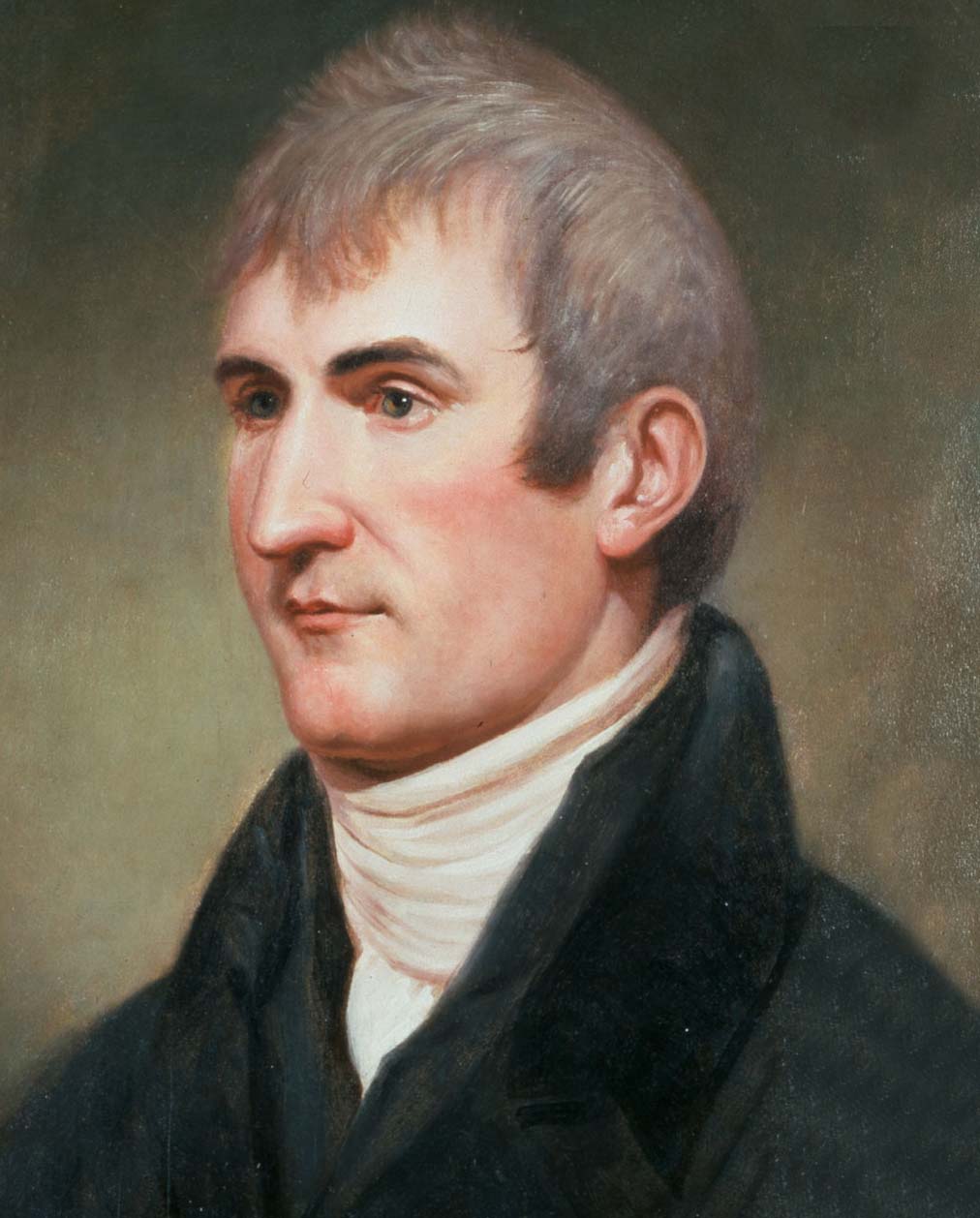
The day’s most quoted passage is private and singular. Lewis closes his entry with a birthday meditation that no other narrator could have written and none knew was being written:
This day I completed my thirty first year, and conceived that I had in all human probability now existed about half the period which I am to remain in this Sublunary world. I reflected that I had as yet done but little, very little indeed, to further the hapiness of the human race… I dash from me the gloomy thought and resolved in future, to redouble my exertio
The entry breaks off mid-word in the surviving manuscript. The contrast with the other four entries is total: Ordway, Whitehouse, Gass, and Clark record a Sunday of trade goods and travel; Lewis records the same day as a private accounting against mortality. The cross-narrator record shows how thoroughly Lewis kept his interior life out of expedition business — the men around him have no inkling it is his birthday.
The composite portrait is unusually complete: Clark’s route and latitude, Gass’s botany and weather, Ordway’s transactional ledger, Whitehouse’s ethnography, and Lewis’s interior monologue. Removing any one narrator measurably impoverishes the day.


