Corps of Discovery
Eugene Daub’s Corps of Discovery is a monumental bronze group set on a granite base, rising approximately 21 feet high and spanning 18 feet at its widest point. The sculpture assembles the principal members of the expedition in a forward-moving configuration: Meriwether Lewis and William Clark stand at the leading edge, accompanied by Sacagawea carrying her infant son Jean Baptiste Charbonneau, the enslaved man York, and Lewis’s Newfoundland dog Seaman. The figures are arranged in a tightly compressed pyramidal mass, with the captains gesturing forward as if reading the terrain ahead. Daub modeled the figures in a naturalistic mode, with detailed period dress—fringed hunting shirts, a cradleboard for the infant, a powder horn, a long rifle—and the granite plinth carries inscriptions identifying the party.
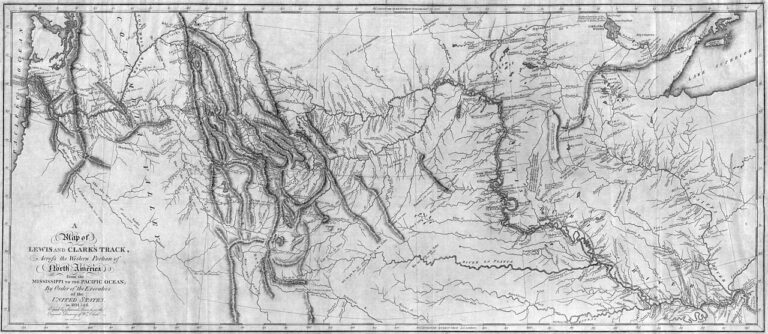
The sculpture was dedicated in 2000, at the leading edge of the national Lewis and Clark Bicentennial commemorations of 2003–2006. It sits at Case Park on Quality Hill in Kansas City, Missouri, overlooking the confluence of the Kansas and Missouri Rivers—the site the expedition reached on June 26, 1804, during its outbound journey upriver. Lewis and Clark spent three days camped at the confluence, taking celestial observations, repairing equipment, and noting the strategic value of the location for a future military post, an observation that would later inform the establishment of Fort Osage and other Missouri River garrisons. The choice of site ties the sculpture directly to a documented expedition encampment rather than a generic westward-movement theme.
Daub, a Pennsylvania-born sculptor based in California, has worked extensively in figurative public monuments and coinage design, including work for the United States Mint’s state quarter and Congressional Gold Medal programs. Corps of Discovery is among his most prominent expedition-era commissions and is frequently cited in the bicentennial-era wave of public sculpture that sought to represent the full party—including Sacagawea, York, and Seaman—rather than the captains alone. The inclusion of York as a fully realized figure, in particular, reflects the late-twentieth-century reassessment of the expedition’s composition that has shaped much of the recent Lewis and Clark commemorative tradition.