Sacajawea and Jean-Baptiste
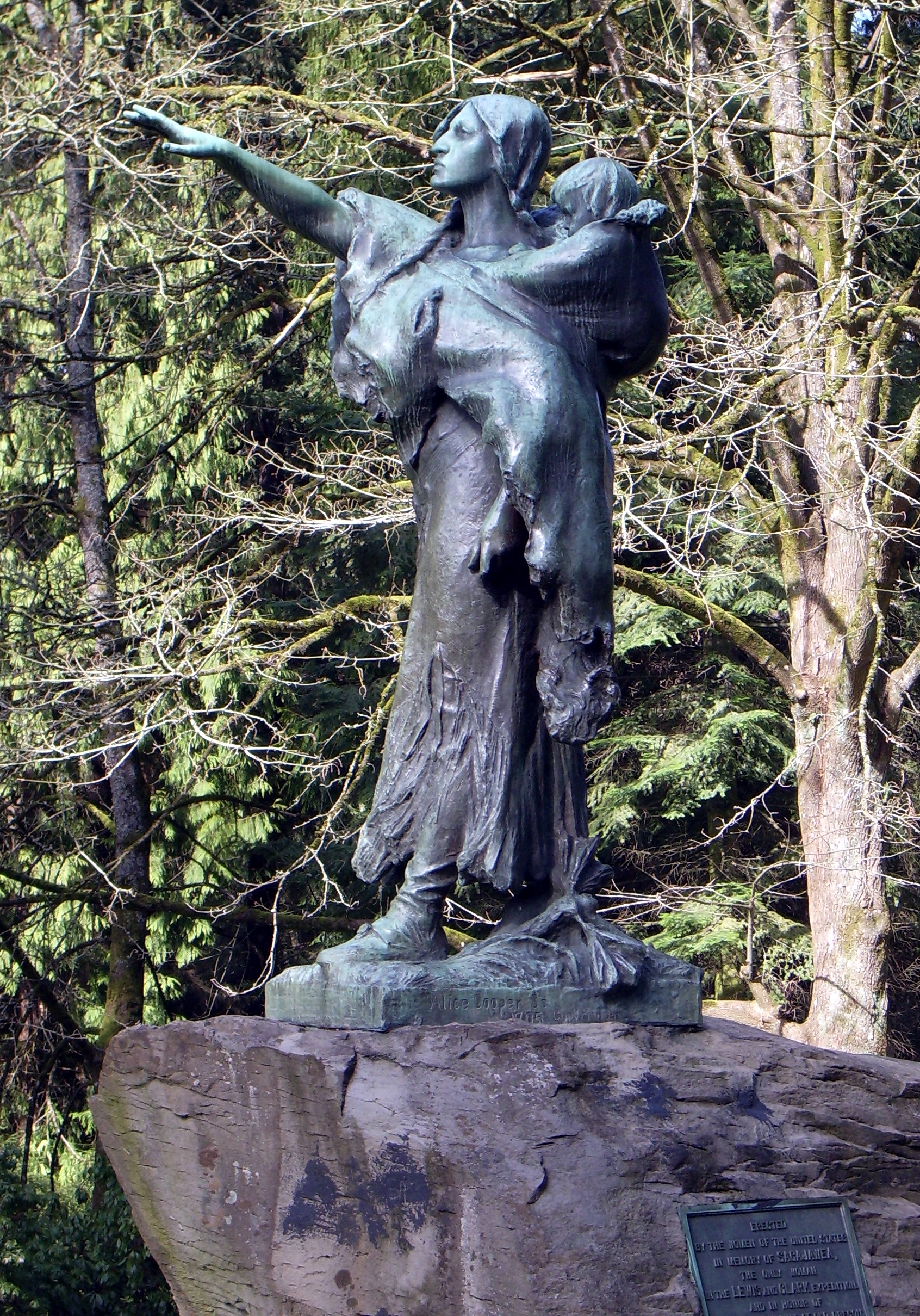
Alice Cooper’s bronze depicts Sacagawea standing upright, her right arm extended outward in a gesture commonly interpreted as pointing the way west, while her infant son Jean-Baptiste Charbonneau is carried on her back in a cradleboard. The figure wears a fringed buckskin dress with a knife sheathed at the waist. The composition emphasizes verticality and forward motion, with Sacagawea’s gaze and outstretched arm directing the viewer’s attention toward an unseen horizon. At roughly seven feet tall, the sculpture sits atop a stone pedestal that elevates the figure well above eye level, giving the work a monumental civic presence rather than an intimate one.
The sculpture was commissioned for the Lewis and Clark Centennial Exposition, held in Portland from June to October 1905 to mark the hundredth anniversary of the expedition’s arrival at the Pacific. Sacagawea joined the Corps of Discovery in the winter of 1804–05 at the Mandan villages on the upper Missouri, traveled with her husband Toussaint Charbonneau and their newborn son to the Pacific and back, and became central to the expedition’s encounters with Shoshone and other peoples. By 1905 her reputation had been refashioned by a generation of women writers and suffragists—most prominently Eva Emery Dye, whose 1902 novel *The Conquest* helped recast Sacagawea as a heroic guide and symbol of westward enterprise. Funding for the sculpture was raised largely by women’s clubs and suffrage organizations, and Susan B. Anthony and Anna Howard Shaw spoke at its dedication on July 6, 1905.
Alice Cooper (1875–1937), a Denver-based sculptor who studied under Lorado Taft at the Art Institute of Chicago, is remembered primarily for this commission; her broader output is modest and less well documented than that of her contemporaries. After the exposition closed, the sculpture was relocated to Washington Park in Portland, where it remains. It is among the earliest public monuments in the United States to honor a Native American woman and an early example of a Lewis and Clark Expedition memorial centered on Sacagawea rather than the captains, a framing that shaped subsequent depictions through the twentieth century, including monuments and the eventual issuance of the Sacagawea dollar coin in 2000.