Journal Entry

Clark: May 31, 1805

May 31, 1805
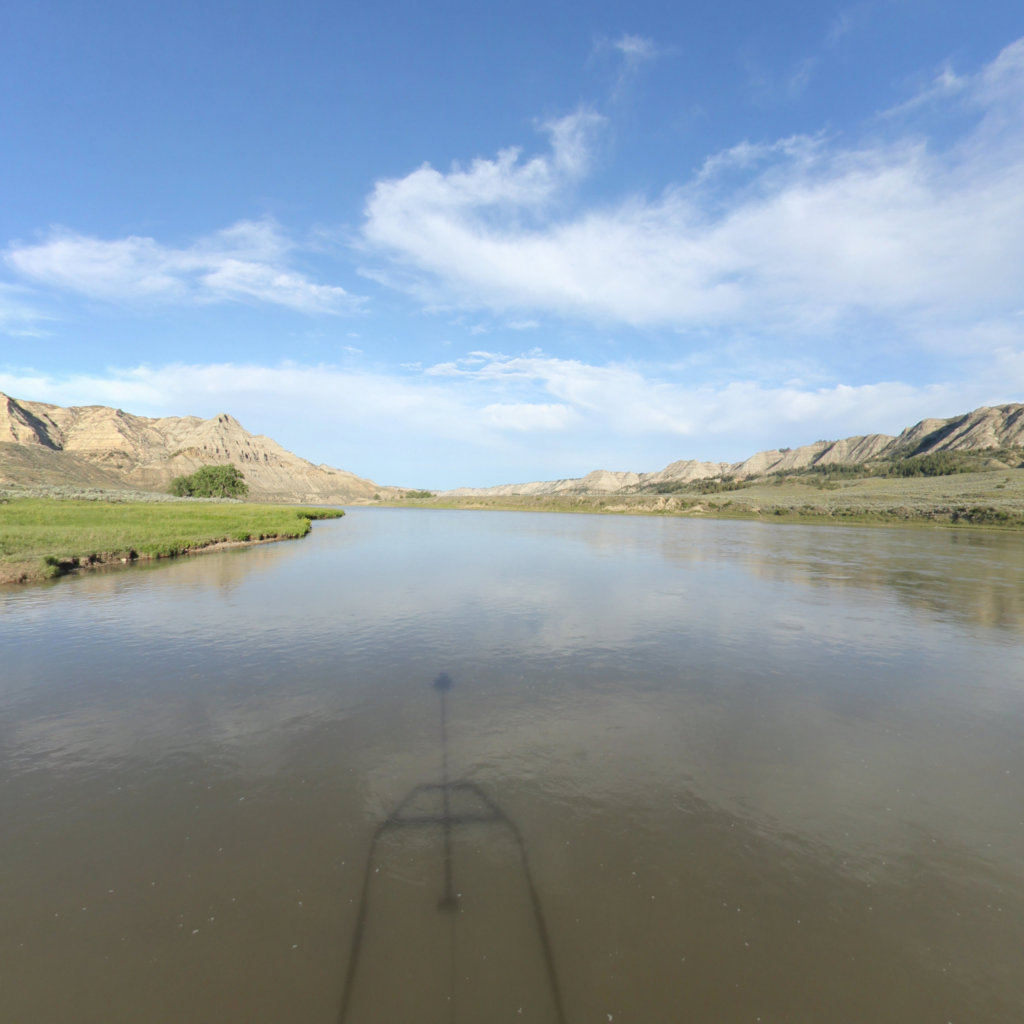
Missouri River, first view of Rocky Mountains
AI Summary

On a cloudy, rainy Friday, the expedition pushed up the Missouri with great difficulty, the men wading through cold water and struggling along slippery muddy banks and sharp rocks while towing the boats. The hemp tow rope of the white pirogue broke, nearly capsizing it. Clark gave the men a dram at noon to refresh them. The party marveled at striking white sandstone bluffs eroded into shapes resembling ruined buildings, columns, and statues, alongside curious black stone walls that looked like masonry. Hunters killed two buffalo, an elk, and a bighorn; Lewis noted an unfamiliar pine and saw a brightly colored fox.

May 31st Friday 1805. A cloudy morning we dispatched all the Canoes to
Collect the meat of 2 Buffalow killed last night a head and a little off
the river, and proceeded on with the perogues at an early hour. I
attempted to walk on Shore Soon found it verry laborious as the mud Stuck
to my mockersons & was verry Slippery. I return’d on board. it
continued to rain moderately untill about 12 oClock when it ceased, &
Continued Cloudy. the Stone on the edge of the river continue to form
verry Considerable rapids, which are troublesom & dificuelt to pass,
our toe rope which we are obliged to make use of altogether broke & we
were in Some danger of turning over in the perogue in which I was, we
landed at 12 and refreshed the men with a dram, our men are obliged to
under go great labour and fatigue in assending this part of the Missouri,
as they are compelled from the rapidity of the Current in many places to
walk in the water & on Slippery hill Sides or the Sides of rocks, on
Gravel & thro a Stiff mud bear footed, as they Cannot keep on
Mockersons from the Stiffness of the mud & decline of the Slipy. hills
Sidesthe Hills and river Clifts of this day exhibit a most
romantick appearance on each Side of the river is a white Soft Sand Stone
bluff which rises to about half the hight of the hills, on the top of this
Clift is a black earth on points, in maney places this Sand Stone appears
like antient ruins some like elegant buildings at a distance, Some like
Towers &c. &c. in maney places of this days march we observe on
either Side of the river extraodanary walls of a black Semented Stone
which appear to be regularly placed one Stone on the other, Some of those
walls run to the hite of 100 feet, they are from about 1 foot to 12 feet
thick and are perpendicular, those walls Commence at the waters edge &
in Some places meet at right anglesthose walls appear to Continue
their Course into the Sand Clifts, the Stones which form those walls are
of different Sizes all Squar edged, Great numbers has fallen off from the
walls near the river which cause the walls to be of uneaquil hite, in the
evening the Countrey becomes lower and the bottoms wider, no timber on the
uplands, except a few Cedar & pine on the Clifts a few Scattering
Cotton trees on the points in the river bottoms, The apparance of Coal
Continus Capt Lewis walked on Shore & observed a Species of Pine we
had never before Seen, with a Shorter leaf than Common & the bur
different, he also Collected Some of the Stone off one of the walls which
appears to be a Sement of Isin glass black earth we Camped on the Stard
Side in a Small timbered bottom above the mouth of a Creek on the Stard
Side our hunters killed, 2 animals with big horns, 2 Buffalow & an
Elk, we Saw Great numbers of those big horned animals on the Clifts, but
fiew Buffalow or Elk, no antelope, a fiew mule deer, Saw a fox to day. The
river rises a little it is from 150 to 250 yds. wide

May 31st Friday 1805 Cloudy morning, we proceeded on at an early hour with
the two Perogues leaving the Canoes and crews to bring on the meat of two
Buffalow that were killed last evening and which had not been brought in
as it was late and a little off the river. Soon after we got under way it
began to rain and Continued untill 12 oClock when it Seased but Still
remained cloudy through the ballance of the day. the obstructions of rocky
points and riffles Still continue as yesterday; at those places the men
are compelled to be in the water even to their armpits, and the water is
yet very cold, and So frequent are those points that they are one fourth
of their time in the water. added to this the bank and bluff along which
they are obliged to pass are So Slippery and the mud So tenatious that
they are unable to bare their mockersons, and in that Situation dragging
the heavy burthen of a Canoe and Walking occasionally for Several hundred
yards over the Sharp fragments of rocks which tumble from the Clifts; and
in Short their labour is incredibly painfull and great, yet those
faithfull fellows bear it without a murmer.

The toe rope of the white perogue, the only one indeed of hemp, and that
on which we most depended, gave way to day at a bad point, the perogue
Swong and but slightly touched a rock, yet was very near oversetting; I
fear her evil Ginnie will play So many pranks with her that She will go to
the bottom Some of those days.

I attempted to walk on Shore this morning but found it so excessivily bad
that I Soon returned on board. at 12 oClock we came too for refreshment
and gave the men a dram which they received with much Chearfulness, and
well deserved all wet and disagreeable. Capt. Lewis walked on Shore, he
informed one that he Saw “the most butifull fox in the world” the Colour
appeared to him to be of a fine Orrange yellow, white and black, he fired
at this fox running and missed him, he appeared to be about the size of
the common red fox of the united States, or rather smaller.

The hills and river clifts which we pass to day exhibit a most romantic
appearance. The Bluffs of the river rise to the hight of from 2 to 300
feet and in most places nearly perpendicular; they are formed of
remarkable white Sandstone which is Sufficiently Soft to give way readily
to the impression of water; two or three thin horizontal Stratas of white
free Stone, on which the rains or water make no impression, lie imbeded in
those clifts of Soft Stone near the upper part of them; the earth on the
top of these clifts is a dark rich loam, which forming a gradual ascending
plain extend back from 1/2 a mile to a mile where the hills commence and
rise abruptly to the hight of about 300 feet more. The water in the Course
of time acecending from those hills and plains on either Side of the river
has trickled down the Soft Sand Clifts and woarn it into a thousand
grotesque figures; which with the help of a little imagination and an
oblique view at a distance are made to represent elegant ranges of lofty
freestone buildings, haveing their parapets well Stocked with Statuary;
Colloms of various Sculptures both Grooved and plain, are also Seen
Supporting long galleries in part of those buildings; in other places on a
much nearer approach and with the with the help of less immagination we
See the remains of ruins of eligant buildings; Some Collumns Standing and
almost entire with their pedestals and Capitals, others retaining their
pedestals but deprived by time or accedint of their capitals, Some lying
prostrate and broken, others in the form of vast Pyramids of connic
Structure bearing a Serious of other pyramids on their tops becomeing less
as they ascend and finally termonateing in a Sharp point. nitches and
alcoves of various forms and Sizes are Seen at different hights as we
pass. a number of the Small martin which build their nests with Clay of a
globular form attached to the wall within those nitches, and which were
Seen hovering about the top of the collumns did not the less remind us of
Some of those large Stone buildings in the United States. The thin Stratas
of hard free Stone intermixed with the Soft Sand Stone Seems to have aided
the water in forming this Curious Scenery.

as we passed on it Seemed as if those Seens of Visionary enchantment would
never have an end; for here it is too that nature presents to the view of
the traveler vast ranges of walls of tolerable workmanship, So perfect
indeed are those walls that I Should have thought that nature had
attempted here to rival the human art of Masonry had I not recollected
that She had first began her work. These walls rise to the hight in many
places of 100 feet, are perpindicular, with two regular faces, and are
from one to 12 feet thick, each wall retains the Same thickness to the top
which it possesses at bottom. The Stone of which these walls are formed is
black, dense and dureable, and appears to be Composed of a large portion
of earth intermixed or Cemented with a Small quantity of Sand and a
Considerable portion of quarts. these Stones are almost invariably regular
parallelepipeds, of unequal Sizes in the wall, but equal in their
horizontal ranges, at least as to debth. These are laid regularly in
ranges on each other like bricks, each breaking or covering this
interstice of the two on which it rests, thus the pirpendicular
interstices are broken, and the horizontal ones extend entire throughout
the whole extent of the walls. These Stones Seam to bear Some proportion
to the thickness of the walls in which they are employd, being larger in
the thicker walls; the greatest length of the parallelepiped appear to
form the thickness of the thiner walls, while two or more are employed to
form that of the thicker walls. Those walls pass the river in Several
places rising from the waters edge much above the Sand Stone Bluffs, which
they Seam to penetrate; thence Continueing their course on a Streight line
on either Side of the river thorough the gradually ascending plains over
which they tower to the hight of from ten to 90 feet untill they reach the
hills which they finally enter and Conceal themselves. these walls
Sometimes run parallel to each other, with Several ranges near each other,
and at other times intersecting each other at right angles, haveing the
appearance of the walls of ancient houses or gardins. both Capt Lewis and
My self walked on Shore this evening and examined those walls minutely and
preserved a Specimine of the Stone.I found many clifts of very
excellent free Stone of a light yellowish brown Colour. Capt. Lewis
observed a Species of pine which I had never Seen, it differs from the
pitch pine in the particular of its leaf and Cone, the first being partly
Shorter, and the latter considerably longer and more pointed. The
appearance of Coal Continues but in Smaller quantities, but little
appearance of burnt hills or pumicestone. the mineral Salt in Some measure
have abated and no quarts. we Saw a great number of the Big Horn, Some
mule deer, and a few Buffalow and Elk, no antelopes or Common Deer-. Capt.
Lewis killed a Big horn animal. the party killed 2 Buffalow one Elk and a
Big horn or Ibex to day-. The river has been from 150 to 250 yards wide
but little timber on the river to day. river less muddy than it was below.

Read this entry in modern English AI-translated

May 31st, Friday 1805. A cloudy morning. We dispatched all the canoes to collect the meat of 2 buffalo killed last night ahead and a little off the river, and proceeded on with the pirogues at an early hour. I attempted to walk on shore, but soon found it very laborious as the mud stuck to my moccasins and was very slippery. I returned on board. It continued to rain moderately until about 12 o'clock when it ceased, and continued cloudy. The stones on the edge of the river continue to form very considerable rapids, which are troublesome and difficult to pass. Our tow rope, which we are obliged to make use of altogether, broke, and we were in some danger of turning over in the pirogue I was in. We landed at 12 and refreshed the men with a dram. Our men are obliged to undergo great labor and fatigue in ascending this part of the Missouri, as they are compelled, from the rapidity of the current in many places, to walk in the water and on slippery hillsides or the sides of rocks, on gravel and through stiff mud barefooted, as they cannot keep on moccasins because of the stiffness of the mud and the slope of the slippery hillsides.

The hills and river cliffs of this day exhibit a most romantic appearance. On each side of the river is a white soft sandstone bluff which rises to about half the height of the hills. On the top of this cliff is a black earth on points. In many places this sandstone appears like ancient ruins—some like elegant buildings at a distance, some like towers, etc., etc. In many places of this day's march we observe on either side of the river extraordinary walls of a black cemented stone which appear to be regularly placed one stone on the other. Some of those walls run to the height of 100 feet; they are from about 1 foot to 12 feet thick and are perpendicular. Those walls commence at the water's edge and in some places meet at right angles. Those walls appear to continue their course into the sand cliffs. The stones which form those walls are of different sizes, all square-edged. Great numbers have fallen off from the walls near the river, which causes the walls to be of unequal height.

In the evening the country becomes lower and the bottoms wider. There is no timber on the uplands, except a few cedar and pine on the cliffs, and a few scattered cottonwood trees on the points in the river bottoms. The appearance of coal continues. Capt Lewis (Capt. Lewis) walked on shore and observed a species of pine we had never before seen, with a shorter leaf than common and the cone different. He also collected some of the stone off one of the walls, which appears to be a cement of isinglass and black earth. We camped on the starboard side in a small timbered bottom above the mouth of a creek on the starboard side. Our hunters killed 2 animals with big horns, 2 buffalo, and an elk. We saw great numbers of those bighorn animals on the cliffs, but few buffalo or elk, no antelope, and a few mule deer. Saw a fox today. The river rises a little; it is from 150 to 250 yards wide.

May 31st, Friday 1805. Cloudy morning. We proceeded on at an early hour with the two pirogues, leaving the canoes and crews to bring on the meat of two buffalo that were killed last evening and which had not been brought in, as it was late and a little off the river. Soon after we got under way it began to rain and continued until 12 o'clock when it ceased, but it still remained cloudy through the balance of the day. The obstructions of rocky points and riffles still continue as yesterday. At those places the men are compelled to be in the water even to their armpits, and the water is yet very cold, and so frequent are those points that they are one fourth of their time in the water. Added to this, the bank and bluff along which they are obliged to pass are so slippery and the mud so tenacious that they are unable to wear their moccasins, and in that situation, dragging the heavy burden of a canoe and walking occasionally for several hundred yards over the sharp fragments of rocks which tumble from the cliffs, in short, their labor is incredibly painful and great, yet those faithful fellows bear it without a murmur.

The tow rope of the white pirogue, the only one indeed of hemp, and that on which we most depended, gave way today at a bad point. The pirogue swung and but slightly touched a rock, yet was very near oversetting. I fear her evil genie will play so many pranks with her that she will go to the bottom some of those days.

I attempted to walk on shore this morning but found it so excessively bad that I soon returned on board. At 12 o'clock we came to for refreshment and gave the men a dram, which they received with much cheerfulness, and well deserved, all wet and disagreeable. Capt. Lewis walked on shore. He informed me that he saw "the most beautiful fox in the world." The color appeared to him to be of a fine orange-yellow, white, and black. He fired at this fox running and missed him. It appeared to be about the size of the common red fox of the United States, or rather smaller.

The hills and river cliffs which we pass today exhibit a most romantic appearance. The bluffs of the river rise to the height of from 200 to 300 feet, and in most places nearly perpendicular. They are formed of remarkable white sandstone which is sufficiently soft to give way readily to the impression of water. Two or three thin horizontal strata of white freestone, on which the rains or water make no impression, lie embedded in those cliffs of soft stone near the upper part of them. The earth on the top of these cliffs is a dark rich loam, which, forming a gradual ascending plain, extends back from half a mile to a mile, where the hills commence and rise abruptly to the height of about 300 feet more. The water, in the course of time descending from those hills and plains on either side of the river, has trickled down the soft sand cliffs and worn them into a thousand grotesque figures, which, with the help of a little imagination and an oblique view at a distance, are made to represent elegant ranges of lofty freestone buildings, having their parapets well stocked with statuary. Columns of various sculptures, both grooved and plain, are also seen supporting long galleries in part of those buildings. In other places, on a much nearer approach and with the help of less imagination, we see the remains or ruins of elegant buildings—some columns standing and almost entire with their pedestals and capitals, others retaining their pedestals but deprived by time or accident of their capitals, some lying prostrate and broken, others in the form of vast pyramids of conic structure bearing a series of other pyramids on their tops, becoming smaller as they ascend and finally terminating in a sharp point. Niches and alcoves of various forms and sizes are seen at different heights as we pass. A number of the small martins, which build their nests with clay of a globular form attached to the wall within those niches, and which were seen hovering about the top of the columns, did not the less remind us of some of those large stone buildings in the United States. The thin strata of hard freestone intermixed with the soft sandstone seem to have aided the water in forming this curious scenery.

As we passed on, it seemed as if those scenes of visionary enchantment would never have an end, for here it is too that nature presents to the view of the traveler vast ranges of walls of tolerable workmanship. So perfect indeed are those walls that I should have thought that nature had attempted here to rival the human art of masonry, had I not recollected that she had first begun her work. These walls rise to the height in many places of 100 feet, are perpendicular, with two regular faces, and are from one to 12 feet thick. Each wall retains the same thickness to the top which it possesses at the bottom. The stone of which these walls are formed is black, dense, and durable, and appears to be composed of a large portion of earth intermixed or cemented with a small quantity of sand and a considerable portion of quartz. These stones are almost invariably regular parallelepipeds, of unequal sizes in the wall, but equal in their horizontal ranges, at least as to depth. These are laid regularly in ranges on each other like bricks, each breaking or covering the interstice of the two on which it rests. Thus the perpendicular interstices are broken, and the horizontal ones extend entire throughout the whole extent of the walls. These stones seem to bear some proportion to the thickness of the walls in which they are employed, being larger in the thicker walls. The greatest length of the parallelepiped appears to form the thickness of the thinner walls, while two or more are employed to form that of the thicker walls. Those walls pass the river in several places, rising from the water's edge much above the sandstone bluffs, which they seem to penetrate, thence continuing their course in a straight line on either side of the river through the gradually ascending plains, over which they tower to the height of from ten to 90 feet, until they reach the hills, which they finally enter and conceal themselves in. These walls sometimes run parallel to each other, with several ranges near each other, and at other times intersect each other at right angles, having the appearance of the walls of ancient houses or gardens. Both Capt Lewis (Capt. Lewis) and myself walked on shore this evening and examined those walls minutely and preserved a specimen of the stone.

I found many cliffs of very excellent freestone of a light yellowish-brown color. Capt. Lewis observed a species of pine which I had never seen. It differs from the pitch pine in the particulars of its leaf and cone, the first being somewhat shorter, and the latter considerably longer and more pointed. The appearance of coal continues, but in smaller quantities. There is little appearance of burnt hills or pumice stone. The mineral salt has in some measure abated, and there is no quartz. We saw a great number of the bighorn, some mule deer, and a few buffalo and elk, but no antelope or common deer. Capt. Lewis killed a bighorn animal. The party killed 2 buffalo, one elk, and a bighorn or ibex today. The river has been from 150 to 250 yards wide, but there is little timber on the river today. The river is less muddy than it was below.

This modernization is AI-generated for accessibility. The original above is the authoritative version.

Our Partners