
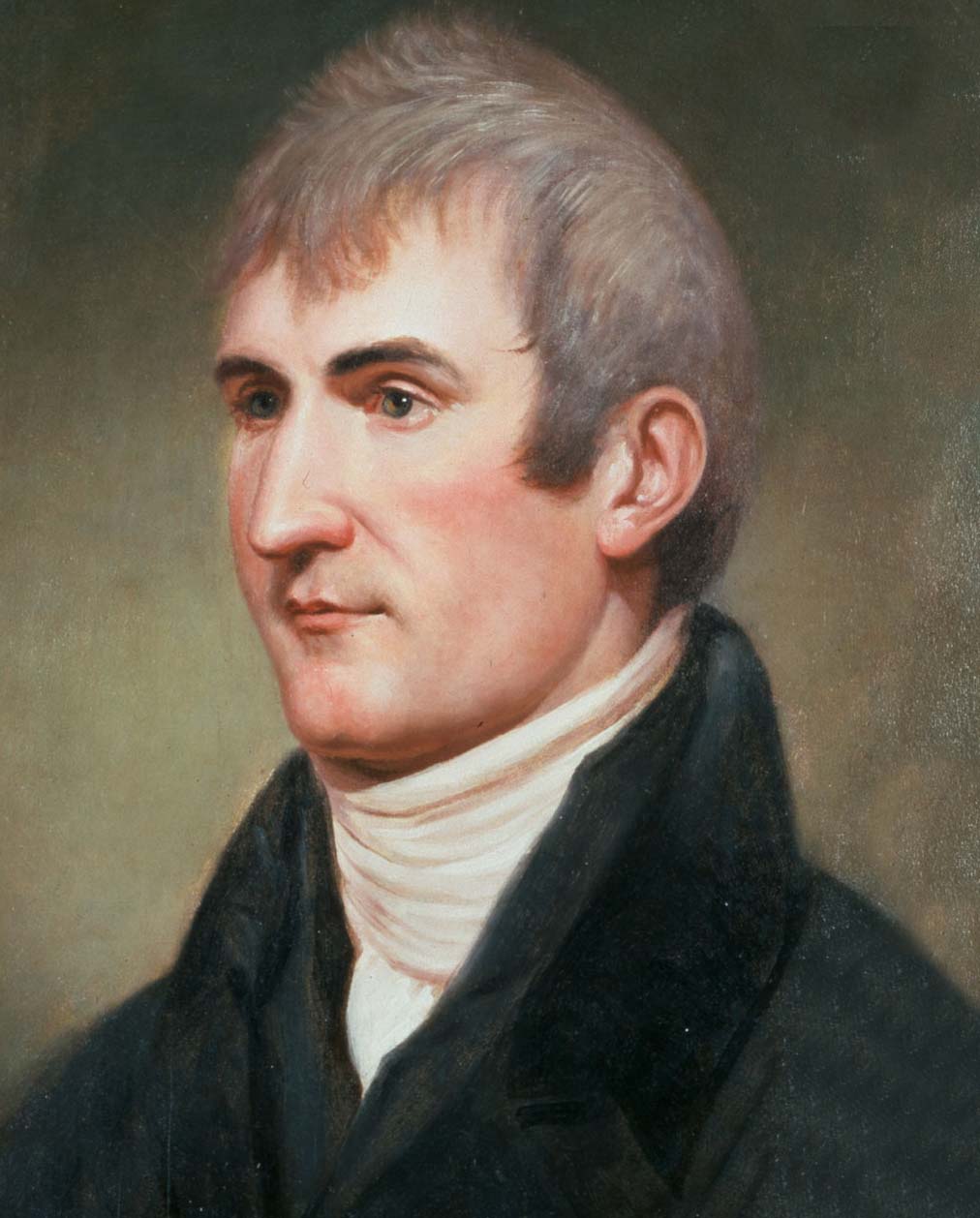
Introduction
Auguste Chouteau (1749–1829), co-founder of St. Louis and patriarch of its dominant mercantile family, is woven throughout the Lewis and Clark journals less as a participant than as a constant background presence: outfitter, host, correspondent, and proprietor of trading expeditions whose boats the Corps repeatedly crossed on the Missouri. The journal record does not describe his life or person; it shows him in his commercial and civic role as the expedition’s principal St. Louis connection. Where the journals are silent on his biography, this synthesis remains silent as well.
Outfitting at the Mouth of the Missouri (May 1804)
Chouteau’s name first enters the record during the expedition’s final preparations at River Dubois and St. Charles. On May 18, 1804, William Clark recorded the receipt of tobacco from Chouteau’s account as the boats were being reloaded:
I had the Boat & Pierogue reloded So as to Cause them to be heavyer in bow than asturn recved of Mr. Lyon 136 lb. Tobacco on act. of Mr. Choteau Gave out tin Cups & 3 Knives to the French hands…
Two days later, on May 20, 1804, Clark listed Chouteau among the "Officers & Several Gentlemen of St Louis" who arrived at St. Charles in a heavy shower:
Capt. Lewis Capt. Stoddard accompanied by the Officers & Several Gentlemen of St Louis arrived in a heavy Showr of Rain Mssr. Lutenants Minford & Werness. Mr. Choteau Grattiot, Deloney, Laber Dee Ranken Dr. SoDrang…
Meriwether Lewis, in his own entry of May 20, 1804, named him more formally as "A. Chouteau" and recorded the social farewell that bracketed the expedition’s departure:
I was joined by Capt. Stoddard, Lieuts. Milford & Worrell together with Messrs. A. Chouteau, C. Gratiot, and many other respectable inhabitants of St. Louis, who had engaged to accompany me to the Vilage of St. Charles…
Lewis’s same entry also records his "affectionate adieu" to the spouse of Pierre Chouteau (Auguste’s half-brother), a reminder that several Chouteaus circulated through the expedition’s St. Louis world.
Chouteau’s Reach into Indian Country
The journals show that Chouteau’s commercial influence ran far up the Missouri and into the Osage country. On May 31, 1804, Clark recorded news brought down to the Corps from the Grand Osage by a courier returning to St. Louis:
a Cajaux of Bear Skins and pelteries came down from the Grand Osarge, one french man one Indian, and a Squar, they had letters from the man Mr. Choteau Sent to that part of the Osarge Nation Settled on Arkansa River mentioning that his letter was Commited to the flaims, the Inds. not believeing that the Americans had possession of the Countrey they disregarded St Louis & their Supplies…
This passage is the journal record’s most substantive glimpse of Chouteau’s diplomatic-commercial role: he was attempting, even as the Corps moved upriver, to communicate American sovereignty to Osage bands that had migrated to the Arkansas — and his letter had been burned.
Encounters on the River (1804)
Joseph Whitehouse twice recorded the same encounter, dated June 9, 1804 in one rendering and June 12, 1804 in another, in which the Corps met a flotilla of his peltry boats descending the Missouri:
Met with 7 peirogues. Loaded with peltry for Cap’^o Chatto [Chouteau] in S! Louis Our men of Each Craft Exchang’d Blankets for Buffalow Robes & Mockisons…
The note’s editorial gloss identifies "Chatto" as Chouteau, and the encounter shows the scale of his returns: seven loaded pirogues bound for St. Louis from the upper river.
Geographic Echoes
The Chouteau name is also affixed to the country itself. John Ordway’s editor identifies Chouteau Creek on September 6, 1804 ("Modern Chouteau Creek, which empties into the Missouri near the western boundary of Bonhomme County, S. Dak.") and again on September 24, 1804. The same family name attaches to Chouteau County in Montana, repeatedly noted as a geographic landmark in Ordway’s entries of May 20, 1805, June 15, 1805, June 17, 1805, and August 1, 1806. These are place-name references rather than personal appearances, but they testify to how thoroughly the family’s commercial reach mapped onto the territory the expedition was crossing.
Re-encounters on the Return Voyage (September 1806)
The richest cluster of Chouteau references comes on the descent of the Missouri, when the Corps repeatedly met traders working out of St. Louis under his auspices. On September 6, 1806, Clark wrote:
at the lower point of Pelecan Island a little above the Petite River de Seeoux we met a tradeing boat of Mr. Ag. Choteaux of St Louis bound to the River Jacque to trade with the Yanktons, this boat was in Care of a Mr. Henry Delorn… we purchased a gallon of whiskey of this man and gave to each man of the party a dram which is the first Spiritious licquor which had been tasted by any of them Since the 4 of July 1805.
This is the journals’ clearest identification — "Mr. Ag. Choteaux of St Louis" — confirming Auguste (rather than Pierre) as the proprietor. Ordway’s entry of the same day, edited under the name September 10, 1806, supplies the editorial footnote "Auguste Chouteau" explicitly.
Encounters multiplied as the Corps neared St. Louis. Ordway, on September 12, 1806, recorded:
we met 2 two canoes and 11 frenchman 1 of which was loaded with Mr Shotoes [Chouteau’s] goods from S’ Louis the others going up trapping…
Clark’s parallel entry for September 12, 1806 identified the destination: "one contained the property of Mr. Choteau bound to the panias on River Platt" — a Pawnee-bound trading venture on the Platte. Each meeting offered news of home, gifts of whiskey, and confirmation that Chouteau’s network was actively pushing trade up every tributary the expedition had explored.
Homecoming in St. Louis
The final, and most personal, journal mention comes on September 25, 1806, two days after the Corps’s arrival. Clark wrote:
had all of our Skins &c. Suned and Stored away in a Storeroom of Mr. Caddy Choteau. payed Some visits of form, to the gentlemen of St. Louis. in the evening a dinner & Ball
"Caddy" here is generally read as a familiar form for Auguste (the editorial conventions of the period sometimes rendered his name in such variants). The expedition’s ethnographic and natural-history collections — the very tangible product of two and a half years’ labor — were lodged in his storeroom. It is a fitting bookend: Chouteau’s tobacco helped load the boats in May 1804, and Chouteau’s storehouse received the skins in September 1806.
What the Journals Do Not Say
The journal record, taken on its own terms, contains no description of Chouteau’s appearance, no record of conversation with him, and no portrait of his household beyond Lewis’s brief farewell to the wife of his half-brother Pierre. He is named eight or nine times directly and is implied in many more references to "Mr. Choteau’s" boats, goods, employees, and accounts. What the journals preserve is his function: the commercial and civic infrastructure that made the expedition possible at its outset, sustained American claims to the Osage country during its absence, populated the river with traders during its return, and received its specimens at journey’s end.
Narrators
Auguste Chouteau is mentioned by William Clark, Meriwether Lewis, John Ordway, and Joseph Whitehouse — every principal journal-keeper of the expedition save Patrick Gass in the entries surveyed here. The convergence is itself revealing: no other St. Louis civilian touches the record at so many points or from so many hands.


