Clark: October 31, 1805
October 31st Thursday 1805 a cloudey raney morning I proceed down the
river to view it more at leasure, I took Jos. Fields & Peter Crusat
and proceeded on down, Send Crusat back at 2 ms. to examine the rapid near
the shore & I proceeded on down about 10 miles to a very high rock in
a bottom on the Stard. opsd. 2 Islands covered with timber on which I saw
Inds. at a distance; found the river rocky for 6 miles, after which the
Current became uniformat 1 mile I passed an old deserted village on
a Pond on a high Situation of 8 Housesat 31/2 miles one house the
only remt. of an antient Village 1/2 a mile lower I saw 8 Vaults for the
Dead which was nearly Square 8 feet Closely Covered with broad boads
Curiously engraved, the bones in Some of those vaults wer 4 feet thick, in
others the Dead was yet layed Side of each other nearly East & west,
raped up & bound Securley in robes, great numbers of trinkets Brass
Kittle, Sea Shells, Iron, Pan Hare &c. &c. was hung about the
vaults and great many wooden gods, or Images of men Cut in wood, Set up
round the vaults, Some of those So old and worn by time that they were
nearly worn out of Shape, and Some of those vaults So old that they were
roted entirely to the groundnotwithstanding they wood is of Pine
& _____ or Seder as also the wooden gods
I can not learn certainly if those people worship those woden emiges, they
have them in conspicuous parts of their houses at 5 miles I passed 4 large
houses on the Stard Side a little above the last rapid and opposit a large
Island which is Situated near the Lard. SideThe enhabitents of
those houses had left them closely Shut up, they appeared to Contn. a
great deel of property and Provisions Such as those people use, I did not
disturb any thing about those houses, but proceed on down below the rapid
which I found to be the last, a large village has at Some period been on
the Stard. Side below this rapid The bottom is high Stoney and about 2
miles wide covered with grass, here C is the head of a large Island in
high water, at this time no water passes on the Stard. Side I walked thro
this Island which I found to be verry rich, open & covered with
Strawberry vines, and has greatly the appearance of having at Some period
been Cultivated, The natives has dug roots in Some parts of this Isld.
which is about 3 miles long & 1 Wide, a Small Island covered with
timber opposit the lower point no water runs on the Stard. Side. of it.
below and in the middle of the river is a large Island Covered with tall
trees opposit the Strawberry Island on its Stard. Side a creek falls in
which has no running water at present, it has the appearanc of throwing
out emense torentsI saw 5 Indians in a canoe belowJo. killed
a Sand hill Crane & we returned by the same rout to camp at the grand
Shute where I found Several Indians, I Smoked. Two canoes loaded with fish
for the Trade below Came down & unloaded the after noon fare
Those Indians Cut off the hands of those they kill & proserve the
fingers.
—
October 31st Thursday 1805 A Cloudy rainey disagreeable morning I
proceeded down the river to view with more attention we had to pass on the
river below, the two men with me Jo. Fields & Peter Crusat proceeded
down to examine the rapids the Great Shute which commenced at the Island
on which we encamped Continud with great rapidity and force thro a narrow
chanel much compressd. and interspersed with large rocks for 1/2 a mile,
at a mile lower is a verry Considerable rapid at which place the waves are
remarkably high, and proceeded on in a old Indian parth 21/2 miles by land
thro a thick wood & hill Side, to the river where the Indians make a
portage, from this place I dispatched Peter Crusat (our principal
waterman) back to follow the river and examine the practibility of the
Canoes passing, as the rapids appeared to continue down below as far as I
could See, I with Jo. Fields proceeded on, at 1/2 a mile below the end of
the portage passed a house where there had been an old town for ages past
as this house was old Decayed and a plat of flees I did not enter it,
about 1/2 a mile below this house in a verry thick part of the woods is 8
vaults which appeared Closely Covered and highly deckerated with
orniments. Those vaults are all nearly the Same Sise and form 8 feet
Square, 5 feet high, Sloped a little So as to convey off the rain made of
Pine or Cedar boards Closely Connected & Scurely Covered with wide
boards, with a Dore left in The East Side which is partially Stoped with
wide boards curiously engraved. In Several of those vaults the dead bodies
wre raped up verry Securely in Skins tied around with cords of grass &
bark, laid on a mat, all east & west and Some of those vaults had as
maney as 4 bodies laying on the Side of each other. the other Vaults
Containing bones only, Some contained bones for the debth of 4 feet. on
the tops and on poles attached to those vaults hung Brass kitties &
frying pans pearced thro their bottoms, baskets, bowls of wood, Sea Shels,
Skins, bits of Cloth, Hair, bags of Trinkets & Small peices of bone
&c and independant of the curious ingraveing and Paintings on the
boards which formed the vaults I observed Several wooden Images, cut in
the figure of men and Set up on the Sides of the vaults all round. Some of
those So old and worn by time, that they were nearly out of Shape, I also
observed the remains of Vaults rotted entirely into the ground and covered
with moss. This must bee the burrying place for maney ages for the
inhabitants of those rapids, the vaults are of the most lasting timber
Pine & CedarI cannot Say certainly that those nativs worship
those wooden idols as I have every reason to believe they do not; as they
are Set up in the most conspicious parts of their houses, and treated more
like orniments than objects of aderation. at 2 miles lower & 5 below
our Camp I passed a village of 4 large houses abandend by the nativs, with
their Bores bared up, I looked into those houses and observed as much
property as is usial in the houses of those people which induced me to
conclude that they wre at no great distance, either hunting or Colecting
roots, to add to their winter Subsistance. from a Short distance below the
vaults the mountain which is but low on the Stard. Side leave the river,
and a leavel Stoney open bottom Suckceeds on the Said Std. Side for a
great Distance down, the mountains high and rugid on the Lard Side this
open bottom is about 2 miles a Short distance below this village is a bad
Stoney rapid and appears to be the last in view I observed at this lower
rapid the remains of a large and antient Village which I could plainly
trace by the Sinks in which they had formed their houses, as also those in
which they had buried their fishfrom this rapid to the lower end of
the portage the river is Crouded with rocks of various Sizes between which
the water passes with great velociety createing in maney places large
Waves, an Island which is Situated near the Lard. Side occupies about half
the distance the lower point of which is at this rapid. immediately below
this rapid the high water passes through a narrow Chanel through the
Stard. Bottom forming an Island of 3 miles Long & one wide, I walked
through this Island which I found to be verry rich land, and had every
appearance of haveing been at Some distant period Cultivated. at this time
it is Covered with grass intersperced with Strawberry vines. I observed
Several places on this Island where the nativs had dug for roots and from
its lower point I observed 5 Indians in a Canoe below the upper point of
an Island near the middle of the river Covered with tall timber, which
indued me to believe that a village was at no great distanc below, I could
not See any rapids below in the extent of my view which was for a long
distance down the river, which from the last rapids widened and had everry
appearance of being effected by the tide,I deturmind to return to
Camp 10 miles distant, a remarkable high detached rock Stands in a bottom
on the Stard Side near the lower point of this Island on the Stard. Side
about 800 feet high and 400 paces around, we call the Beaten rock. a Brook
falls into the narrow Chanel which forms the Strawberry Island, which at
this time has no running water, but has every appearance of dischargeing
emence torrents &c. &c. Jo. Fields Shot a Sand hill Crane. I
returned by the Same rout on an Indian parth passing up on the N W. Side
of the river to our Camp at the Great Shute. found Several Indians from
the village, I Smoked with them; Soon after my return two Canoes loaded
with fish & Bear grass for the trade below, came down,from the village
at the mouth of the Catterack River, they unloaded and turned their Canoes
up Side down on the beech, & camped under a Shelveing rock below our
Camp
one of the men Shot a goose above this Great Shute, which was floating
into the Shute when an Indian observed it, plunged into the water &
Swam to the Goose and brought in on Shore, at the head of the Suck, as
this Indian richly earned the goose I Suffered him to keep it which he
about half picked and Spited it up with the guts in it to roste.
This Great Shute or falls is about 1/2 a mile with the water of this great
river Compressed within the Space of 150 paces in which there is great
numbers of both large and Small rocks, water passing with great velocity
forming & boiling in a most horriable manner, with a fall of about 20
feet, below it widens to about 200 paces and current gentle for a Short
distance. a Short distance above is three Small rockey Islands, and at the
head of those falls, three Small rockey Islands are Situated Crosswise the
river, Several rocks above in the river & 4 large rocks in the head of
the Shute; those obstructions together with the high Stones which are
continually brakeing loose from the mountain on the Stard Side and roleing
down into the Shute aded to those which brake loose from those Islands
above and lodge in the Shute, must be the Cause of the rivers darning up
to Such a distance above, where it Shows Such evidant marks of the Common
current of the river being much lower than at the present day
Entities mentioned in this entry
Auto-extracted from the entry text. Hover any entity for context.
Terrain360 · the place today
Cascades of the Columbia, portage in 360°
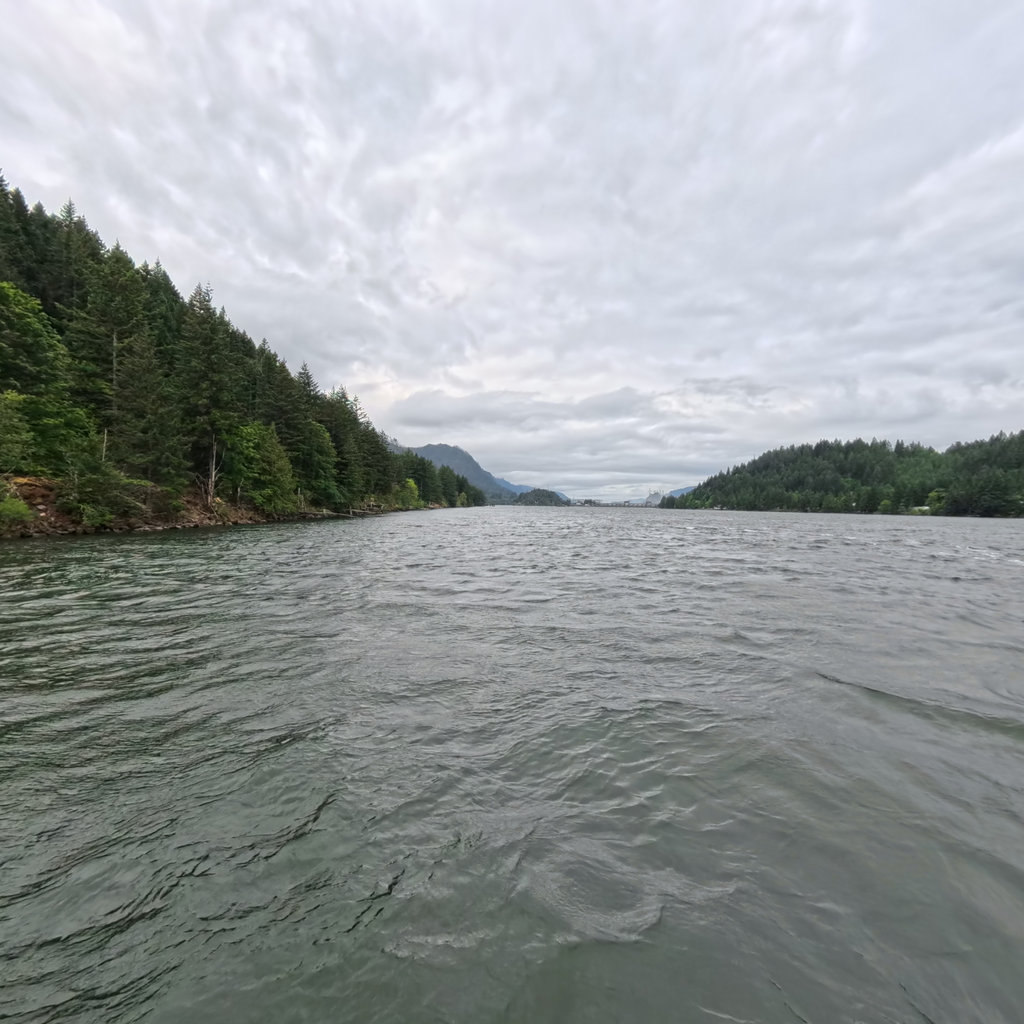
10 frames across 1.5 mi of the route around this location
Analyses
Artwork
Help improve this record
See something that needs correcting, or know a source we are missing? The archive gets better through its readers.


