Lewis: August 13, 1805
Tuesday August 13th 1805. We set out very early on the Indian road which
still led us through an open broken country in a westerly direction. a
deep valley appeared to our left at the base of a high range of mountains
which extended from S. E. to N. W. having their sides better clad with
pine timber than we had been accustomed to see the mountains and their
tops were also partially covered with snow. at the distance of five miles
the road after leading us down a long decending valley for 2 Ms. brought
us to a large creek about 10 yds. wide; this we passed and on rising the
hill beyond it had a view of a handsome little valley to our left of about
a mile in width through which from the appearance of the timber I
conjectured that a river passed. I saw near the creek some bushes of the
white maple, the shumate of the small species with the winged rib, and a
species of honeysuckle much in it’s growth and leaf like the small
honeysuckle of the Missouri only reather larger and bears a globular berry
as large as a garden pea and as white as wax. this berry is formed of a
thin smooth pellicle which envellopes a soft white musilagenous substance
in which there are several small brown seed irregularly scattered or
intermixed without any sell or perceptable membranous covering.we
had proceeded about four miles through a wavy plain parallel to the valley
or river bottom when at the distance of about a mile we saw two women, a
man and some dogs on an eminence immediately before us. they appeared to
vew us with attention and two of them after a few minutes set down as if
to wait our arrival we continued our usual pace towards them. when we had
arrived within half a mile of them I directed the party to halt and
leaving my pack and rifle I took the flag which I unfurled and avanced
singly towards them the women soon disappeared behind the hill, the man
continued untill I arrived within a hundred yards of him and then likewise
absconded. tho I frequently repeated the word tab-ba-bone sufficiently
loud for him to have heard it. I now haistened to the top of the hill
where they had stood but could see nothing of them. the dogs were less
shye than their masters they came about me pretty close I therefore
thought of tying a handkerchief about one of their necks with some beads
and other trinkets and then let them loose to surch their fugitive owners
thinking by this means to convince them of our pacific disposition towards
them but the dogs would not suffer me to take hold of them; they also soon
disappeared. I now made a signal fror the men to come on, they joined me
and we pursued the back tarck of these Indians which lead us along the
same road which we had been traveling. the road was dusty and appeared to
have been much traveled lately both by men and horses. these praries are
very poor the soil is of a light yellow clay, intermixed with small smooth
gravel, and produces little else but prickly pears, and bearded grass
about 3 inches high. the prickley pear are of three species that with a
broad leaf common to the missouri; that of a globular form also common to
the upper part of the Missouri and more especially after it enters the
Rocky Mountains, also a 3rd peculiar to this country. it consists of small
circular thick leaves with a much greater number of thorns. these thorns
are stronger and appear to be barbed. the leaves grow from the margins of
each other as in the broad leafed pear of the missouri, but are so
slightly attatched that when the thorn touches your mockerson it adhears
and brings with it the leaf covered in every direction with many others.
this is much the most troublesome plant of the three. we had not continued
our rout more than a mile when we were so fortunate as to meet with three
female savages. the short and steep ravines which we passed concealed us
from each other untill we arrived within 30 paces. a young woman
immediately took to flight, an Elderly woman and a girl of about 12 years
old remained. I instantly laid by my gun and advanced towards them. they
appeared much allarmed but saw that we were to near for them to escape by
flight they therefore seated themselves on the ground, holding down their
heads as if reconciled to die which the expected no doubt would be their
fate; I took the elderly woman by the hand and raised her up repeated the
word tab-babone and strip up my shirt sieve to sew her my skin; to prove
to her the truth of the ascertion that I was a white man for my face and
hads which have been constantly exposed to the sun were quite as dark as
their own. they appeared instantly reconciled, and the men coming up I
gave these women some beads a few mockerson awls some pewter
looking-glasses and a little paint. I directed Drewyer to request the old
woman to recall the young woman who had run off to some distance by this
time fearing she might allarm the camp before we approached and might so
exasperate the natives that they would perhaps attack us without enquiring
who we were. the old woman did as she was requested and the fugitive soon
returned almost out of breath. I bestoed an equvolent portion of trinket
on her with the others. I now painted their tawny cheeks with some
vermillion which with this nation is emblematic of peace. after they had
become composed I informed them by signs that I wished them to conduct us
to their camp that we wer anxious to become acquainted with the chiefs and
warriors of their nation. they readily obeyed and we set out, still
pursuing the road down the river. we had marched about 2 miles when we met
a party of about 60 warriors mounted on excellent horses who came in
nearly full speed, when they arrived I advanced towards them with the flag
leaving my gun with the party about 50 paces behid me. the chief and two
others who were a little in advance of the main body spoke to the women,
and they informed them who we were and exultingly shewed the presents
which had been given them these men then advanced and embraced me very
affectionately in their way which is by puting their left arm over you
wright sholder clasping your back, while they apply their left cheek to
yours and frequently vociforate the word ah-hi’-e, &h-hi’-e that is, I
am much pleased, I am much rejoiced. bothe parties now advanced and we wer
all carresed and besmeared with their grease and paint till I was heartily
tired of the national hug. I now had the pipe lit and gave them smoke;
they seated themselves in a circle around us and pulled of their
mockersons before they would receive or smoke the pipe. this is a custom
among them as I afterwards learned indicative of a sacred obligation of
sincerity in their profession of friendship given by the act of receiving
and smoking the pipe of a stranger. or which is as much as to say that
they wish they may always go bearfoot if they are not sincere; a pretty
heavy penalty if they are to march through the plains of their country.
after smoking a few pipes with them I distributed some trifles among them,
with which they seemed much pleased particularly with the blue beads and
vermillion. I now informed the chief that the object of our visit was a
friendly one, that after we should reach his camp I would undertake to
explain to him fully those objects, who we wer, from whence we had come
and wither we were going; that in the mean time I did not care how soon we
were in motion, as the sun was very warm and no water at hand. they now
put on their mockersons, and the principal chief Ca-me-ah-wait made a
short speach to the warriors. I gave him the flag which I informed him was
an emblem of peace among whitemen and now that it had been received by him
it was to be respected as the bond of union between us. I desired him to
march on, which did and we followed him; the dragoons moved on in squadron
in our rear. after we had marched about a mile in this order he halted
them ang gave a second harang; after which six or eight of the young men
road forward to their encampment and no further regularity was observed in
the order of march. I afterwards understood that the Indians we had first
seen this morning had returned and allarmed the camp; these men had come
out armed cap a pe for action expecting to meet with their enemies the
Minnetares of Fort de Prarie whome they Call Rah’-kees. they were armed
with bows arrow and Shield except three whom I observed with small pieces
such as the N. W. Company furnish the natives with which they had obtained
from the Rocky Mountain Indians on the yellow stone river with whom they
are at peace. on our arrival at their encampmen on the river in a handsome
level and fertile bottom at the distance of 4 Ms. from where we had first
met them they introduced us to a londge made of willow brush and an old
leather lodge which had been prepared for our reception by the young men
which the chief had dispatched for that purpose. Here we were seated on
green boughs and the skins of Antelopes. one of the warriors then pulled
up the grass in the center of the lodge forming a smal circle of about 2
feet in diameter the chief next produced his pipe and native tobacco and
began a long cerimony of the pipe when we were requested to take of our
mockersons, the Chief having previously taken off his as well as all the
warriors present. this we complyed with; the Chief then lit his pipe at
the fire kindled in this little magic circle, and standing on the oposite
side of the circle uttered a speach of several minutes in length at the
conclusion of which he pointed the stem to the four cardinal points of the
heavens first begining at the East and ending with the North. he now
presented the pipe to me as if desirous that I should smoke, but when I
reached my hand to receive it, he drew it back and repeated the same
cremony three times, after which he pointed the stern first to the heavens
then to the center of the magic circle smoked himself with three whifs and
held the pipe untill I took as many as I thought proper; he then held it
to each of the white persons and then gave it to be consumed by his
warriors. this pipe was made of a dense simitransparent green stone very
highly polished about 21/2 inches long and of an oval figure, the bowl
being in the same direction with the stem. a small piece of birned clay is
placed in the bottom of the bowl to seperate the tobacco from the end of
the stem and is of an irregularly rounded figure not fitting the tube
purfectly close in order that the smoke may pass. this is the form of the
pipe. their tobacco is of the same kind of that used by the Minnetares
Mandans and Ricares of the Missouri. the Shoshonees do not cultivate this
plant, but obtain it from the Rocky mountain Indians and some of the bands
of their own nation who live further south. I now explained to them the
objects of our journey &c. all the women and children of the camp were
shortly collected about the lodge to indulge themselves with looking at
us, we being the first white persons they had ever seen. after the
cerimony of the pipe was over I distributed the remainder of the small
articles I had brought with me among the women and children. by this time
it was late in the evening and we had not taisted any food since the
evening before. the Chief informed us that they had nothing but berries to
eat and gave us some cakes of serviceberries and Choke cherries which had
been dryed in the sun; of these I made a hearty meal, and then walked to
the river, which I found about 40 yards wide very rapid clear and about 3
feet deep. the banks low and abrupt as those of the upper part of the
Missouri, and the bed formed of loose stones and gravel. Cameahwait
informed me that this stream discharged itself into another doubly as
large at the distance of half a days march which came from the S. W. but
he added on further enquiry that there was but little more timber below
the junction of those rivers than I saw here, and that the river was
confined between inacessable mountains, was very rapid and rocky insomuch
that it was impossible for us to pass either by land or water down this
river to the great lake where the white men lived as he had been informed.
this was unwelcome information but I still hoped that this account had
been exagerated with a view to detain us among them. as to timber I could
discover not any that would answer the purpose of constructing canoes or
in short more than was bearly necessary for fuel consisting of the narrow
leafed cottonwood and willow, also the red willow Choke Cherry service
berry and a few currant bushes such as were common on the Missouri. these
people had been attacked by the Minetares of Fort de prarie this spring
and about 20 of them killed and taken prisoners. on this occasion they
lost a great part of their horses and all their lodges except that which
they had erected for our accomodation; they were now living in lodges of a
conic figure made of willow brush. I still observe a great number of
horses feeding in every direction around their camp and therefore
entertain but little doubt but we shall be enable to furnish ourselves
with an adiquate number to transport our stores even if we are compelled
to travel by land over these mountains. on my return to my lodge an indian
called me in to his bower and gave me a small morsel of the flesh of an
antelope boiled, and a peice of a fresh salmon roasted; both which I eat
with a very good relish. this was the first salmon I had seen and
perfectly convinced me that we were on the waters of the Pacific Ocean.
the course of this river is a little to the North of west as far as I can
discover it; and is bounded on each side by a range of high Mountains. tho
those on the E. side are lowest and more distant from the river.
This evening the Indians entertained us with their dancing nearly all
night. at 12 O’Ck. I grew sleepy and retired to rest leaving the men to
amuse themselves with the Indians. I observe no essential difference
between the music and manner of dancing among this nation and those of the
Missouri. I was several times awoke in the course of the night by their
yells but was too much fortiegued to be deprived of a tolerable sound
night’s repose.
This morning Capt Clark set out early having previously dispatched some
hunters ahead. it was cool and cloudy all the forepart of the day. at 8
A.M. they had a slight rain. they passed a number of shoals over which
they were obliged to drag the canoes; the men in the water 3/4ths of the
day, they passed a bold runing stream 7 yds. wide on the Lard. side just
below a high point of Limestone rocks. this stream we call McNeal’s Creek
after Hugh McNeal one of our party. this creek heads in the Mountains to
the East and forms a handsome valley for some miles between the mountains.
from the top of this limestone Clift above the creek The beaver’s head
boar N 24° E. 12 Ms. the course of Wisdom river or that which the opening
of it’s valley makes through the mountains is N. 25 W. to the gap through
which Jefferson’s river enters the mountains above is S 18° W 10 M. they
killed one deer only today. saw a number of Otter some beaver Antelopes
ducks gees and Grains. they caught a number of fine trout as they have
every day since I left them. they encamped on Lrd. in a smooth level
prarie near a few cottonwood trees, but were obliged to make use of the
dry willow brush for fuel.
Entities mentioned in this entry
Auto-extracted from the entry text. Hover any entity for context.
Terrain360 · the place today
Camp Fortunate / Shoshone contact in 360°
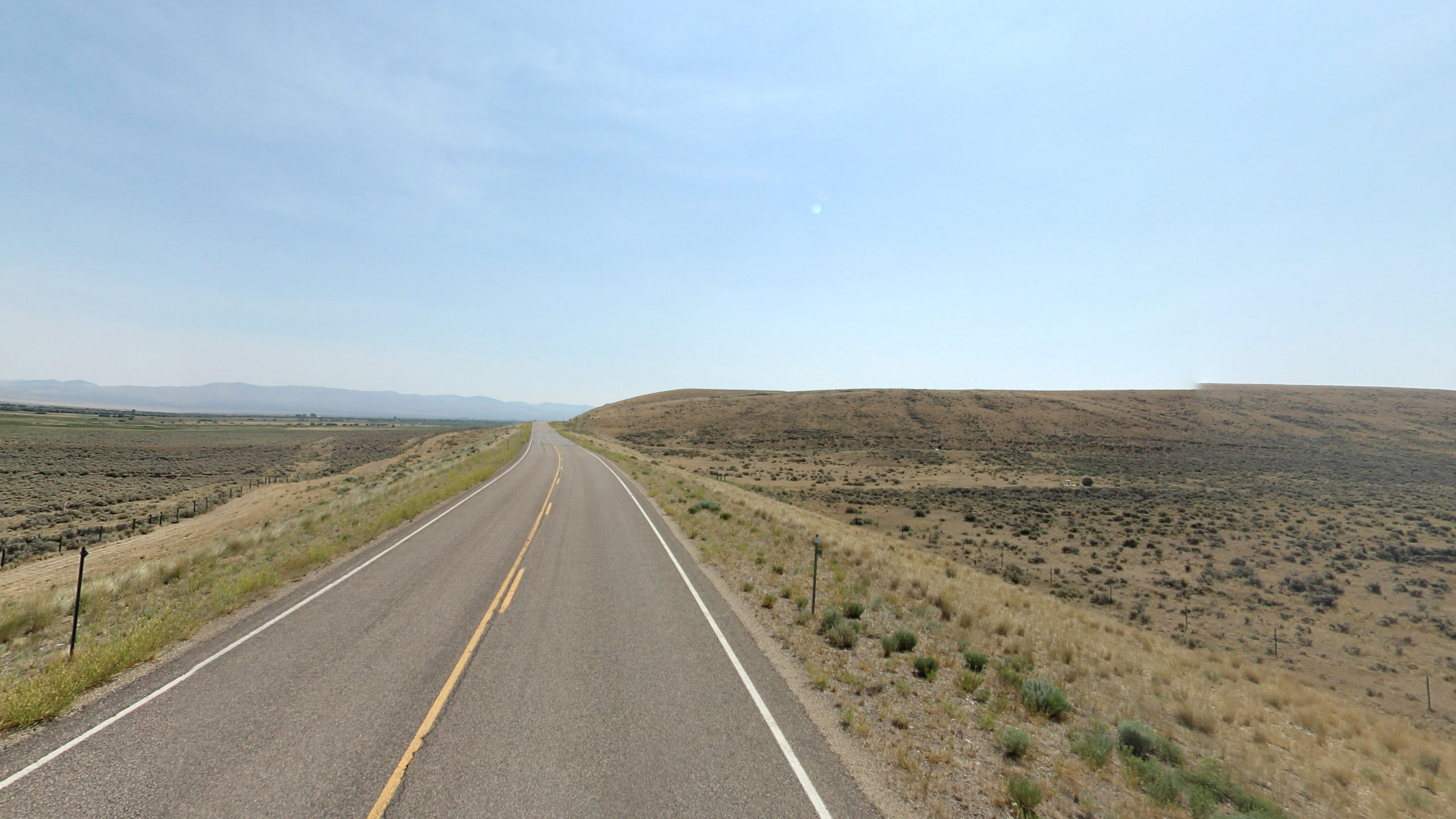
10 frames across 1.6 mi of the route around this location
Analyses
- Thomas Jefferson: The Distant Architect of the Voyage of Discovery
- Seaman: Lewis’s Newfoundland and the Fourth Member of the Corps
- Hugh McNeal: A Private’s Long March
- The Shoshone Nation: Sacagawea’s People and the Horse Trade
- The Mandan Nation: Heart of the Upper Missouri
- Cameahwait: The Lemhi Shoshone Chief Who Traded Horses
Artwork
Help improve this record
See something that needs correcting, or know a source we are missing? The archive gets better through its readers.


