Lewis: May 27, 1805
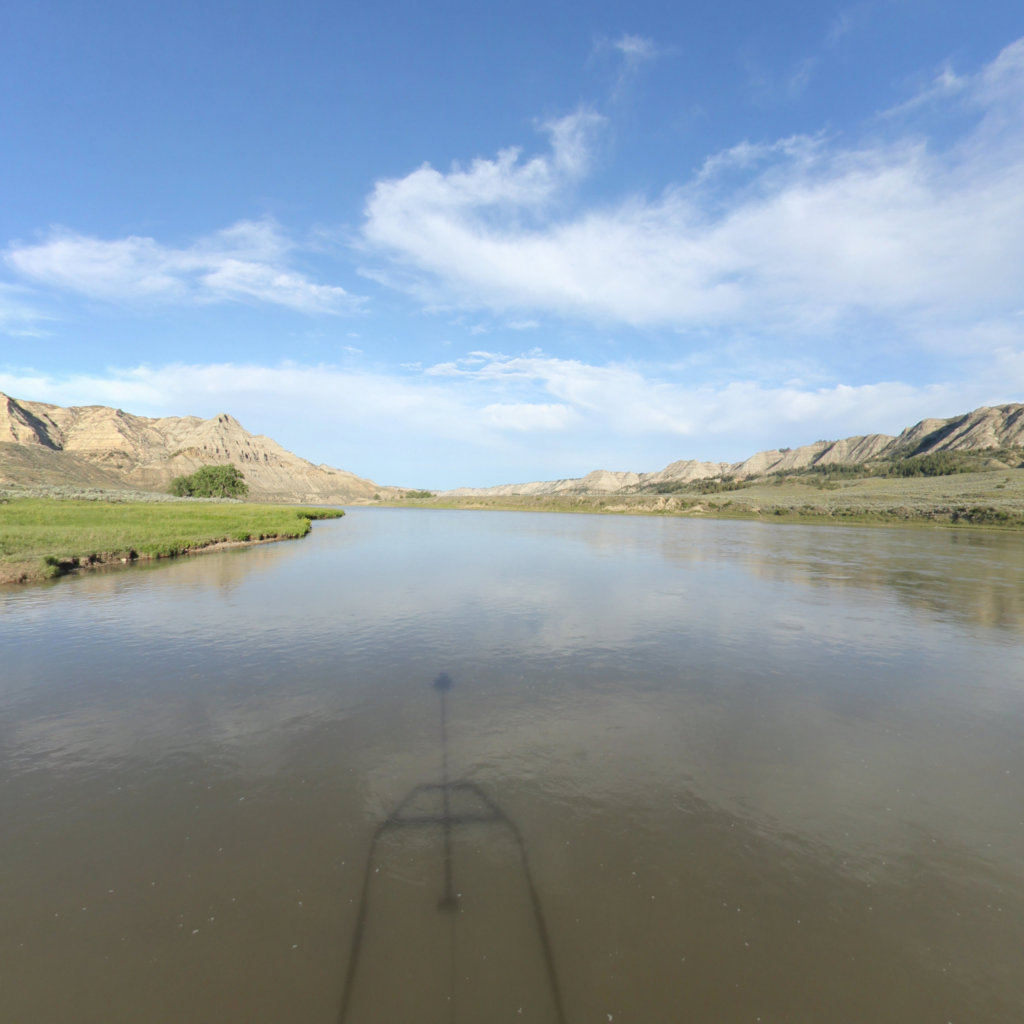
Strong morning winds delayed departure until 10 A.M., after which the party spent most of the day towing the boats by cord up an increasingly rapid, rocky river. Tall, rugged bluffs of clay, sandstone, and ironstone bordered the channel closely, with little level ground and only sparse, stunted cottonwoods. Coal, pumice, and burnt hills reappeared. Midday was very warm. The crew saw small herds of bighorn sheep and two elk, killing one. They camped on the larboard side near two dead-topped cottonwoods, finding only a meager supply of firewood.
Monday May 27th 1805. The wind blew so hard this morning that we did not
sent out untill 10 A.M. we employed the chord most of the day; the river
becomes more rappid and is intercepted by shoals and a greater number of
rocky points at the mouths of the little gulies than we experienced
yesterday. the bluffs are very high steep rugged, containing considerable
quantities of stone and border the river closely on both sides; once
perhaps in the course of several miles there will be a few acres of
tolerably level land in which two or thre impoverished cottonwood trees
will be seen. great quantities of stone also lye in the river and garnish
it’s borders, which appears to have tumbled from the bluffs where the
rains had washed away the sand and clay in which they were imbeded. the
bluffs are composed of irregular tho horizontal stratas of yellow and
brown or black clay, brown and yellowish white sand, of soft yellowish
white sand stone and a hard dark brown free stone, also of large round
kidneyformed and irregular seperate masses of a hard black Iron stone,
which is imbeded in the Clay and sand. some little pine spruce and dwarf
cedar on the hills. some coal or carbonated wood still makes it’s
appearance in these bluffs, pumicestone and birnt hills it’s concommutants
also are seen. the salts and quarts are seen but not in such abundance.
the country more broken and barren than yesterday if possible. about
midday it was very warm to this the high bluffs and narrow channel of the
river no doubt contributed greatly. we passed a small untimbered Island
this morning on the Lard. side of the river just above our encampment of
last evening. saw a few small herds of the Bighorned anamals and two Elk
only, of the last we killed one, the river is generally about 200 yds.
wide, very rappid and has a perceptable fall or declination through it’s
whole course.
This evening we encamped, for the benefit of wood, near two dead toped
cottonwood trees on the Lard. side; the dead limbs which had fallen from
these trees furnished us with a scanty supply only, and more was not to be
obtained in the neighbourhood.-
Read this entry in modern English AI-translated
Monday, May 27th, 1805. The wind blew so hard this morning that we did not set out until 10 A.M. We used the cord most of the day; the river becomes more rapid and is interrupted by shoals and a greater number of rocky points at the mouths of the little gullies than we encountered yesterday. The bluffs are very high, steep, and rugged, containing considerable quantities of stone, and they border the river closely on both sides. Perhaps once in the course of several miles there will be a few acres of tolerably level land, on which two or three impoverished cottonwood trees may be seen. Great quantities of stone also lie in the river and line its borders, which appear to have tumbled from the bluffs where the rains had washed away the sand and clay in which they were embedded. The bluffs are composed of irregular though horizontal strata of yellow and brown or black clay, brown and yellowish-white sand, of soft yellowish-white sandstone and a hard dark brown freestone, also of large round, kidney-formed, and irregular separate masses of a hard black ironstone, which is embedded in the clay and sand. There is some pine, spruce, and dwarf cedar on the hills. Some coal or carbonated wood still makes its appearance in these bluffs, and pumice stone and burnt hills, its concomitants, are also seen. The salts and quartz are seen but not in such abundance. The country is more broken and barren than yesterday, if possible. About midday it was very warm; the high bluffs and narrow channel of the river no doubt contributed greatly to this. We passed a small untimbered island this morning on the larboard side of the river, just above our encampment of last evening. We saw a few small herds of the bighorn animals and only two elk, of the latter we killed one. The river is generally about 200 yards wide, very rapid, and has a perceptible fall or declination throughout its whole course.
This evening we camped, for the benefit of wood, near two dead-topped cottonwood trees on the larboard side; the dead limbs that had fallen from these trees furnished us with only a scanty supply, and no more was to be obtained in the neighborhood.
This modernization is AI-generated for accessibility. The original above is the authoritative version.
Entities mentioned in this entry
Auto-extracted from the entry text. Hover any entity for context.