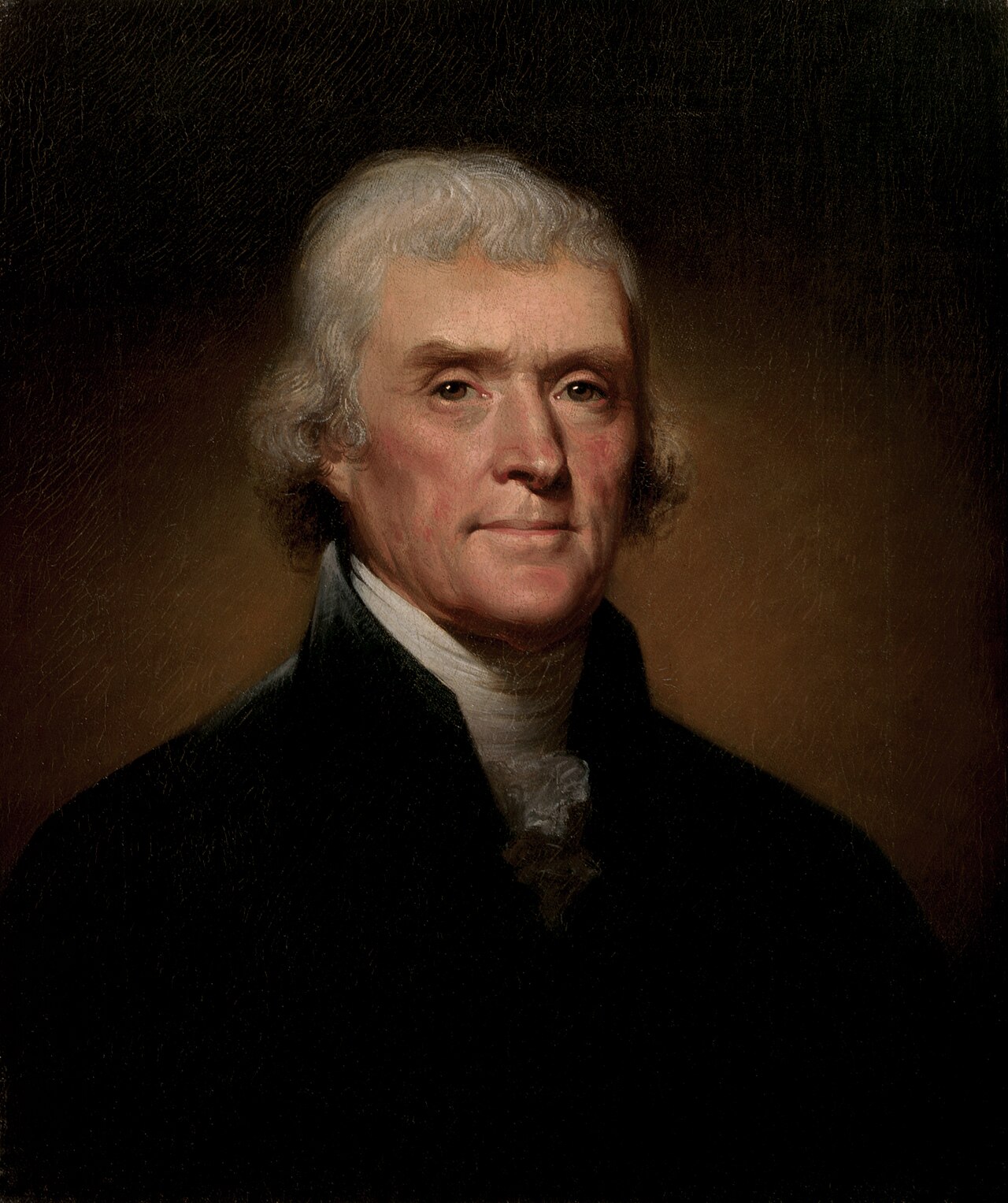
Thomas Jefferson (Expedition Patron)
Rembrandt Peale’s 1800 portrait of Thomas Jefferson presents the Virginia statesman in a half-length composition, turned slightly to the viewer’s left against a dark, unadorned background. Jefferson is shown at age fifty-seven, his reddish hair receding and lightly powdered, wearing a dark coat with a high collar and white cravat. Peale modeled the face with close attention to the asymmetries of the sitter’s features, working in the restrained Anglo-American portrait idiom inherited from his father, Charles Willson Peale. There is no allegorical apparatus, no books or busts—only the head and shoulders, lit from the upper left, with the brushwork tightest in the flesh passages and looser in the costume and ground.
The portrait was painted in Philadelphia in the winter of 1800, while Jefferson was serving as vice president under John Adams and campaigning, by proxy, for the presidency he would win that fall. The sitting took place at a moment when Jefferson was already considering the western reconnaissance that would eventually become the Lewis and Clark Expedition; his correspondence with Andrew Michaux and others had explored similar projects throughout the 1790s. Within three years of this portrait, Jefferson would secure the Louisiana Purchase and instruct Meriwether Lewis to ascend the Missouri. The 1800 likeness therefore captures the expedition’s patron on the threshold of the administration that would launch it.
Rembrandt Peale (1778–1860), the second son of Charles Willson Peale, painted Jefferson several times across his career, including the better-known 1805 life portrait now at the New-York Historical Society. The 1800 version belongs to the earlier group of sittings, made when Peale was twenty-two and establishing himself as a portraitist of national figures; he would later produce his “porthole” portraits of George Washington and travel to Paris to paint French savants. The painting is held by the White House Historical Association in Washington, D.C. Because Jefferson’s image is inseparable from the institutional memory of the Corps of Discovery, Peale’s early portraits of him recur regularly in exhibitions, textbooks, and commemorative publications tied to the expedition’s bicentennial and ongoing scholarship.