Bird’s-Eye View of the Mandan Village
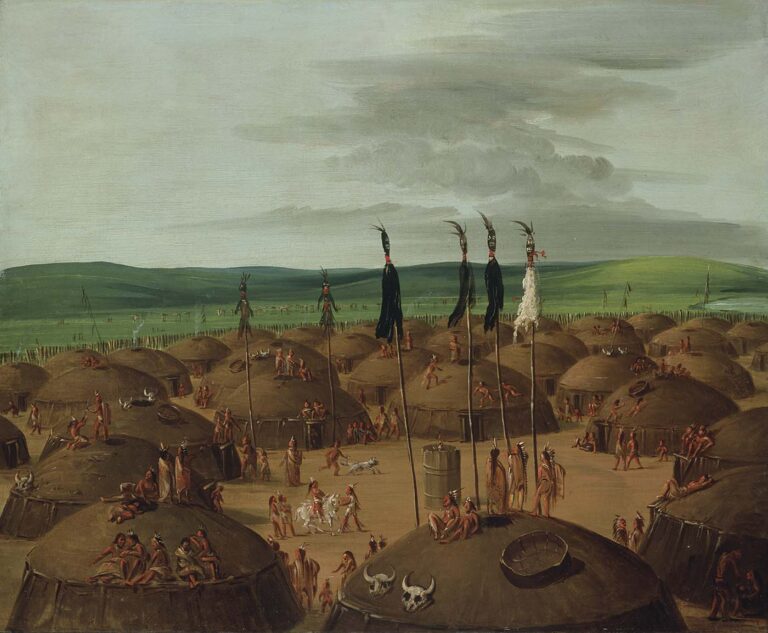
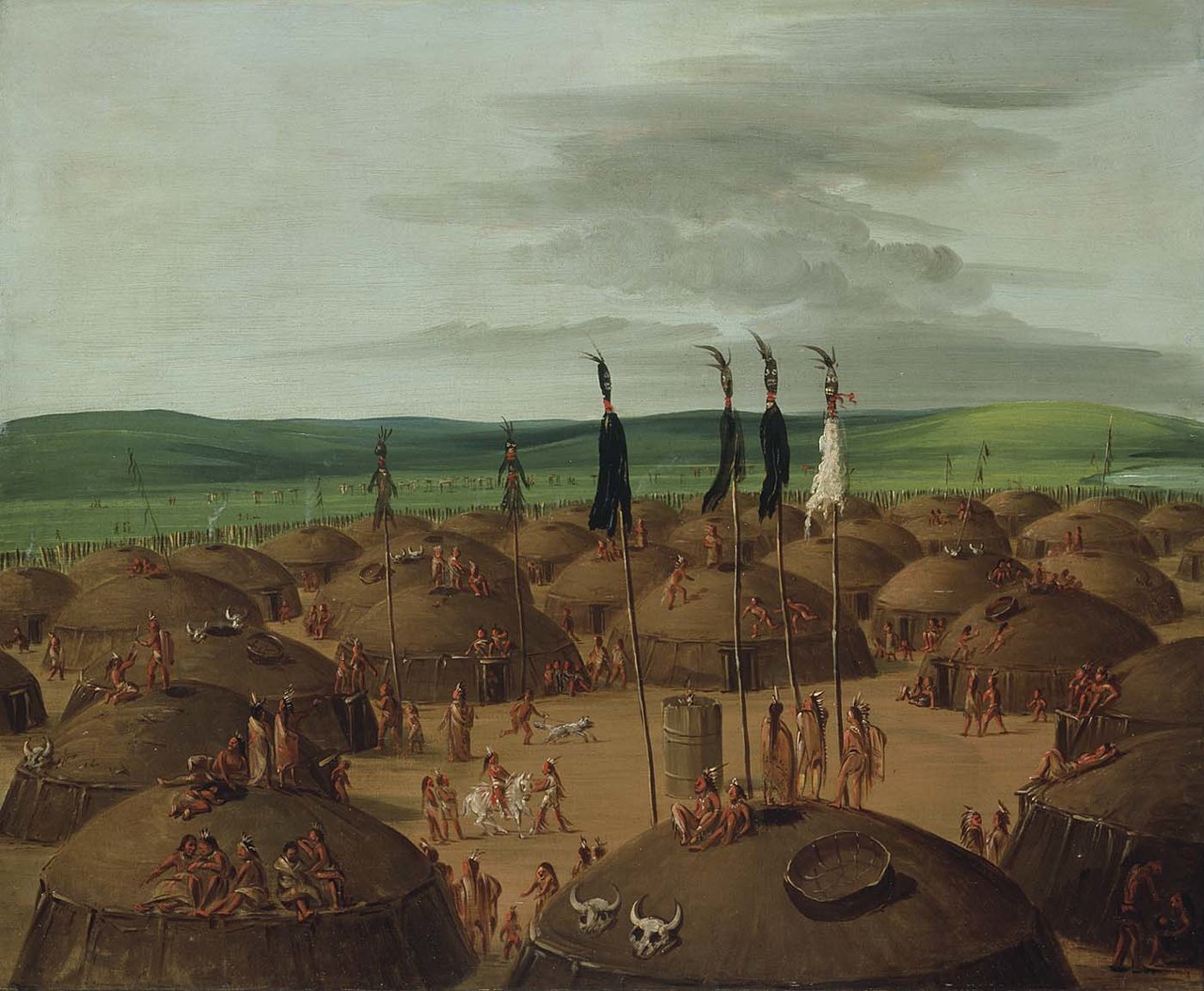
Catlin’s painting shows a fortified Mandan village on the upper Missouri River viewed from an elevated, slightly oblique angle that flattens the settlement into a readable pattern. Earthen lodges, dome-shaped and packed closely together, fill the interior of a circular palisade of upright timbers. At the village center stands the open plaza with the cylindrical plank “ark” — the cedar shrine associated with the Mandan creation narrative and the O-kee-pa ceremony. Figures move among the lodges, on the rooftops, and along the river bluff below; bull boats and a few canoes are visible at the water’s edge. The Missouri curves across the lower half of the canvas, with rolling prairie extending to a low horizon. Catlin painted the scene loosely, with thin oil washes and rapid brushwork typical of his studio reworkings of field sketches.
The view derives from Catlin’s residence at the Mandan villages near Fort Clark in the summer of 1832, three decades after Lewis and Clark wintered among the same people in 1804–1805 at Fort Mandan, roughly sixty miles upriver. Catlin’s documentation acquired unintended weight after the smallpox epidemic of 1837 reduced the Mandan population to a remnant and destroyed the village world he had recorded. He painted this bird’s-eye composition between 1837 and 1839 while assembling his Indian Gallery for exhibition in eastern cities and, soon after, in London and Paris.
Catlin (1796–1872) trained as a lawyer before turning to portraiture and, in the late 1820s, to the project that defined his career: a visual ethnography of Native peoples west of the Mississippi. The Mandan paintings, made possible by his ascent of the Missouri aboard the American Fur Company steamer Yellow Stone, are among the most historically consequential works in that body. The canvas is part of the large Catlin holdings at the Smithsonian American Art Museum, acquired through the 1879 gift of Mrs. Joseph Harrison Jr., whose husband had rescued the Indian Gallery from creditors in 1852. The image has been reproduced widely in Lewis and Clark scholarship as the closest surviving depiction of the kind of settlement the captains described in their winter journals.
Scene Location
Mandan Village, near Washburn, North Dakota