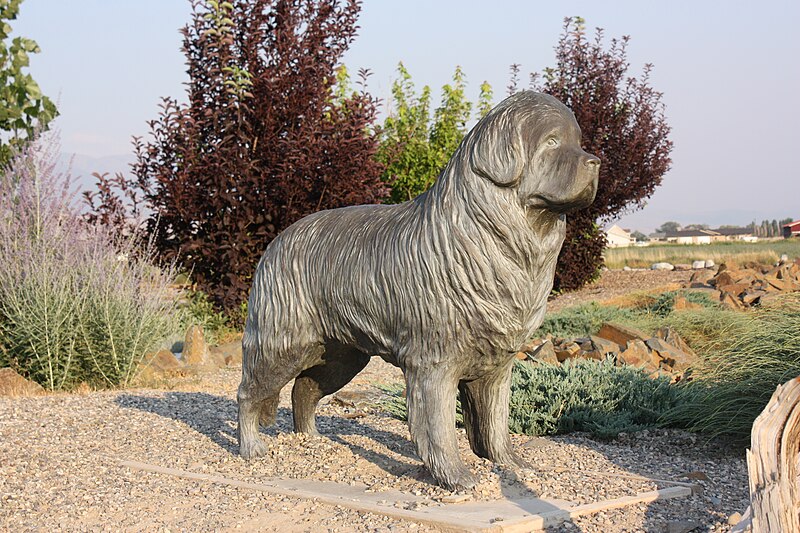
Seaman
Seaman was a large Newfoundland dog purchased by Meriwether Lewis for $20 before the expedition departed. He accompanied the Corps of Discovery for the entire journey to the Pacific Ocean and back, serving as a hunter, guard dog, and companion. Lewis recorded multiple incidents involving Seaman in his journal, including the dog catching squirrels, being bitten by a beaver, and being stolen by Native Americans (who returned him after Lewis sent armed men). Seaman became such a curiosity to the Plains tribes that some offered to trade horses for him. He is one of the most celebrated animals in American exploration history.
Portrait: Seaman statue, National Park Service. Public domain.
Related Locations
Note: the longest gap between tagged appearances is about 9 months (Nov 16, 1803 → Aug 8, 1804). Seaman may have been present in the corps during that span but is not named in the journals.
Journal Entries (50)

Cross-Narrator Analyses
Analyses that cite or discuss Seaman — showing 13 of the most recent matches.
Seaman: Lewis’s Newfoundland and the Fourth Member of the Corps
A $20 Purchase in PittsburghIn August 1803, while waiting for the keelboat to be completed at Pittsburgh, Meriwether Lewis acquired a large…
A Beaver, a Bear, and a Bleeding Newfoundland: Three Sergeants on the Missouri
The journal entries for May 19, 1805, offer a textbook case of how the enlisted journalists of the Corps of Discovery cross-pollinated…
A Buffalo in the Camp: Two Sergeants Recount a Near Disaster on the Missouri
The journal entries for May 29, 1805, offer a rare opportunity to compare two enlisted-man accounts of the same chaotic night and…
Four Pens at the Yellowstone’s Mouth: Measuring an Elk, Naming a Berry
April 30, 1805 found the Corps of Discovery pushing upriver from the recently passed mouth of the Yellowstone, fighting a hard northeast…
Four Pens at the Yellowstone: Converging Accounts of a Long-Wished-For Confluence
The arrival at the mouth of the Yellowstone River — the “Roche Johne,” “Roshjone,” or “river Jaune” in the variant orthographies of…
Hauling Canoes Through the Grand Shoot: Two Sergeants at the Cascades
April 11, 1806 found the Corps of Discovery struggling upstream against one of the Columbia's most formidable obstacles: the Cascades, which the…
Preparations at the Portage Camp: A Day of Logistics, Medicine, and Lost Notes
Two Captains, Two WorkloadsThe June 19 entries divide cleanly along rank. Lewis remains at the lower portage camp managing personnel, provisions, and…
Stranded Among Drift Logs: Two Voices on a Storm-Bound Camp
By 11 November 1805 the Corps of Discovery had spent four days battered against a narrow shelf on the north bank of…
The Captain Walks Ahead: Four Voices on the Approach to the Yellowstone
April 25, 1805 produced one of those revealing days in the expedition record when the corps physically divides and the journals divide…
Two Camps, One Day: Boat-Building, Bears, and a Crimson Creek
By late June 1805, the expedition was strung out along the eighteen-mile portage around the Great Falls of the Missouri. The four…
Wind on the Missouri: A Disputed Beaver and a Day’s Delay
The journals of Patrick Gass and John Ordway for 18 April 1805 cover the same stretch of the Missouri in what is…
The Nez Perce (Chopunnish): Allies of the Bitterroot and Kooskooske
First Encounter at Weippe PrairieWhen Clark's advance party stumbled out of the Bitterroot Mountains in late September 1805 — half-starved, exhausted, and…
The Shawnee Nation in the Lewis & Clark Record
A thin record, not an empty oneThe Corps did not travel through Shawnee towns on the Missouri. The journals still name the…
From the Heacock Memorial Archive
2 lewis-clark.org articles that mention Seaman, preserved here for Robert Heacock’s photography. The articles were written by that site’s contributing authors.
Researcher or educator?
Get help using the archive in your work, suggest sources we should include, or talk with us about collaboration and classroom use.


