
Tillamook
The Tillamook were a Coast Salish-speaking people—the southernmost Salishan group on the Pacific Coast—who inhabited the coastal bays, estuaries, and rainforests of present-day Tillamook County, Oregon. Members of the expedition encountered the Tillamook in January 1806, when Clark led a party south from Fort Clatsop to obtain blubber and oil from a whale that had washed ashore near present-day Cannon Beach. The Tillamook had already processed much of the whale by the time Clark's party arrived, and they proved to be firm but fair traders, exchanging whale blubber and oil for trade goods. The Tillamook shared the broader Northwest Coast cultural pattern of cedar plank houses, canoe-based maritime subsistence, and elaborate social stratification.
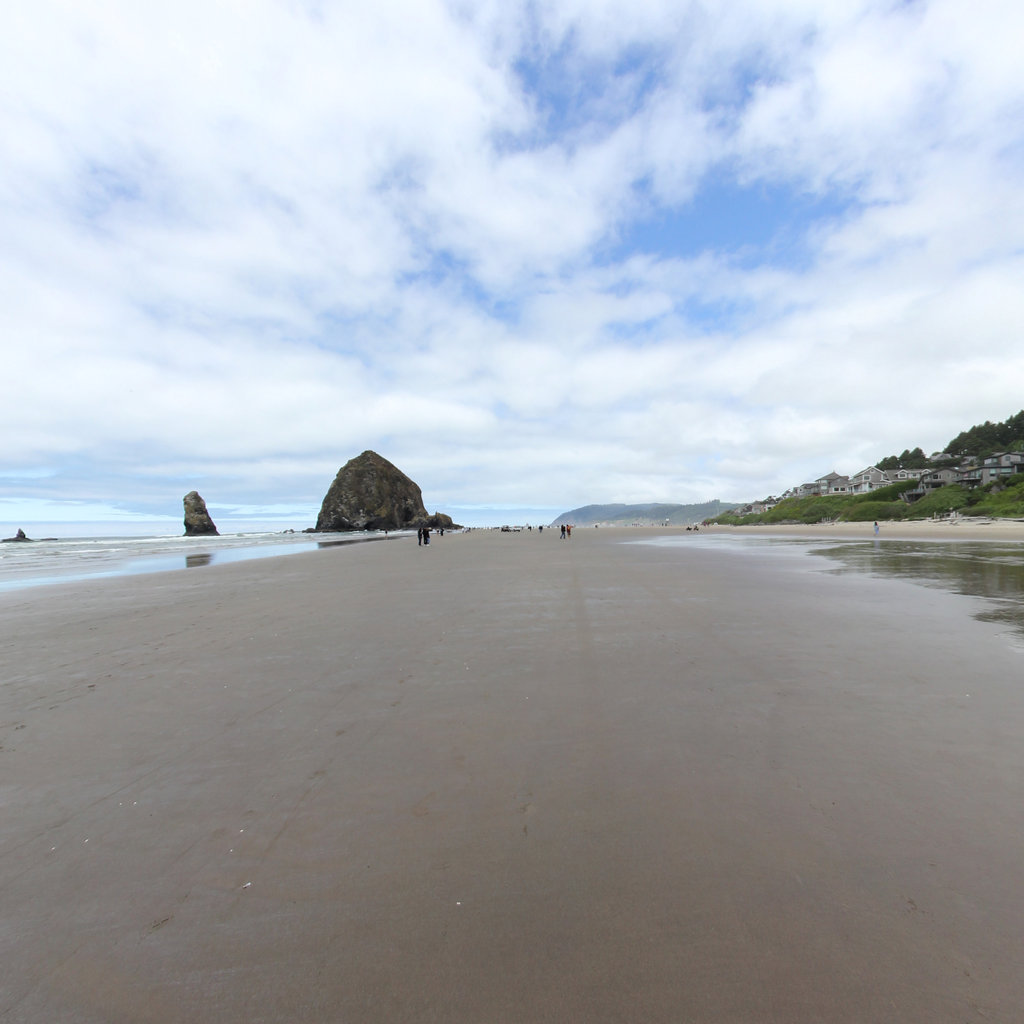
Portrait: Cannon Beach from Ecola Point, Tillamook homeland. Photo: Joe Mabel, 2019 (CC BY-SA 4.0) / Wikimedia Commons
Most Mentioned in Tillamook-tagged Entries
People
- Drouillard (9)
- Patrick Gass (7)
- Joseph Field (7)
- Capt. Clark (6)
- Nathaniel Pryor (6)
- Capt Lewis (5)
- Colter (4)
- Shannon (4)
- Collins (4)
- Willard (3)
Places
- Columbia River (12)
- Fort Clatsop (4)
- Missouri River (4)
- Pacific Ocean (3)
- Rocky Mountains (3)
- Tillamook Head (2)
- Cape Disapointment (2)
- Kil a mox River (2)
- Wappato Island (2)
- Point Adams (2)
Biography
The Tillamook were a Salishan-speaking people of the northern Oregon coast. The expedition encountered them in January 1806 when Clark led a party to the coast near present-day Cannon Beach to obtain blubber and oil from a beached whale.
The Tillamook had already salvaged much of the whale by the time the expedition arrived. Clark traded for about 300 pounds of blubber and some whale oil — valuable provisions for the monotonous diet at Fort Clatsop. The expedition also noted the Tillamook’s skill in processing whale products and making canoes.
Sacagawea accompanied this coastal expedition after insisting on seeing both the ocean and the whale — one of the few times her personal wishes are recorded in the journals.
Territory & Encounter Locations
Treaties (1)
Journal Entries (29)


Cross-Narrator Analyses
Analyses that cite or discuss Tillamook — showing 13 of the most recent matches.
The Tillamook (Killamuck): Coastal Neighbors of Fort Clatsop
IntroductionThe Tillamook — rendered "Killamucks" or "Kil-a-mox" by the captains — were the Salish-speaking coastal people whose territory lay along the Pacific…
The Whale at Tillamook Head: Three Vantage Points on a Single January Day
The journal entries for January 8, 1806, capture the Lewis and Clark expedition at a moment of geographic and narrative dispersal. Clark,…
A Lost Canoe and a Coastal Trade Network
The journal entries for January 11, 1806, written from the soggy confines of Fort Clatsop, illuminate two themes that preoccupied the expedition…
Dog Meat, Whale Blubber, and a Captain’s Honest Disagreement
The journal entries for January 3, 1806 offer a rare and revealing instance in which Lewis and Clark, who routinely shared field…
Four Pens, Two Errands: The Whale Road and the Beaver Bait
The journals for January 7, 1806 split the Corps of Discovery into two narrative theaters. William Clark leads a party of fourteen…
Marrowbones and Smallpox: Four Voices at Fort Clatsop
The journal entries for February 7, 1806, offer an unusually clear demonstration of how the Lewis and Clark expedition's record-keeping operated on…
Six Pounds in Two Days: Hunger, Habit, and Hospitality at Fort Clatsop
The entries of January 20, 1806 capture a quiet day at Fort Clatsop in which the dominant subjects are diplomatic visitation, dwindling…
Spoiled Elk, Wapato Roots, and a Whale on the Coast
The entries of December 29, 1805, offer a striking case study in how three members of the Corps of Discovery filtered the…
Three Pens at Tillamook Head: Ethnography, Exhaustion, and a Whale
The journal entries for January 9, 1806 offer a rare opportunity to watch three members of the Corps of Discovery process the…
Weather, Whale, and the Salt Camp: Two Journals on a Pivotal Day
The sixth of January 1806 was, by the standards of the Fort Clatsop winter, a remarkable day: the rains relented, a beached…
Hugh McNeal: A Private’s Long March
Enlistment and Mess AssignmentHugh McNeal first appears in the expedition record on May 26, 1804, when Captain Lewis issued detachment orders organizing…
Sacagawea: The Shoshone Interpreter of the Corps of Discovery
Recruitment at Fort MandanSacagawea entered the expedition record indirectly, through her husband. On November 4, 1804, Clark’s journal for that day records…
The Clatsop Nation: Hosts of the Corps’ Pacific Winter
A Nation Named on the MapThe Clatsop people, a Chinookan-speaking nation occupying the south side of the Columbia River near its mouth,…
From the Heacock Memorial Archive
3 lewis-clark.org articles that mention Tillamook, preserved here for Robert Heacock’s photography. The articles were written by that site’s contributing authors.
Your Nation, your story
Are you a representative or member of this Nation? Help us tell this story accurately: review how your Nation is represented, correct the record, or contribute materials and perspective.


