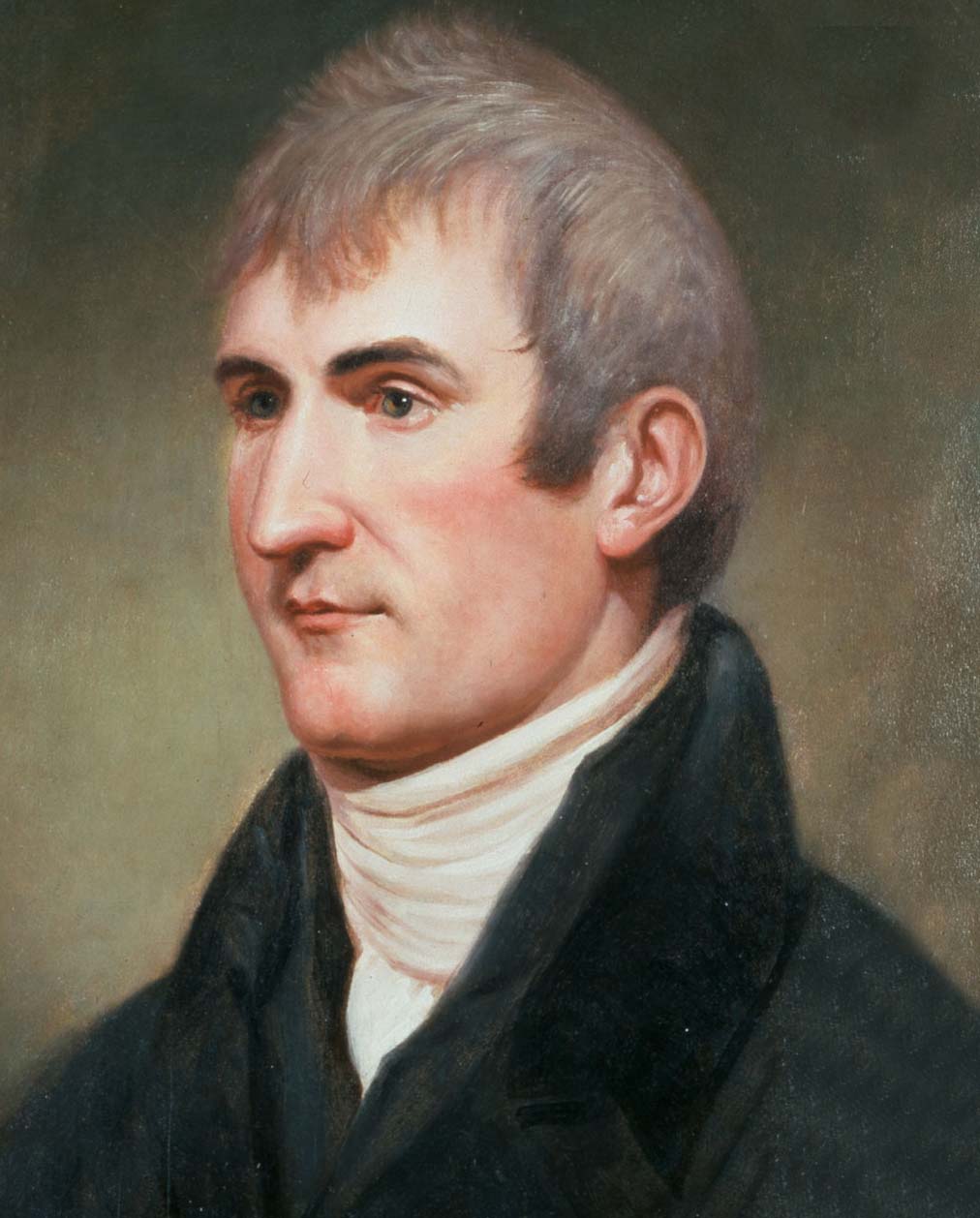
Voice
Meriwether Lewis writes in a register that is at once military, scientific, and quietly literary. Where William Clark tends toward terse navigational shorthand, Lewis composes paragraphs—often very long ones—built on subordinate clauses, parenthetical qualifications, and the periodic syntax of an educated late-eighteenth-century gentleman. He is by temperament a cataloguer, and his sentences accumulate detail the way his specimen boxes accumulate seeds, skins, and stones.
His prose has three distinct gears. The first is the workaday log entry, recording weather, miles, and personnel: the entry of May 15, 1804, on the barge running foul of submerged timber, is characteristic in its mixture of incident and instruction (“Persons accustomed to the navigation of the Missouri… uniformly take the precaution to load their vessels heavyest in the bow”). The second gear is the natural-history description, where Lewis adopts an almost Linnaean formality. His description of the Steller’s jay on December 19, 1805 opens with anatomical precision:
It’s beak is black convex, cultrated, wide at its base where it is beset with hairs… the crest is very full the feathers from 1 to 1½ Inches long and occupye the whole crown of the head.
The third gear is reflective and even philosophical—rare, but unmistakable. On April 7, 1805 (sampled here through adjacent entries), and most famously around the Marias decision (June 6–10, 1805), Lewis turns inward, weighing his own judgments. His tribute to Shields on June 10—”we have been much indebted to the ingenuity of this man on many occasions; without having served any regular apprenticeship to any trade, he makes his own tools principally”—shows his capacity for warm, attentive prose about individuals, which Clark almost never attempts.
Lewis’s spelling is erratic in the period manner (“accedent,” “furtile,” “perogue,” “mockersons,” “pumicestone”), but his grammar is controlled and his vocabulary unusually wide. Words like cultrated, fusiform, celindric, hisped, proliferous, and repand appear without apology, alongside Frenchified frontier terms like cache (which he spells cash) and engagé.
Omissions
What Lewis leaves out is as revealing as what he records. He is famously silent for long stretches—the great gap between Fort Mandan and April 1805 is partly explained by his concentration on natural-history reports, but other lacunae are harder to explain. His pocket watch and chronometer get more attention than his own birthday. He almost never writes about his mother, his political ambitions, or Thomas Jefferson, despite carrying out Jefferson’s commission. The President is implicit on every page and explicit on almost none.
Lewis also writes around emotion. On February 14, 1806, he announces, almost in passing, one of the great accomplishments of the expedition:
we now discover that we have found the most practicable and navigable passage across the Continent of North America.
There is no celebration, no flourish—the sentence is buried in a paragraph about Clark’s mapmaking. Similarly, the reunion of Sacagawea with her brother Cameahwait (August 16–21, 1805) is described in Lewis’s pages with surprisingly little drama; he is more interested in the Shoshone moccasin construction (“made of deer Elk or buffaloe skin dressed without the hair”) than in the human reunion that Clark, in his looser way, framed more vividly.
Lewis omits, too, the ordinary friction of command. Discipline appears chiefly when it has already escalated—Howard scaling the Fort Mandan palisade on February 9, 1805 and being committed for court-martial—but the daily grind of managing thirty-odd men is largely invisible. He records men as instruments: “sent Drewyer,” “dispatched Sergt. Pryor,” “directed Reubin Fields.”
Patterns
Several preoccupations run continuously through Lewis’s entries.
Instruments and accuracy. The chronometer haunts him. On July 15, 1804, he records its third stoppage with the careful reasoning of a man who needs his data to be defensible: “as her rate of going after stoping, and begin again set in motion has in two instances proved to be the same, I have concluded, that whatever this impediment may procede from, it is not caused by any material injury.” By August 24, 1804, he is more resigned (“fear it procedes from some defect which it is not in my power to remedy”), and by April 24, 1805, he is grim: “my pocket watch, is out of order, she will run only a few minutes without stoping.” These passages double as a barometer of Lewis’s morale.
Measurement of animals. Lewis cannot encounter a new mammal without producing a column of dimensions. The badger (“Braro”) on July 30, 1804 is sixteen pounds; the pronghorn buck on September 14, 1804 gets a full table (“length from point of nose to point of tail 4 9… Eye deep sea green, large percing”). He writes the pronghorn’s eye as a poet might describe a jewel: “deep sea green, large percing and reather prominent.” The white-tailed jackrabbit on the same date is described with equal granularity.
Material culture. Lewis is unusually attentive to indigenous technology. The Mandan battle-axe on February 5, 1805 earns a critical engineering review:
the great length of the blade of this ax, added to the small size of the handle renders a stroke uncertain and easily avoided, while the shortness of the handel must render a blow much less forceable if even well directed.
The Arikara/Mandan glass-bead-making process on March 16, 1805 is described as a recipe (“Take glass of as many different colours as you think proper, then pound it as fine as possible”), and Clatsop conical hats, plank houses, and canoe burials all receive equally careful treatment.
Geology and “mineral appearances.” The phrase “mineral appearances” is virtually a Lewis tic during the spring of 1805. The salts encrusting the banks (April 28, May 7, May 11), the “black porus rock which resembled Lava” at the Big Bend (September 20, 1804), the loam that “desolves as readily as loaf sugar” (May 11, 1805), and the unaccountable “artillery of the Rocky Mountains” (July 11, 1805) all show a Jeffersonian curiosity disciplined by a determination to record before explaining.
Risk and Providence. Lewis returns repeatedly to a sense of narrow escape. The caving banks on May 11, 1805—”providence seems so to have ordered it that we have as yet sustained no loss”—and Joseph Field’s bear adventures on June 25, 1805 share a tone of grateful vigilance. He ascribes “equal fortitude and resolution” to Sacagawea on May 16, 1805 when the white pirogue nearly capsized—a remarkable acknowledgment.
Comparisons and Change Across the Expedition
Lewis’s voice changes audibly across the journey. Early on (1804–early 1805), he writes as a curious tourist with a notebook—observations are crisp, framed with reference to “the U States,” and frequently comparative (“the same with that of the small frogs which are common to the lagoons and swamps of the U States,” April 15, 1805; the rattlesnake of June 15, 1805 compared to “the rattle snake common to the middle attlantic states”). The reader feels him still oriented eastward.
By the Great Falls portage (June 15 – July 11, 1805), the entries become more harried, more practical, and more anxious. The iron boat experiment is documented in something close to real time, and Lewis’s confidence cracks: “I fear I have committed another blunder also in sewing the skins with a nedle which has sharp edges” (July 3, 1805). Self-doubt, almost absent earlier, surfaces again at the Marias junction and over the Bitterroot crossing on September 18, 1805, when he writes—with characteristic restraint—”this morning we finished the remainder of our last coult.”
The Fort Clatsop winter (December 1805 – March 1806) produces Lewis’s most sustained and ambitious natural-history writing. Released from daily navigation, he composes set-piece descriptions of the Steller’s jay, the sage grouse (“Cock of the Plains,” March 2, 1806), the sewellel, the Sitka spruce (No. 1 fir), the salmon-trout, the candlefish, and the conifers numbered No. 1 through No. 7. These winter entries are encyclopedic in ambition and read as drafts of the report he intended to publish. They also contain his rare moments of dry humor: on January 29, 1806, on a diet of lean elk, he confesses, “I find myself sometimes enquiring of the cook whether dinner or breakfast is ready.”
The return journey (spring 1806) shows Lewis at his most assertive and least patient. The encounter with the Wallawalla and Walula villages and the trading frustrations near the Cascades produce uncharacteristically blunt prose. On April 21, 1806, after another theft, he writes:
I now informed the indians that I would shoot the first of them that attempted to steal an article from us. that we were not affraid to fight them, that I had it in my power at that moment to kill them all and set fire to their houses.
This is a different Lewis from the man who, at the Council Bluffs (August 28, 1804), issued tidy administrative orders about messes and cooks. The voice has hardened.
Compared to Clark, Lewis is the more elaborate stylist, the more theoretically inclined naturalist, and the less consistent diarist. Clark writes through the silent months; Lewis disappears and reappears. Compared to the sergeants (Gass, Ordway, Floyd), Lewis offers almost no chronicle of the men’s morale, songs, dances, or quarrels—those textures are absent from his pages. What he provides instead is the expedition’s intellectual memory: the measurements, the species lists, the indigenous technologies described as if for a future museum, and a continuous, sometimes melancholy meditation on instruments, accidents, and Providence. He is the captain who looks not just at the river ahead but, with equal intensity, at the eye of a pronghorn, the stratigraphy of a bluff, and the inner workings of a stopped watch.


